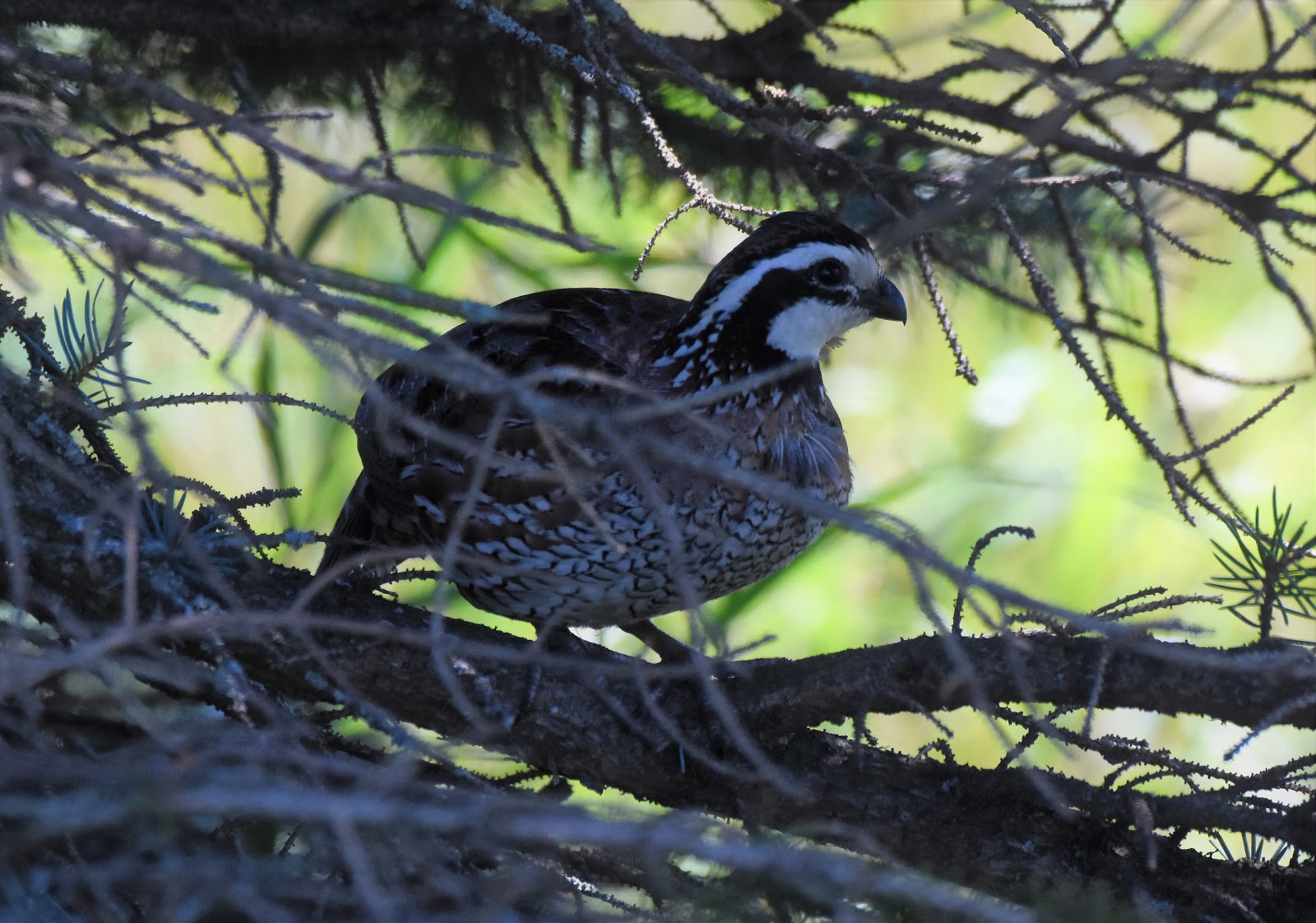
Gambel's Quail-male; he is territorial and watching out for his partner and little ones
In Part 3 from my blog series on Arizona birds, we'll examine the chicken like birds that hang out in the state. This is a popular group of birds that visitors and locals alike hope to spy on their walks. We'll once again examine what's countable and where we can find them. This group of birds is unique in that humans have played a role in some of the species living here in the state. Let's get started with the native and local species first. The Gambel's Quail.
The female Gambel's Quail carefully takes the little ones to safety while the male keeps an eye out for Cooper's Hawks
Gambel's Quail are one of the most easily seen quail in the state. They are found in local parks, around the deserts and foothills of the Arizona landscape. Most often they are vocal and seen in larger coveys. But don't get too cozy. The rest of the quail species can be tricky!
This male Scaled Quail is looking for love from within his territory
Over the years, I have gotten to know the Scaled Quail better. This quail can be difficult to find during certain times of years. And while locals who live in their habitat range say that they are backyard birds and easy to spot, this isn't always the case. They are common and widespread in Southeastern Arizona in the grassland range around places like Cochise Lake in Willcox or along the San Pedro Riparian area of Sierra Vista. And even then, they can be shy.
These two birds feed safely under the vegetation out of hawk sight
As a birder, I'd give this quail a rating of 3 on the 1-5 difficulty range(5 being most difficult). People have been known to dip on this quail. When the males are calling, it's easy. Quail and Grouse CAN be easy to spot during their breeding season ANYWHERE. But the thing is, birders don't always have the luxury of visiting during their most vocal and visual time period. So let's go onto EXTREMELY difficult.
the male Montezuma Quail sits completely still on a rock watching me watching him; there we scream inside of our heads with excitement over our discovery! YES! But we barely breath while looking at the bird:)
Montezuma Quail. Birders say that you never should look for them. Instead, they'll find you when the time is right. But what if you don't have a lot of time to spare?! This bird is a FIVE on the difficulty scale. It is a common bird. But don't take the word "common" to mean that they're easy to spot. This quail is super intelligent and is quick to disappear at the slightest sound. And if they can't escape, they will remain completely still until you almost step on them.....and then as you are about to step on them, they BLAST off giving you a near heart attack. And if you feel stupid for not having better eyes, DON'T. This happens to so many birders of all skills.
The good thing is that these birds are often times vocal and have an eerie martian call. Most of the time they are heard nearby but never seen. Over the years, I have played games with these birds as they have played games with me. Like the Flammulated Owl(in a later post), it sometimes takes a team to triangulate their positions. The good part is that they will freeze hoping you won't see them. If you get great views of this bird, consider yourself blessed by the bird gods.
The female tries to hide from me. My team mate signals with his hand that the female is exposed! It took two of us to triangulate her position before she gave up and flew off.
So for now, I'd like to address the OTHER 2 quails that have been reported in Arizona. The first 3 are native species and common in their habitat range. The California Quail below was introduced on a hunting ranch many years ago up in the White Mountains. The habitat in that area is unique and not very large. But it was enough to sustain a population of countable California Quail over the years. These birds are native from California and up along the Pacific Coast. They can be found in Utah and Idaho. They were also introduced in Chile and other countries around the world. But in Arizona, there is only one spot you can go to see them and count them on your ABA list. Most of the time, they are heard only birds because the vegetation is thick around the Wenima area where they live. Arizona birders will chase these birds to come back with only a recording of their calls as a reward for their hard work. Difficulty level is a 4 or 5 due to the location.
The California Quail, as seen in Pacific Northwest, feed in a large covey
The OTHER quail is known as the Elegant Quail. It's a beauty and a common bird for Mexico. Many years ago, one was recorded in the town of Douglas. Many believe it was an exotic bird released from a cage. And yet the possibility is that this one bird strayed quite a ways outside of its northern most range and got mixed up with a covey of Gambel's Quail. Quail don't migrate or fly long distances outside of their ranges so for one to show up in Arizona is suspicious. Either way, one was recorded in this state.
The Gould's Wild Turkey of the Santa Rita Lodge in Madera Canyon put on a show for us. This tom is looking for a lady!
Now let's move onto grouse and turkeys. A nemesis bird for me over the years has been the Dusky Grouse. It's the ONLY grouse found in Arizona and it's normally seen in the northern parts of the state around places like the North Rim of the Grand Canyon, the San Francisco Peaks near Flagstaff and near Greer in the White Mountains.
Wild Turkeys were once almost hunted to extinction in North America. Today, thanks to conservation efforts, their numbers are healthy and growing. In Arizona, there are two subspecies of Wild Turkey, the Merriam's(common to most states) and the Gould's(common for Southern Arizona, New Mexico and Northern Mexico). If you're a bird nerd like me, you'd want to see the differences between the subspecies. Most people wouldn't care because a turkey is a turkey. But to find this Merriam's subspecies, we went to the North Rim of the Grand Canyon. To find the Gould's Wild Turkey of Southern Arizona, you'll need to head to the foothills on up into the forests of the sky islands. Further south towards the border, they can be found along riparian corridors.
Ring-necked Pheasant
Now. Let's go through the rest of the "game" birds. Ring-necked Pheasants were introduced to the US decades ago for hunting purposes. Eventually, several states saw them "naturalize" and become permanent residents around the US. Today, they continue to release these birds for hunting purposes. In Arizona, the ONLY countable population is found around farm fields bordering California, Mexico and the Colorado River near Yuma, AZ. If they are found anywhere else in the state, they are not ABA countable.
Chukar on Antelope Island near Salt Lake City, Utah
Chukars. Another introduced bird to the US. Again, several populations naturalized in states like Oregon, Utah and Idaho. Here in Arizona, the only countable Chukar would be the one found near the Arizona/Utah border. Chukars have been found in other places around the state but are considered survivors from hunters releasing them into the wild for target practice.
a wild Indian Peafowl at a park in Orange County, CA
Indian Peafowl are not countable. In California, they are breeding. But in Arizona, they are considered escapees.
a Northern Bobwhite in Wisconsin
Finally. There are two great mentions here. We cannot forget these Arizona birds. And it's important to note their status. The Northern Bobwhite was once commonly found in the southern grasslands of Arizona. Some even say that there are still small populations that continue along the US/Mexican border. They are a unique subspecies of Northern Bobwhite that are often called Masked Bobwhite.
Similar to the Masked Bobwhite, this is another subspecies of Northern Bobwhite in Chiapas, Mexico
This subspecies of bobwhite was wiped out from the area due to cattle grazing. Today as the Federal Government restores the grasslands of the Buenos Aires Wildlife Refuge, it faces the huge task of reintroducing this species back onto their former grasslands. They have a facility that contains 98% of the world's population of Masked Bobwhite. The Phoenix and San Diego Zoos are also involved now to protect these birds from another possible avian flu epidemic. It has been a decades struggle and their reintroduction has hit many bumps which include disease and domestication. Today, workers are trying something new and perhaps, Arizona will one day have a wild and special population of Northern Bobwhite living freely in the grasslands along the border.
Greater Sage-Grouse in the Pacific Northwest
And finally, it is important to note that Arizona was once home to a small population of Greater Sage-Grouse in the very northern regions of the state along the Utah border. I remember asking myself this question years ago. Why couldn't there be Greater Sage-Grouse here? Over time, I discovered from study and conversations that their ranges across the US and Canada have seen drastic changes over the decades as housing and farming developments destroyed a lot of their habitat.....and leks. In a recent report, their populations have risen sharply which gives me hope for their future. Will they ever return back to Arizona? Is there a lek we don't know about along the border? These are questions that only time will answer.
Photo not mine. This is from Tucson Daily Photo
I love the chicken birds. In Arizona, you can reliably count on 5 species of grouse, quail and turkey. The question is. Can you find them all? I still need to find that darn Dusky Grouse! My next series will be on Grebes and Loons. Until next time.....
Historic and still operational lighthouses dot the shores of Lake Michigan
If you ever wanted to experience a piece of "AMERICANA", Wisconsin is the place to visit. Washington Island attracts tourists from all over the world during their summer months. It is part of the infamous Door County experience. My Dad likes to road trip and suggested we go to the island. Last year we went to the island but didn't bring our car! To make matters worse, we didn't check the train schedule and were stuck at port. Never again.
And so we waited in line. The lighting in Wisconsin this time of year is unique. It has that sunny, golden "Somewhere in Time" haze. Maybe it's just me but the photos have a different feel than from the ones I take in other places.
Eventually we parked our car onto the ferry and seated ourselves in a shady spot in the passenger area.
Washington Island is a beautiful place to bird. Here you'll find one of Wisconsin's unique birding hotspots while also enjoying the laid back atmosphere of the island.
Double-crested Cormorants hang out on a buoy at the Washington Island harbor
I've seen quite a few of the Wisconsin birds already so there wasn't anything in the lifer category to chase. But I was curious about the prairie habitat in the middle of the island. I wanted to understand better how Northern Bobwhite survived in certain sections of the island. This species of bird doesn't go this far north in its' range. Plus it's on an island. So I spoke with the locals about their birds. We found lots of nesting Bobolinks and Eastern Meadowlarks in the area.
American Lady on Lavender
While planning for this trek, my nephew asked me what my favorite bird was and I had a hard time answering his question. I like them all but I especially like gulls, sparrows, grouse and parrots. Owls are also pretty neat but grouse are super interesting!
As we drove around Washington Island, I spotted my first pair of "chickens":) The Ring-necked Pheasants casually crossed the road. My Dad stopped the car and I quickly got out to make sure the birds wouldn't get hit. You gotta watch these Illinois tourists. They're known to the Cheeseheads as FIBs. According to Urban Dictionary, a FIB(or #$%@ing Illinois Bastard) refers to people from Illinois, how they drive and act. They drive really fast at home but slower than an old lady with a walker when they're vacationing in Wisconsin plus they don't know where they're going. Locals call them rude. But Wisconsinites also recognize that this subspecies of humanity brings lots of money with them:) This is a long standing joke? between the two states. Anyhow, I am thankful that this driver eventually slowed down for this pair of pheasants.
How can I explain Door County? It's like going back into the 1950's. There are a lot of richy rich tourists. They are mostly white and cleanly dressed people who would make great extras in the movie "Dirty Dancing." If you're saying to yourself, "Ugh. Why would I want to go there?" Well, you gotta look past the vacationing crowds of people. There's more to Door County than cherry wine, cheese curds and perch dinners.
Wisconsin culture is a fascinating one because it is so unique from the other states in the US. Many of the people have an accent and a fun sense of humor that you'll mostly understand if you down several beers. I always forget how much drinking people do here. At a grocery store, I burst out laughing when a guy frantically asked where they sold all their "booze". It's been awhile since I've heard that word:) And what they lack in "booze" is made up with lots of creamy and delicious dips and meats and cheeses. The next day, I'd lock myself up in my room wondering how I put on 10 pounds! Generally speaking, my hobbit kind are the most friendly people you'll ever meet. Sometimes Often, they make off colored jokes that may offend most people but because this state is comprised of many small towns similar to the world of the Shire, they are often excused due to their genuine sincerity and friendly demeanor.
Take for example this sign. My first reaction was, "NOOOOO!!! Inappropriate!!" Then, both of us burst out laughing. There is a logic to the Wisconsinite. How many of us read the usual state made signs? I know that I often overlook them, but when they are written like the sign above, it grabs the tourist's attention with a shock or laugh and at the same time delivers their message, "Stay Out!" Or in this case, who knows?!
Washington Island is a great place to bring your family. Or just fix your hair while having a drink. There are great restaurants, museums, trails, and shops. And there are state parks. So back to my point, if you aren't crazy about tourists, no worries. There are so many open spaces around the island to escape. And birders always find those spaces:)
While birding, it's hard not to get distracted by places with lavender fields. The color purple. It gets me every single time.
Anyhow, we stopped at this fun lavender shop on the way back from our Northern Bobwhite conquest. These birds are a bit tropical and prefer the warmer climates. In Wisconsin, the Northern Bobwhite is rare for most parts of the state and considered a species of special concern. The winters are too cold for them and their survival rate isn't very successful (especially among the females). Many live for only ONE year! I've been following this population of Northern Bobwhite on the island now for a few years. So how were they surviving on an island in Lake Michigan?!!
Not one to wait for answers, I spoke with the local naturalist on the island at the nature center. Apparently hunters released these birds and several other grouse species for their shooting pleasures. It still didn't explain why there have been consistent reports of breeding on a yearly basis around the island. I studied the area via satellite and scratched my head. Locals also reported that the past several winters had been fairly mild. Cities along the lake also enjoy a milder winter due to Lake Michigan's warmer waters. Okay. But what about food and shelter when there were weeks of blizzard and sub zero temps? I've seen this bird in Chiapas. Sub-zero temps are almost impossible to survive. Especially for a warmer climate bird like the Bobwhite.
Red Admiral
Then it came time to explore the general area. There was the appropriate prairie land for them to nest. It was lined by forest, etc etc. BUT how did they survive winter? Well right across from the prairie, there was a home with feeders and lots of places to keep warm.
Layers of work go into finding birds. Sometimes, it's all for ONE bird. Historical reports, satellite images, speaking with local residents and birders in the area along with habitat requirements usually answer so many of my questions. It's part of the game and detective work that goes into birding. A special shout out to Melody Walsh, a resident birder of the island, who was my virtual guide throughout the whole process. The layout of the island is interesting. The forest area had breeding warblers. The interior held the grassland species. And the waters surrounding the island held a healthy number of lake birds.
The perimeter of Washington Island is forest and the central prairie area is protected from the harsh winter winds off the lake. Around October and November, the tourism season ends and the island goes quiet until spring again. To make your trek to the island successful, you'll need to look at the ferry schedule times here. To stay on the island, you'll need to book in advance. Another island, known as Rock Island, is a camping/hiking only trip. This year, Rock Island had a nesting pair of Peregrine Falcons, a first in decades!
Wisconsin days fly by much too quickly. The sunset is around 8:15 PM giving one the impression that they can play outside all day. Then I saw the time and was shocked by how my body had been tricked!
My ebird report for Washington Island can be found here. If you are interested in more information about the Door County Outdoor experience, Magill Weber has written a book on the best hiking and biking trails around the area. She grew up in this area and in her book, she'll take you to many of the popular natural areas in this part of the state. This is for nature enthusiasts who don't want to spend all their time shopping:) On my next trek, I join friend, naturalist and birder Nancy Gill as we explore Horicon Marsh State area. Until next time, happy birding!!
I was so excited to take Gordon to one of my favorite places to bird in Green Bay. PLUS! We were officially going birding during the summer here. Something I had never done before. We went on an overcast day to the Bay Beach Wildlife Sanctuary. It turned out to be a great outing full of amazing birds! A lot of wild birds call this park their home because it's full of great habitat!
Great Crested Flycatcher
Gordon needed the American Black Duck on his lifelist. From my experiences with these ducks in various states, they can be difficult for photos. I've been in many areas where they are swimming a mile away from shore. Sometimes they are behind the reeds and difficult to see. But at Bay Beach, they come right up to you! I was excited to add data to the lacking information at this site about these ducks for the month of June.
At Bay Beach Wildlife Sanctuary, the ABDU walk up SO close to people because people love feeding the ducks...and geese...and swans?!?! They sell bags for a dollar at the desk:) I checked records on this duck and there weren't any for this spot during the month of June! So it was a gamble. This could be a disappointment or a fun find for Gordon. It was a lifebird and that was our goal. For me, I was just super thrilled to bird the area again. During the winter, many of the waterfowl come to hang out along the river shore near the rehabilitation center. It's quite a show!
Tree Swallow
We started off with some amazing birds all around us. If you are a birder, you should definitely give this place a look. If you're not a birder, you should still go and take the family. It's a large preserve funded by the city of Green Bay. It's also free to visit! How sweet is that? Your kids are going to love it!
There were so many birds calling and we were still trying to figure out the various calls. It was after all, a whole new group of bird song we had to learn!
Rose-breasted Grosbeak
I let out a sigh of relief when we found 3 of the ducks still hanging around the area. Granted, they aren't in large number during the summer because they are breeding in the lake, but I knew there had to be some hanging out. Thank the bird gods! Once the target bird was found with excellent observations, it was time to just have fun and bird. The American Black Duck is a bird species showing a decline in numbers due to hybridization with Mallards.
American Black Duck
I nearly crapped my pants when I surveyed the area and discovered SWANS in the area! At first I clumped them all together and called them Tundra Swans. Gordon takes a closer look and discovers a Trumpeter mixed in for the fun!!! They are rare for this area during the summer months, but a few remember this place as home and have stayed around the grounds where there is plenty of food and hospitality:) Most of the Tundra swans are breeding in Canada and Alaska while the Trumpeter Swans have a more diverse range.
Hey, what species are you? You look like me, but something is not quite right.
Okay. Ready for your bird lesson? I've put both similar looking swans together. There are two noticeable differences with these birds. Can you see what they are?
Tundra Swan
Now look carefully. Hint. The field marks are with the bill.
Trumpeter Swan
Did you figure it out? Or did you give up and just feed the swans instead?:) The yellow lore(near the eye) is a great field mark for the Tundra Swan. It's not always clear due to the distance so sometimes we have to look at the bill(which is the second field mark), the way the bird flies or more importantly, listen for their distinct calls.
Another bird of interest for me was the Purple Martin. There are several pairs here that nest. In the photo below, you'll notice House Sparrows taking over the nest boxes. I apologize to my European readers for what I am about to write. These aggressive sparrows are a nuisance and have taken over much of the Martin space. Native vs Non-Native species. In some cases, House Sparrows and European Starlings are "removed" from the area so that the native birds can nest. These Purple Martins seem to be "tolerating" their neighbors for the moment.
House Sparrows and Purple Martins
A beautiful songbird that comes to the feeders in the eastern half of the US is the American Goldfinch. It's a stunner with that brilliant yellow coloring. I had to laugh while entering the data. First off, most of the eastern birds either have the words "Eastern" or "American" in front of them. They were like foreign words to me while I was jotting down the info. Arizona bird lingo would pop up and eventually I'd just cut to the word...Goldfinch! Or Towhee! Or Duck!
Rarely does something as epic as a first ever mega rare bird come along and pull the entire US birding community together as quickly as the Rufous-necked Wood Rail did a few days ago. And it would happen 6 hours away(5 if you push it) from Tucson in the beautiful Bosque Del Apache Wildlife Refuge of New Mexico.
Red-tail Hawk nesting
Twitchers, people who chase these mega-rare birds, fly and drive from all over the country to find these rare gems. People doing Big Years join together and rush to the scene to get the "tick" that will possibly give them the edge in the competition. I wanted to experience this event (and possibly see this bird). But to drive all of this in one day and be back by the next day.......well that's something quite different.
Green Heron
This past week the bird has been spotted around the Marsh Loop basking and playing in the sun for hours. Birders spy upon the bird with their scopes and binoculars. The Rufous-neck Wood Rail performed several dances, a couple of songs and taught me a lesson I won't quickly forget.
Western Sandpipers
This bird, common to tropical and subtropical conditions, found its way into New Mexico. It is a US first and driving birders mad! For several days this past week, it has been out in full sight, but as we'd find out quickly, our luck would run out. We left early in the morning from Tucson and arrived at 12:45. And what's the line birders hate to hear the most? Oh yeah....."You just missed it!" But my ears could still hear it. It was still there. And I heard it fly through the reeds away from us. Then far away from us.......
Least Bittern
We spent over 6 hours with many birders searching the reeds. North. South. East. West. Nothing. Wait???!!! Is that a Least Bittern out in the open? Why yes it was!!! A lifebird. I would get distracted by these little surprises and forget about the time. But back to this bird. I've been doing this long enough to get "feelings in my gut". When the bird stopped calling from a far distance, I knew that the honeymoon was over for many of us. I spent a week hemming and hawing over going to this place. Each day the reports would come in with positive observations and I felt drawn to this event. Not drawn.....more like pulled. Eventually, I convinced myself to go with Pat. If I didn't try, I'd regret staying home for what will probably be the biggest show of the year for many birders.
Western Sandpiper-note Rufous-y Colors and patches on wings
And yet I learned a lot about the people behind "twitching". They are addicted to the hunt. One woman said that it was a "bad carbon footprint" to chase rare birds. Another said that she had a disease. I asked her if she was sick. She responded yes......"Sick in the head for chasing birds." Another told me a story about how he left to chase this bird in the middle of a family event. Yet another older woman drove alone from a far away place to find this one single bird out in the middle of nowhere. One man came from work and had a head piece that spoke directly into his head. No scope. No binoculars. Fancy clothes and a head piece. The stories went on and on like this. I discovered a whole new level of birders that I hadn't met before. True dedication.
Least Sandpiper-note yellow legs. Also the smallest of sandpipers
There was one stylish lady with a cowboy hat from Southern Arizona who made me smile on our hot and muggy hunt. She was fun to pass the time with as we waited and listened for "the bird". She had been everywhere during her life. And by no means was she finished! I really liked her. Overall, the experience was a bit overwhelming. Like any community, there are those who are cocky, hilarious, smug, humble, etc. This crowd had them all. They rattled off refuges and wildlife preserves from all around the world. They were world birders.......like me. But not me because they must have had a little money:)
While waiting for this bird, I became antsy and dehydrated. There were so many other things flying around us that captured my attention. How in the world did I stand in one place for 6 and half hours???!!!!! Well the Least Bittern was one of the reasons:)
Desert Spiny Lizard
I began to walk. Pat went to the car and saw a bird that looked like a cross between a turkey and peacock. My brain began racing. What in tarnation was Pat saying??? Big as a turkey.....but not. Like a Peacock.....but not. I pulled up my data and discovered that this peacock may be in fact a "Ring-necked Pheasant"!!! And there were coati, deer, snakes and other critters out there! Why was I wasting my time on this boardwalk??!!!
Monarch Butterfly
The people waited and waited. The sun became brighter and brighter.....hotter. Muggier. The mosquitoes became very bad.
That was it. I walked from the boardwalk and.......got lost in the world around me. I am not a Twitcher. Yes I chase birds but I will not twitch again. And yet....:) Seriously, the whole reason why I bird is because I love the hiking and wildlife photography.
Western Meadowlark
And when I did this, things became clear. No more. I'll hopefully one day see this bird down in Mexico or Central America, but for now, I will not miss out on what is PRESENT.
And that's how we found our Ring-necked Pheasant.
People are currently finding the Rufous-necked Wood Rail from the same location at the Marsh Loop area of Bosque Del Apache. It was a no show last night and this morning, but as of this write, it's back! There are lots of happy birders out there.
Eventually we ate at this place near Socorro
For the latest information on rare birds around the US, the ABA Rare Bird page can be found on Facebook. The ABA Listserv is a also a great place to find out what's going on in your area. I put the video down below from when it was first discovered by Matt Daw. Finding Least Bitterns out in the open is amazing. But having it photobombed by a rare bird? Well now that's epic. More coming up.......


 Posts