Saturday, September 6, 2014

The Green Joy


She inched slowly across the carpet of ferns. The unceasing fog cloaked her aging body.  From the tree tops, the feathered ones sang their timeless melodies.  


Her solitude cloaked between the woven limbs of trees.  Trapped inside of eternity.  The green joy. 


Her bittersweet memories had become a heavy burden. A sunlight eclipsed by the darkest of clouds.  There she had dwelt for so many years trapped inside her mind. "I wish He would take me. I am ready.", she once told her grandson years ago. How could anyone understand her pain?


Along the mossy emerald path, she inched toward the old totem pole that marked where they had grown their magical gardens together. Here time had no meaning. This ethereal space made her forget the loss. There hung the rotted and forgotten Purple Martin boxes. Once they were home to so many, but now they had disappeared from the skies.  Only the boxes served as reminders that they once existed. 


Her glorious gardens even had pheasants once!  There they would roost up into the dark branches of the forest watching her tend strawberry patches, dill, kohlrabi, ground cherries(her favorite) and so much more!  But they had also vanished. She tried to imagine it all as it once was. 


She remembered the happiest times here. Those moments had seemed like yesterday but in reality happened decades ago. Each moment to be cherished.  Each person to be embraced.  Never knowing what tomorrow would bring. She was the spent dandelion that blew apart in the wind.  And all those who had clung to her had drifted away.  


Once they all celebrated together in these woods and gardens. There she had laughed with her family under the dappled sunlight. But now the grasses had reclaimed the gardens. Only the stubborn rhubarb remained.  This green joy.  A melancholy.  The happiest of memories grown over by moss and lichen. 


"A curse.  Outliving all the people you love.", she once said. She had remembered how she was a central figure to her family. Needed.  Wanted. Somehow life had become busier than she once remembered. Her sons had their own families and life was passing by much too quickly for them to notice. Secondary.  Forgotten.   


The gentle grasses of the prairies gradually gave way to the suburbs. Gravel roads became paved. The meadow covered by dirt. Butterflies that once fluttered freely were hung onto walls and remembered. Familiar haunts had also disappeared.  She had a godchild that wrote her every week.  Her frail hands dutifully ticked away back on the old typewriter next to her vase of ground cherries, pussy willows or fragrant roses. Her own hand writing had become chicken scratch due to the arthritis. 


And she remembered the old days. Often. Horse drawn wagons replaced by cars. Scarlet fever had claimed the lives of her parents by the time she was 14 years of age. There she lived on a farm with her Aunt for the rest of those teenage years.


She had outlived all of it.  Her eyesight grew weak. Her crooked hands carefully guided a wrinkled body to the tree where she first met him. Years later, he'd hold her hand after a near death experience.  "Please don't go." he pleaded, "You're my best friend." She squeezed his hand back and this man of rare emotion kissed her. She would survive. Memories of past and present collided together. 


This place had become a sanctuary.  Before, the prairie grass had grown tall protecting the forest and gardens from the outside world. Today, she could see a road nearing her paradise.  The prairie grass cut.  The milkweed gone. The young sugar maple where she met her true love was now old and twisted. There they sat again at the wrinkled trunk. Helicopters swirled about them as they spun to the ground.  Ballet dancers. 


Within this moment, she is at peace.  Her green joy is revealed. Renewed. 


As the night seized this day, she gazed into the starlight and remembered it all. 


Tuesday, September 2, 2014

The "Other" State


 The body grows tired, and my work gets mixed up in flowers, lizards, snakes, bats and bugs.  But onward I trekked with an amazing crew of wildlife trackers and herpers.  Being one of two birders, we safely entered the state of Sonora, Mexico which borders the southern part of Arizona. 

Flame Skimmer
We camped for several days and nights without electricity, air conditioning and other creature comforts.  And yet the rewards were higher on this trek than any other because we were in some remote areas around Sonora.  While the birds were in great numbers, they took a backseat on this trek.  


Pallid Bats
Some of the greatest mysteries still remain on the mountain tops of Northern Mexico.  Sonora is an amazing state full of surprises. As I've reported before, Arizona is a well birded state in most of the various regions.  In contrast, much of Sonora has not been ebirded. It's rather sad since it's all connected. Part of my job at our locale was to find birds and other rarities.  Birds like Green Kingfishers and Five-striped Sparrows are often seen in these places and this time was no different.  


I'm not a rough and rugged hiker as I do prefer the softer side of camping. And yes, camping can be fun and comfortable! One of my big dislikes for this time of year comes in the form of scaly fanged critters known as snakes. It makes birding a challenge! There were rattlesnakes and other venomous creatures hanging out in the thick grasses.  In one situation, I had a Black-tailed Rattler sound off with a loud "RAAAAATTTTLE!" and flee further back into the grasses!  I did my heebie jeebie dance and got away from the area.  The herper with me was sad that it had escaped. While I was freaking out, he was running after the snake!  Hopefully he didn't look back and see me doing my willy nilly freak out.  And yes, guys can admit that snakes freak them out.  Just don't kill them.  They are good to have around.....just not my personal space.  Herpers are a fascinating group of people.  Both birders and herpers are nerds in their own sense but I'll just say that one group is wilder than the other:)  Might have to challenge those stereotypes!


It was hard to ignore the many beautiful butterflies around the area. However our mission was to track Jaguars.  These elusive creatures had been found around several spots and so we went to check equipment around the various locations.  

Queen Butterfly
I am truly fascinated by this state.  This year Las Aventuras took you to Rocky Point, Sonora for a seabird adventure.  Now we're visiting the interior mountain region of the state.  It's a large area to cover and I hope to get further south for a closer look at the indigenous peoples and their tropical birds. 

Dark Buckeye
Finding a crew to go to Mexico is no easy task.  Not many Americans feel comfortable these days crossing the border.  And rightly so!  BUT crossing the border was a much safer option for me than staying near the border on the Arizona side to observe Five-striped Sparrows.  This year we ran into drug trafficking around the Ruby Road area and it was a bit unsettling. 

Africanized Bees!  Very dangerous when a swarm becomes upset.  Each year several people will die from their stings.
 One of my favorite things about the Sonoran desert is how wild and dangerous it all can be.  Poisonous critters, spiky cacti, heat and strange human varieties all inhabit this vast landscape.  Coming from Wisconsin, this place continues to fascinate me.  Every day I wake up in MY HOME, I think.....I live here!  I really really live here!  Purple sunsets.  Prickly cactus pads.  Sparkling hummingbirds.  Colorful lizards.  Outdoor dining.  Mountains.  Canyons.  It's all so beautiful and overwhelming at times.  And much of it is still so very wild. 

Ocotillo line a wash
The Sonoran desert enters a good portion of Mexico. Political lines, drug issues and very remote and rocky roads can make this area very undesirable to explore. And maybe language barriers:)  I'd love to piece together the "birdscape" puzzle between Arizona and the state of Sonora.  I'd get to use my Spanish and study birds.  Pretty awesome!

Southern Dogface
 While on this trek, a major discovery happened for me.  I glanced down on the ground and noticed this strange looking snake.  But it wasn't a snake.  Instinctively I knew this but it took me time to wrap my head around the creature I was staring at intently. Once my brain ID'd this lizard.....yes lizard......I did a secret herper lifer dance.  The move looks something like a snake wrapping itself around its prey. Not pretty at all.  There are not many lizards or snakes that inspire me to move in a positive manner, but the Madrean Alligator Lizard is like finding a Montezuma Quail!  Herpers and birders alike rejoice at these beauties.   Note their tiny tiny feet. 

Madrean Alligator Lizard
 With the recent monsoon rains, the canyon was ALIVE!  Imagine Julie Andrews singing the "Hills are Alive" running through the grasses and then getting bit by a venomous snake.  That's how green the mountains and canyons were!  Black and Turkey Vultures would quickly find her body and have a snack. Definitely not a Disney production:) Thankfully Julie never ran through THOSE grasses.

Common Lesser Earless Lizard
Most of the time, it's all very brown.  Yet with a wet rainy season, everything really greens up nicely!  All of this happens within a matter of a month!


The warbler migration has begun.  Most evident were the Nashville, MacGillivray's, Yellow and Wilson's Warblers dripping from the trees!  They were everywhere.  Blue Grosbeaks and Yellow-breasted Chats were also very abundant. 

Five-striped Sparrow

However, my mission this year was to observe Five-striped Sparrows and a Green Kingfisher.  I could not relocate the Rose-throated Becard.  Their nest was still present, but no one was home!

MacGillivray's Warbler
I am now home after a long weekend of satisfying work and bug bites! 


A special thank you goes out to Kathy Cooper and her daughter Mary Ann for making such wonderful meals.  It truly takes talent to work off the grid feeding a group of people without having the use of electricity.  Each meal was an amazing piece of art and our group was grateful for their hard work.  Kathy and Mary Ann, you both are one of a kind.  Thank you for organizing this spectacular event. 

Ares Metalmark
While it was a challenging weekend, we each completed our goals to help keep tabs on the wildlife in that area so that they stay protected.  We discovered Mountain Lions, Javelina, Coues Deer and so much more.  As for the Jaguars?  I hope they keep their secrets hidden from humans.  I know they are out there.  Once, 6 years ago, I came across one in the Amazon.  We briefly made eye contact and I smiled.  Some secrets are sacred.   For more on wild birds and other fun things found around our world, check out Wild Bird Wednesday!


Monday, August 25, 2014

A Mere Fact


At the tip of Merepoint, ME
 Our trip to Maine was so much fun.  I wish Kathie were closer so that we could bird more often, but we knew the time would fly by quickly. 


I won't forget the first night Gus made us Lobster rolls!  I had watched birders salivate while telling me their stories of Maine and their love for....lobster rolls.  Now I understand better why they went crazy over the mention of Maine. 

Chestnut-sided Warbler in Kathie's backyard

For me, birding is about great observations on new birds. It's also about getting better observations on older birds that I've previously seen. Sometimes the work is difficult but it's also very rewarding. 


Many times we didn't have to go far to encounter new birds.  We'd find them everywhere around Merepoint, Wharton's landing, Brunswick and other areas. 

Pileated Woodpecker near Brunswick Landing
The primary targets for the Maine adventures were finding all the "Eastern" versions of our "Western" birds like the Eastern Whip-poor-will, Eastern Towhee, Eastern Phoebe, Eastern Wood-Pewee, Eastern Kingbird, etc etc.  Because I don't live on the eastern side of the US, many of these birds were new!  For many others, these are common birds around their feeders. 

Copulating Horseshoe Crabs
The other targets for our Maine journey focused on the Atlantic Puffin and Bicknell's Thrush.  Those required special trips out to the various areas and were planned well in advance. 


Ruby-throated Hummingbird
As our checklist and time narrowed, we chose our destinations carefully. I think over the course of two weeks, we took two days to do some light birding around Kathie's house. These days were meant for relaxing and recharging our birder batteries:)


These days allowed for us to closely examine several already seen birds and their nesting habitats better.  For example, we watched a Yellow Warbler family nest near the landing by Kathie's house. 

Yellow Warbler
Without disturbing the nest, I took some photos and watched the parents feed their young ones over the course of several days. 


Nesting wasn't just limited to the Yellow Warbler family.  Song Sparrows were busy feeding their young ones as well. 

Song Sparrow
There was a lot of great habitat around Kathie's house. 


She had nesting Bald Eagles and a field full of Bobolinks!

Bobolinks in the fields of gold
And when we weren't walking around, we just sat and watched the feeders together.  Hairy Woodpeckers, Purple Finches and Tufted Titmice came to visit.  

Hairy Woodpecker parent feeding juvenile
Common Grackles lived up to their name. And looking back at it all, Kathie's backyard was a wonderful place of discovery.  The entire drive up and down her magical Merepoint was a wildlife experience.  I will forever remember driving down that several mile road along the forest and ocean.  It was always relaxing and peaceful.  So on the 4th of July when we had to say good-bye, I was sad to go. We didn't have fireworks but we did have fireflies:)
Common Grackle
It is always hard to say good-bye to dear friends.  Everyone was exhausted by the time the trip came to an end, but it was a pretty exciting ride! At the end, I added 35 new bird species to my list and Kathie added several more to her Maine and Life Lists as well. 


I'd like to thank Kathie and Gus for a wonderful time.  It's now time for me to reciprocate the love.  She will need to come and visit in the spring of next year to Arizona so that I can help her find the LeConte's Thrasher and several others she needs for her list:)  Life is short.  It is to be enjoyed and explored.  Our adventures continue back home in Arizona. Until next time Maine!


Micheal discovers L.L. Bean in Freeport, ME
For more birds both near and far, check out Wild Bird Wednesday


Tuesday, August 19, 2014

Working With Unknowns

Thick-billed Parrots at the Sonoran Desert Museum.  This is a place I like to go and actively study my birds.  
Lately, I've taken on a slower birding pace due to the heat and my work. Oh wait! I need to track down a Painted Bunting, Short-tailed Hawk, Mississippi Kite, Mexican Chickadee, Ridgway's Rail(formerly known as a Clapper Rail) and several other elusive-but-already-seen birds like the Pinyon Jay and Brown Pelican(for AZ).

A Swainson's Hawk alongside the road near St. David
This is probably the closest I'll ever get to doing a "Big Year" in the US.  I mostly stayed within the United States to search for new birds. I thought that while I was doing that I'd rediscover a lot of the other birds already seen.  So it has been a lot of fun chasing them down. 

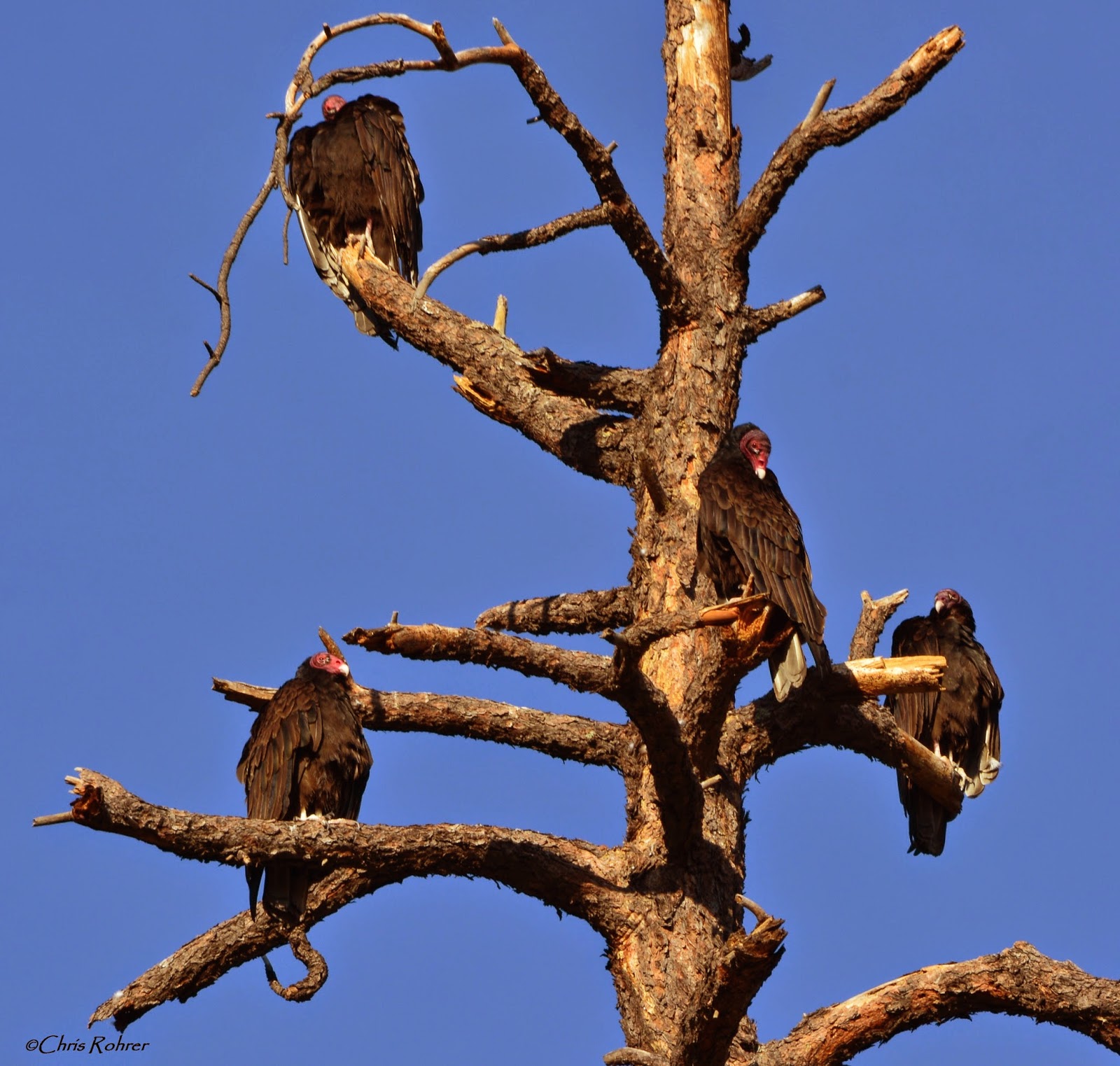
A kettle of Turkey Vultures on Mt. Lemmon

Next year it will be a different game as we head to Southern Mexico.  In fact much of my work will be taking me out of Arizona.  There are lots of other new birds for me here in the US but my attitude is to take it slow and enjoy the fun.  

A pair of Red Crossbills(male and female) in Greer
July and August are the starts to early migration, but since I had done all my running around earlier in the year, most of my work is done within Arizona.  For the birds mentioned above, I need time and money to find them.  Since my work has begun again and my funds are exhausted, I have to budget yet again for the new year.  Plus I am personally exhausted. I have seen 442 bird species, so far, in North America. So there are nice trips coming up over the next several months but they aren't as frequent as they once were.  Which is good!

A Mountain Bluebird in Greer
I was going to head over to find the Mexican Chickadee in a remote part of the state, but the uncertain monsoons came and wrecked major havoc around the area.  Imagine desert landscape without water.  And then imagine sudden raging rivers coming out of nowhere carrying you away on an isolated road!  That's what happened with this poor lady below! Over the past several days, there have been many rescues around Southern Arizona due to the heavy monsoon rains.  Running washes are no joke!


Pic courtesy of KOLD news
The treks right now are very dangerous as we experience random intense storms, deal with really bad insects known as chiggers, rattlesnakes(cool) are out with their little ones and the heat is oppressive.  So I stay close to home and bird locally for an hour or so before returning to my air conditioned home.  I find that August and October generally tend to be my "off" months when it comes to birding.  

Female Vermilion Flycatcher
It allows me to catch up on my reading and studies on birds I'd like to find.  I think the highlight for me this month has been my study of the Cassin's Sparrows in the grasslands.  They are rather plain birds but they are so different from their relatives.  During breeding season, they will shoot straight up into the air and back down again.  I think these birds are real gems because they are difficult to ID when they aren't "larking".  So it's great fun to spend a good part of our birding adventures just observing one bird.  I have spent a lot of time studying this bird at home so that when I go out into the field, I am able to recognize the various behaviors and sounds of this bird right away.  I really enjoy the challenging birds. P.S.  Any bird with the label "Cassin's" is a piece of work.  Ask any beginning birder:)

Cassin's Sparrow in the Buenos Aires grasslands
In fact many of my evenings are spent inside of bird guides.  There are SOOO many birds.  Flycatchers can be tricky and offer a real challenge sometimes when it comes to ID.  But my biggest challenge will be the sea birds found off of the coast of California.  To me, they all look the same.  I'm beginning to note the differences between Skuas, Gulls, Terns, Jaegers, Petrels, etc. 

Great-crested Flycatcher at Merepoint, ME
On occasion, I've been known to go to an area and not really study up on the place. Sometimes it's on purpose and others times it isn't. Take for example the bird below, the Upland Sandpiper.  I didn't even know this bird existed until Kathie had mentioned to me that this was a bird she had hoped to observe.  So while I was in Maine, I studied the call which is pretty cool.  The bird runs around in grassy areas and can often be hidden from sight if it's not sitting on a fence post.  And their call!!!  I started laughing because to me, it sounds like a guy whistling at a woman passing by.  By today's standards that activity in the US is considered tacky, but we aren't dealing with humans here, are we?:)  Pretty awesome bird.  I'm no scientist but my first impression was that the bird was the offspring of a Curlew and Sandpiper:)  In fact, it looks like the evolutionary step between the various species.  They are after all related. 


Upland Sandpiper in the Kennebunkport Plains
 Other birds that are difficult for me are the warblers.  I think they're tricky for everyone not only because they're small but because there are so many of them!  In Arizona, I know where I can find my warblers but when birding another state, it's all unknown.  I try to study their habitats, but memorizing it all is impossible. In fact, the bird guides have several pages dedicated to ALL the warblers! Take, for example, the Prairie Warbler below.  I kept hearing this call that I could not ID. I went through every warbler call I knew in my head and it wasn't matching anything I knew.  At that point, I realized I was dealing with a life bird.  But who was it?  I had heard it several times on the trip to Maine but couldn't pinpoint it. Then it happened!  We were able to get a visual on the bird calling and that's when we discovered our Prairie Warbler!  But alas, the rain began to fall and the observation ended:(


Prairie Warbler near the Kennebunkport Plains, ME
I always hope for better observations.  Seeing common birds spoils us into thinking that they are all this way.....but as many birders and photographers know.....it's not.  On our camping trip to Greer, I was hoping to observe Red Crossbills better.  And we did!  It's never a given as all of it is always unknown, but when it happens, there is an internal sigh.  Even if the chances are good, I try to hold back from saying outloud, "Oh we'll find that bird!" because it will jinx the observation!  


Okay, so some of you might be wondering how a Crossbill eats?  The bill is shaped to get the seeds out of pine cones!  Pretty cool!  They eat other things as well like insects, but they do have an interesting bill!

Summer Tanager at Audubon's Paton's House in Patagonia
So on these days of extreme heat, raging rivers, nasty chiggers and avenging baby rattlesnakes protecting themselves from being stepped on, I take a step back and explore close to home....and study.  One of my projects in the next couple years is to take on the Eared Quetzal and Thick-billed Parrots of Chihuahua, Mexico.  They do rarely show up here in Arizona, and when they do, the whole birding world from around the US flocks to find them.  Sadly, these parrots were extirpated from our area a long time ago.  They tried to reintroduce them back into their former habitat many years ago but found that hawks had taken over the area making it difficult for the parrots to reestablish themselves. Another issue was starvation.  Since many of these parrots were captive bred relying on human handouts, they didn't stand a chance.  The project was terminated with little hope. Today, the parrots can be found in a small area of Northern Mexico.  However, once and a decade one shows up.....:) 


 I also believe this is a sensitive species in that if one did show up, it would be kept secret on places like Ebird.  I've discovered sensitive birds over the past several years and those records are locked for my eyes only and the researchers at Ebird.  In part, it's to keep the bird(s) safe from poachers or photographers who would endanger a bird for a photo.  


Anyhow, it's good to take a break and do so some relaxing.  I'll be back in force at the end of the month searching for some rarities in Sonora, Mexico, learning about birds and doing some birding with Gordon and AZFO in Globe and finally, taking a trip up to Colorado.  But for now, it's back to the books. And it's kind of nice:)  More soon......