Showing posts with label Western Scrub Jay. Show all posts

Tuesday, March 29, 2016

Los Angeles County Arboretum & Botanic Garden


On a much needed escape, I headed out to California to find several birds to add to my life list.  Anytime you bird in California, you need to give yourself time to get to and from your destinations.  One of our treks would take us to Arcadia, home to the beautiful Los Angeles County Arboretum and Botanic Garden.  


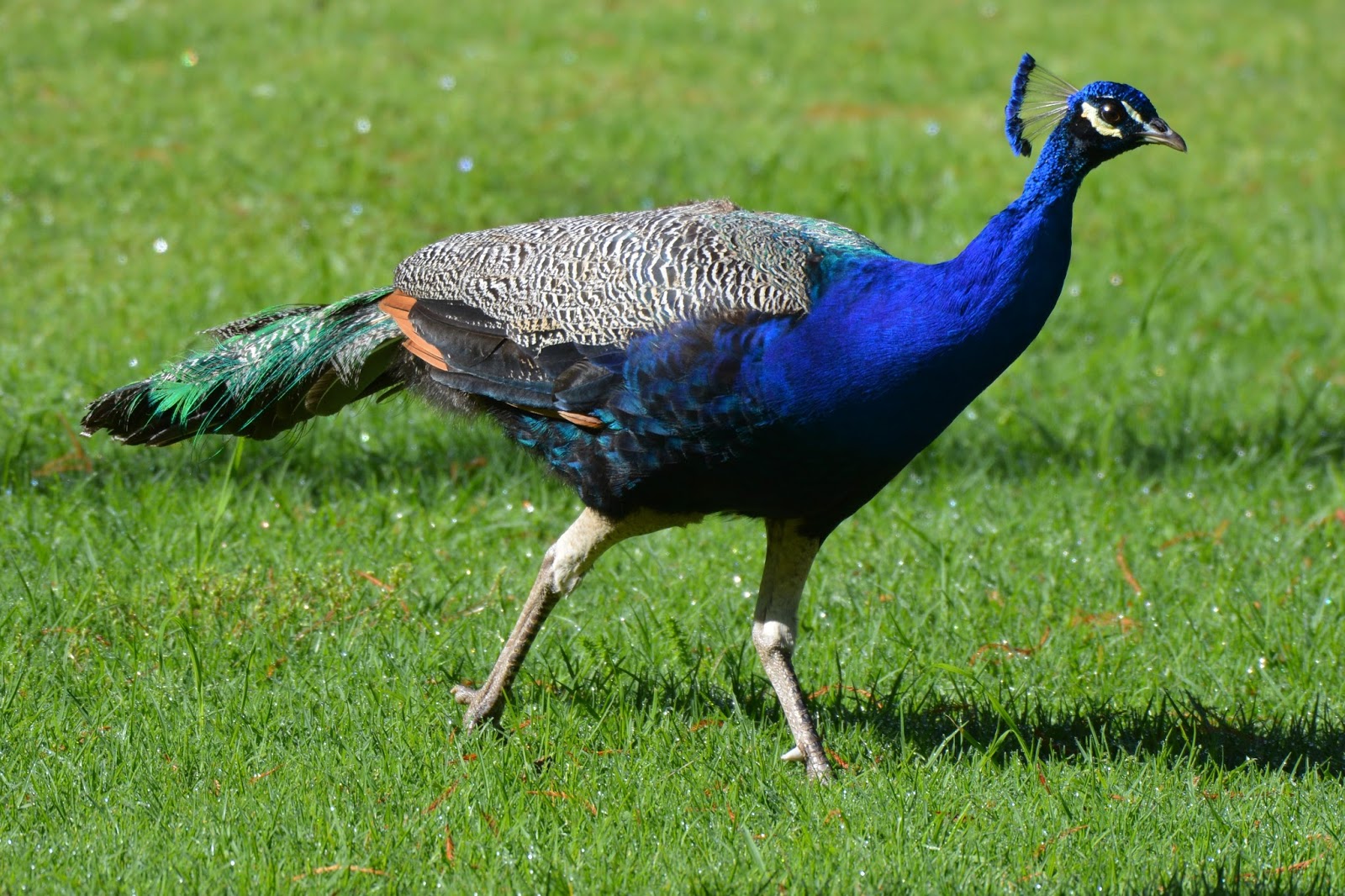
Indian Peacock
We arrived early so that we would avoid the nasty traffic and also find ourselves a decent parking space before the masses arrived.  However, we didn't expect to find the Pasadena Audubon group getting ready for their Saturday morning bird walk! BONUS! So we joined our guide, the very funny Julia Ray and had a great morning out. 


As expected, the gardens were worth the visit. It's also a reliable area to find several birds that can't be found anywhere else!  In fact, we found both target species within the first 10 minutes of parking our car!  So our running joke was, "Found our target birds, time to go."  But it was just a joke. When you find your target birds right away, you can enjoy all the other birds at a relaxed pace.  The way it should be. 

Downy Woodpecker working on a his nesting hole
Another part of our trek to California was really to pay attention to the subspecies.  Rumor has it that some will be broken into their own species. Take for example this brightly colored "Coastal" Western Scrub-Jay.  The bird looks slightly different from Arizona's very own "Woodhouse's" subspecies.  It even acts differently and isn't as shy!

Western Scrub Jay(the Coastal Subspecies)
The garden is home to several watering holes full of varied vegetation which attracts a lot of incredible birds. 


A common winter bird for California is the Allen's Hummingbird.  Here, he sips the nectar from one of the many flowering plants at the park. 

Allen's Hummingbird
And the plants were just beginning to bloom. 


Our first targeted bird, the Yellow-chevroned Parakeet, is a native to South America.  However, here in Los Angeles, the birds seem to be doing quite well. 

Yellow-chevroned Parakeet on a Silk Floss Tree
We had a high count around the garden.  These birds are not considered ABA countable and yet they have established themselves in the Los Angeles area. 


They were seen in great numbers around the Silk Floss trees.  We had a count of 26 birds in this location. Their numbers seem to be increasing just like our own Rosy-faced Lovebirds(in Phoenix) in these human created urban spaces.  Will it be ABA countable for those ABA listers in CA?  Only time will tell. 


So we continued further into the urban jungle searching for the Red-whiskered Bulbuls.  Our other exotic target species. 


And to be honest, it was all rather too easy:)  We found a healthy population on the garden grounds. 

Red-whiskered Bulbul
Again, we found evidence of nesting happening in the area. The birds were out calling in many different areas. They are native to southern Asia, Pakistan and Southern China. 


It's a lovely bird and one that I had never seen before.  For all of these new birds, all I had to do was listen for a different call.  With it being spring, we had no problem locating our birds. 


During courtship, the male will lower his head in a bow to the female.  The nest is built in the fork of a tree.  The adult pair may have 2-3 broods a year. Again this bird is not ABA countable in CA....yet. I think they are countable in Florida. I put the ABA part on now because I have several readers who are actually ABA listers.  My purpose in birding is to seek out new bird species(on the official list or not) and learn about them. 


And finally, we discovered an adorable nest of Bushtits.  They are cute little gray birds that often forage together in groups of 8-12 individuals. 


Bushtit
What beautiful views they have from their hanging nest!  


And for you trinket lovers out there, they have a shop with all kinds of knickknacks. They also have a coffee shop and small restaurant for a snack after your walk is done. 


Overall, we had a fabulous morning out.  I'd like to thank Julia Ray for showing us around this beautiful botanical garden. For more about the birds, click on our ebird checklist here. Until next time....


Friday, October 18, 2013

Data Gaps

Black Squirrel

 During my research, I utilize several methods to find birds. Obviously I use Ebird to help track down recent sightings, but I also do a lot of reading on habitat and range using guides and the internet. Arizona is Ebirded to death.  The professionals will tell you that it's not true as there are some large gaps in the state that don't have many reports.  This is true.  But if you are like most people wanting to bird the state, you'll fly into Phoenix or Tucson and have no issues finding all of our hotspots with recent reports from those areas.

Black-capped Chickadee

This is not true for many places like, for example, Colorado or Wisconsin. Heading into Colorado was hit or miss.  I wrote down all the major and potential lifebirds to be found. However there were gaps in the data. Or in other words, there wasn't any data on certain areas at all!  If there was data, it was years old.  I had the same issue in Guatemala and Mexico. So on these trips, I had to bridge the gaps with my own experience.  For my Colorado trip, I had about 5 or 6 life birds to find.  My brother-in-law is leaving for Kuwait hence the trek north.  Everyone likes to be outdoors and so we hiked our way through the many beautiful spaces of Colorado Springs.


One of the first things I wanted to do was get the Black-billed Magpie with my camera.  This is a very common bird in Colorado Springs.  I have a post on them from long ago but I was just learning how to use my camera.  One of the places we went to bird was Sondermann Park.  It had several birds on my target list which included an Eastern Kingbird.  This is a beautiful trail along a stream full of birds!  While I dipped on the Eastern Kingbird reported there, I picked up a life bird I wasn't expecting. 

Black-billed Magpie

The Olive-sided Flycatcher!!!  Yes!  It just sat on the branch and said to us, "Here I am.  Take as many pics as you want!"  And I did.  If this had been the only life bird I found for the day, I would have been happy.  But as luck would have it, more birds would pop up along this trail.

Olive-sided Flycatcher

But since it's a life bird and a first for the blog, here are some close-ups of the flycatcher.  They are found in Arizona.  Some of them are in trickier spots to find around the state.  Some of them are too far to chase. And they do pop in Tucson during migration, but I kept dipping on this bird.  When we found this handsome bird, everyone moved on to find more.  Pat understands the word, "life bird" and is constantly trying to aide in my quest to find them.  So when I said "life bird", Pat stood with me longer to observe the bird while the others moved further down the trail.  But what we didn't realize was that there was going to be a cluster of activity along the stream's edge.


It was hard to take my eyes off of this bird, but when someone said, "Blue Jay!", I was forced to move.


But not without spotting the first of the year Downy Woodpecker!  Hairy Woodpeckers are common in Arizona.  The Downy is much harder to find, but in Colorado Springs, they dominate the landscape.  In fact, we saw many Downy Woodpeckers, Williamson's Sapsuckers, and Northern Flickers.  I think Colorado Springs is the headquarters for Northern Flickers:)

Downy Woodpecker

Finally!  As a child growing up in Wisconsin, I had seen many birds but I couldn't trace the dates when I saw them so decades later, I discovered my first common Blue Jay that most people see.  And it was awesome.  Technically, another lifebird in molt:)

Blue Jay

Another fun place to bird is Garden of the Gods.  It's popular among the tourists and overall, just a nice place to hike.

Garden of the Gods

This area is a hotspot for Western Scrub-Jays and Magpies.  There are lots of beautiful Aspen trees and red rock formations.

Western Scrub Jay

One last note.  I have learned to balance the birding bit by birding in local areas around the neighborhoods of family and friends.  Another spot that was not really birded well was Quail Lake which was 5 minutes from our place. So I jumped in the car and did a quick walk around the lake and discovered.......

Quail Lake in Colorado Springs

Several juvenile Common Grackles.  Another life bird!  I heard the "grackle" sound and watched them for quite a bit of time to make sure I was actually seeing a Common Grackle and not a Red-winged Blackbird or Great-tailed Grackle or Brewer's Blackbird:)  These birds were mixed in with Red-winged Blackbirds. It was really gray and cloudy making the black on the bird tricky.  But to ID Common Grackles, I looked for the yellow eyes(check), their vocalizations(check) and a variation in color from the bluish head and darker body(check).  In the pics, it's hard to see that bluish sheen on the head because of the lighting.

Common Grackle

We had a nice trip and visit.  I have more photos from several other places coming up.  And hopefully I will have added more data to Ebird that will be useful.  Recently, four of my lists that I marked as a Hotspot for Ebird in Colorado Springs were accepted. That never would have happened in Arizona. Hopefully other Ebirders will visit and bird these beautiful parks and trails.


Keep your eyes open for the hummingbird moth below during summer and early fall:)  Rumor has it that snow has fallen over there!

White-lined Sphinx Moth
They were all over!


Dear blogger friends, I will be visiting soon.  I'm on vacation right now and will be back next week. There is a lot more to report, but for now I hope all of you are enjoying fall....or spring wherever you may be.  All my best.  More soon.....
I'm linking up with Wild Bird Wednesday.  So many amazing birds out there!

Sunday, August 11, 2013

Jay Walking


Mexican Jay at Madera Canyon
Here is another series of birds I'd like to present from this year.   I have been extremely fascinated by the group of birds known as Jays.  They come in all shades of blue.....plus!  They are the easiest of birds to recognize by sight and call.  Many times they'll come to you if you just wait;)

Steller's Jay of Mt. Lemmon
Their size and color also make these birds an easy one to capture on film....most of the time.  The secret?  Nuts.  Lots and lots of peanuts!  Over the course of this year, I've discovered more of these birds both here in the US and in Guatemala.  There are so many more to discover yet, but here are a few I've had the privilege of getting to know:)
Brown Jay of Tikal National Park, Guatemala

Surprisingly, not all Jays are blue.  Some are brown, green, or gray!  Take for example the Brown Jay of Tikal, Guatemala.  They were all together in their typical group fashion chatting up a storm doing what Jays do best......chasing other birds away:)

Bushy-crested Jay at Finca Pilar near Antigua, Guatemala

In Guatemala, I found them difficult to capture on film.  Most people didn't have feeders out or places to quietly stalk the birds so I had to do the best that I could.  While not the best shot, this Bushy-crested Jay was a common sight during our travels.

Unicolored Jay, Biotopo del Quetzal near Coban, Guatemala

This Unicolored Jay above is the prototype for all Jays.  It was also the most secretive.  On Ebird, it was considered a rare bird for the cloud forest we were exploring.  It's location was revealed thanks to a loud Montezuma Oropendula.  This Jay is said to be closely linked to the Pinyon Jays below.

Pinyon Jays near Greer-Overgaard, Arizona
Everyone stops to look at Jays like they do with Cardinals and all colorful birds.  But did you know that they are related to Crows and Ravens?  They are part of the Corvidae family which includes Nutcrackers, Magpies, Jackdaws and Treepies.  They are generally called Corvids by the birder crowd.

Western Scrub-Jay at the South Rim of the Grand Canyon
My challenge for this year is to find an Eastern Blue Jay back in Wisconsin.  I've seen them before as a child but technically do not have them on my lifelist.  We also have other Jays that I have yet to find....like Gray Jays!  They are indeed Gray.  In Texas, they have Green Jays! And there is a much larger list of them all around the world.  They are all just as colorful and full of character as their name suggests.

And dare I reveal a birder secret?  Sure:) The secret to finding owls can happen with the help of a Jay.  They love to bother other birds....especially Owls.  If you ever notice some sort of drama going on in the skies, tune your eyes into that area and you may just spot an owl or something rare:) Jays also have the opposite effect of chasing birds off.  Last week I was tracking a secretive Montezuma Quail and came upon a bunch of Jays quietly hanging out.  When they saw me, they all started to squack!  And the quail flew over my head!!! No pic! Bugger! Oh well, what am I to do:) This post is part of series on groups of birds I'm studying this year.  If you are interested, here is one on Trogons posted several weeks ago.  There is a lot of material to cover from this past summer and I'll have more coming up:)

Tuesday, April 16, 2013

Grand Happenings


The Grand Canyon is a national symbol.  It's an international sensation full of loud tourists who all come to witness this incredible landscape from picnic tables and parking lots while eating their 10 dollar ice cream cones.  But we weren't there to look at the canyon or rocks.  We were there to find the two nesting pairs of the very rare Californian Condors.  We grabbed our camelbacks and began our 7 mile hike along the rim checking out all the nooks and crannies trying to avoid the crowds.  And most of the time, it worked.
Now most of the tourists were oblivious to the wildlife hiding in the trees etc.  They sped quickly in their motor cars past elk, birds and other incredible things. WHITE THROATED SWIFT!!!
White-throated Swift
And back to.......beautiful........canyons.......cooler weather.....people watching..........back to hike.
Along the way, we'd stop to take a break noting large numbers of Mountain Chickadees staring back at us.
Mountain Chickadee
I tried to resist the urge to take shots but that's impossible when you're at the Grand Canyon.
I'm not one for heights nor standing close to the edges.

But I had to do this so that I could scan the cliffs......
                                                  this curious ring captured King Tuzigoot's attention.
It was a memorial to a person who had died at the Grand Canyon.
While we were there, Western Scrub Jays ruled the airways.  I loved seeing a new type of jay besides our Mexican Jay variety but it made me miss them.  Does this happen to you?  Do you sometimes miss your backyard birds?
Western Scrub Jay
Tourists fed these jays. And they gladly ate.
After all was said and done, we had a nice list of birds.  I dipped yet again on the Condors but that just gives me a reason to return:) Our bird count is below....

Turkey Vulture  3

Cooper's Hawk  1
Red-tailed Hawk  1
White-throated Swift  10
Pinyon Jay  2
Western Scrub-Jay  12
Common Raven  15
Violet-green Swallow  1
Mountain Chickadee  16
White-breasted Nuthatch  3
Pygmy Nuthatch  3
Western Bluebird  1
Spotted Towhee  4
Dark-eyed Junco  10
Dark-eyed Junco (Gray-headed)  10
Brewer's Blackbird  1
House Finch  6
Red Crossbill  2
I'm linking up with Stewart's Wild Bird Wednesday