Showing posts with label University of Arizona. Show all posts

Sunday, April 12, 2015

Whispers of Wonders


The traditional seasons in Arizona are not always visible to our visitors. In the US, most states celebrate a distinct fall, winter, spring and summer. If you've lived in the desert for awhile, you begin to pick up the subtle beauty of the Sonoran desert.  Some people describe our seasons as "hot or not as hot".  And while that may be somewhat true, I'd like to present our version of spring this week:)

Hedgehog Cactus
The "summer" birds begin to arrive into Southern Arizona while others are in the middle of nesting. Cacti begin to bloom.  Butterflies begin to show up in greater numbers while the "Snowbirds" (the human and bird kinds) begin to leave:) Reptiles begin to hang out on rocks. Snakes slink their way across roads and into Herpetologist's hearts.

Elegant Earless Lizard
And the owls.  I love the owls the best.  It's one of the better times of the year to find owls near their nests....or just find owls period:)  Our Great Horned Owls were successful again this year raising 4 owlets!  Along with another teacher, we monitor their nest each day to make sure they are developing as they should.  With over 2000 people on our campus, it's amazing that the parent owls return each year to this site.  But we're glad they do.  It's also a great way to educate future birders.  Soon they will leave this make shift nest and bounce their way into the nearby Ironwood Trees.

4 Great Horned Owlets
While monitoring my ebird work patch, I found this soon to be leaving White-crowned Sparrow taking a dirt bath.  The bird didn't seem to mind me watching. 

White-crowned Sparrow
As it warms up, the birds begin looking for a companion to begin their nesting process. Some nest within the holes of these massive Saguaros below. Others prefer nesting within the Cholla cactus(center)

From left to right.  Saguaro Cactus(large upright cactus), Tree Cholla(reddish blooms), Palo Verde Tree(yellow blooms)
This is also a great time to visit southern Arizona. It's not too hot or cold and there's lots to see!  While on my treks this week, I spotted a Cooper's Hawk feeding.  Normally I don't see them banded so I did some follow up.  When I don't know something, I throw the information out on the google machine and Facebook. I am always thankful for the positive feedback I get from people.  The University of Arizona is conducting a study on Cooper's Hawks.  These birds are numerous in the Tucson area and their population appears to be growing. In fact, the Old Pueblo has one of the highest counts in the US. This may also explain why our Inca Dove population has almost completely disappeared from the area.  

A 8 year old male Cooper's Hawk
Anyhow, I found the right person and he emailed me back straight away. Here's the info he gave me on this bird. 
"Hi Chris:
The bird you saw was a male and was banded as a nesting adult on 13 June 2007. He was nesting on Silverbell Golf Course  (just south of the wetlands) at that time and has been seen there each year since. Your photo lets us record that he is alive and back in the same area again this year.  Thanks!
Bill Mannan"

If you find a banded Cooper's Hawk, you can report your sighting and pic to this email. mannan@ag.arizona.edu.  
Until next time......

Tree Cholla Cactus Bloom


Saturday, July 28, 2012

A Return Visit

Last year, we went to the Biosphere 2 after the UA had taken it over.  Over a year has passed and I headed back to see what has changed about the takeover. Biosphere 2 is considered one of Tucson's major attractions.  At 20 dollars a ticket, it can be a pricey entrance fee.   So I'll tell you what I know from past experiences and bring you all up to speed.
Last year I reported that the facility was in need of repair.  The good news is that the place has cleaned up quite a bit.  Of course their work is still ongoing but you can see the improvements.  Inside the biosphere, one can see the saltwater damage that has occurred over the years along the side of the "ocean".  So that's a negative but a positive to balance it all out?  The facility feels alive again with research activity and projects set up around the property.   In fact, a major project on rainwater is in the works and it will be exciting to see what happens.  As for the tour.....
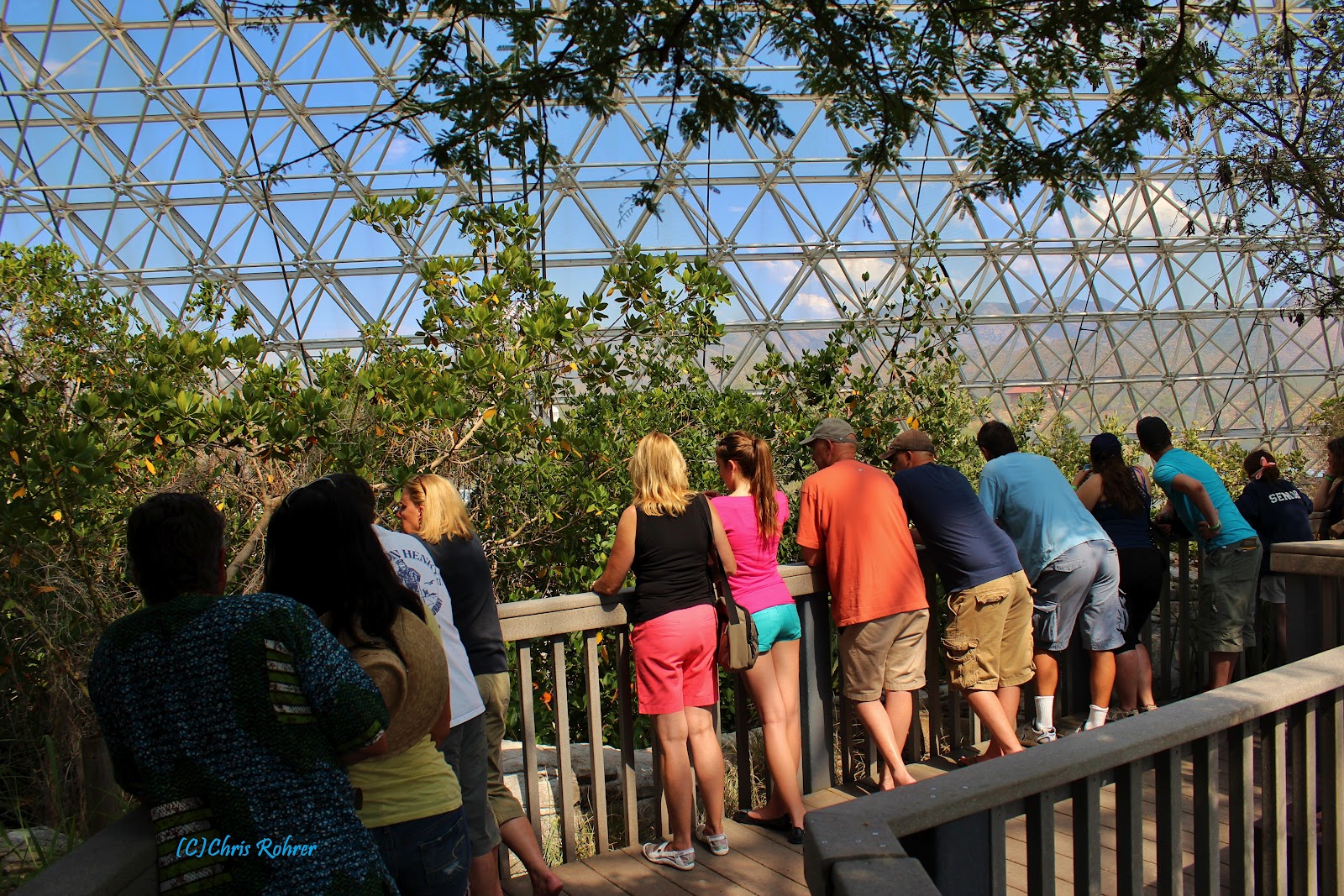
I was a bit....what's the word I'm looking for?  Disappointed is too strong.  Let down?  At one point, years ago, the tour went from the ocean room into the most exciting....the rain forest.  Instead, they hit you with the rain forest room first and it was honestly a big let down.  We walked into the room and spent around 10 or 15 minutes there and left.  What's even worse?  The entrance was a closed off patio area and you looked over the entire room instead of being inside of it like before.  We once could stand in the mist and be surrounded by all the plants.  Those days are over.  But here is something fascinating.  There was a tree frog that was placed into the Biosphere from the early 90's.  Even though the place has gone through several changes over the past 2 decades, this tree frog still has found a way to survive. One had been recently spotted while they were cleaning the algae off of the windows.
Most of the animals after the '93 experiment were relocated to zoos, but some found ways to breed in secret places and today this tree frog continues to be spotted by facility operators.
Essentially you move from the rain forest, to the ocean area where you get to spot the really cool Mangrove forest, and then move into the coastal desert room.   
The route has been altered.  Before, you started with the ocean and then moved into the rain forest room at the end of the tour.  The mist had felt good:)  It was hard to imagine that it was 111 degrees outside on this very hot day in the Sonoran desert.
There was an insect experiment above and yet another experiment on water usage from ancient cultures below by a Saudi Arabian study team.  They are facing an extreme water shortage in their own country.  The population continues to rise.  The water table continues to lower. They will not be able to sustain their people.  And in the upcoming decade, Saudi Arabia will face this huge crisis.  They also import most of their food from around the world.  I guess "gas" will get you only so far.  Research is now being done to correct the mistakes of the past and they are studying the ancient ways of utilizing water again in the desert. Another write related to this topic will be coming up. I started asking more questions to myself about these deserts and found out some fascinating information.  This was the most fascinating project for me.  I didn't know all this was going on....so I learned something new:)

So my final words for today?  I'm really happy that this place is up and running again.  I'm also happy that they are using it for research.  As for the tour?  Well, I'll let you read the reviews on TripAdvisor.  It seems like most people enjoyed the tour.  Some specifically mentioned that the tour is all about the guide.  I should mention that the campus is quite excellent for wildlife watching.  So keep your eyes open.  More tomorrow....

Wednesday, February 2, 2011

Biosphere 2

The Sunset reveals a Secret Rain Forest hidden beyond the Glass Windows
 "This was not a failed experiment!!  If I hear one more person say that...." During an argument in the car before we arrived to the Biosphere, we discussed whether or not the Biosphere was a failed experiment.  I didn't think so but my other half Pat did. It was a rather lengthy chat, but it came to a halt when we were shown a movie and one of the scientists told us, the audience, that it was not a failed experiment.  Both of us laughed outloud enjoying our previous conversation even more.


The Visitor Center

First impressions.  I cannot help but feel saddened by this place.  It was a live thriving experiment that was threatened only several years ago.  It was the talk around town and it was pristine and beautiful.  Today, it is still magnificent, but the rust on the pipes is beginning to show. The place was shut down not so long ago as Columbia University which managed it didn't want the Biosphere anymore.  There was a debate for several months on who or if the place would remain.  Condos were proposed for the area and people felt strongly about leaving it as a research station.  In a bold move forward, the U of A took control of the managment in 2007. The CDO Ranching are partners in the ownership.  Today it has classrooms, conference rooms, and many other things for the public and researchers to use for educational purposes.

The ticket price is 20 dollars for an adult.  Since movies this past year have been so terrible, we felt why not help out the research and learn something new! But seriously...movies have been terrible this year.  Anyhow, the tour lasted for about an hour and a half plus another hour for all the extra stuff around the Biosphere(i.e. the ocean viewing room).  The place is located 1 hour north of downtown Tucson near the small city of Catalina.
Idiot me!  We've all done it.....forgotten the memory card and arrived at the place over an hour away with no store in site. You only hope that the shop has a disposable camera for sale or that they actually sell a memory card!!  Which they didn't.  So I reluctantly purchased the disposable camera and snapped shots I only hoped would turn out.....no macroshots, microshots, inverted shots....just general shots from a distance.  How did we ever live without digital cameras?  I could give up anything in this world but my camera.  It's an extension of who I am and what I am able to do.....I've always loved photography and snapping images of an adventure or lesson randomly taught in the middle nowhere.  The camera equals life. :) Lesson learned.  I'll have extra memory cards in my camera bag. I'll need a lot for Panama with all the video shots and pics!

Now for the fun.  I love the desert.  Please don't misunderstand me.  It's just that when I entered this magical world of plants; I didn't want to leave.....especially the rain forest area.  I was transported to another time and place.  We didn't spend all that much time in this particular biome, but while I was there, I didn't want to leave.  In typical rain forest fashion, the leaves blocked out the sun and covered the windows.  We were not in the high desert anymore.....we were in the Amazon.  Tropical plants are awesome and if the desert didn't have our frosty nights in winter, they would be very hardy here.  Once established, a lot of these plants don't require huge amounts of water.

The skinny.  Wear comfortable shoes.  You will see 5 biomes...the ocean, desert, rainforest, a coastal desert, marsh, and savanna.  The main research happening right now is focused on climate change.  The Biosphere is located on 3.14 acres. The campus is 34.5 acres.  It's 91 feet at its' highest point. It's open from 9 AM until 4 PM everyday except Thanksgiving and Christmas. The phone is 520-838-6200 or check out the website at B2science.org    Email is info@B2science.org  


This place is researching "green rooftops" in an effort to reduce urban islands of heat in our large cities.  These concrete islands are pushing the much needed monsoon rains away from the city.  This creates a stress on water use. Water harvesting, solar panels, as well as other projects revolving around a sustainable world are explored.


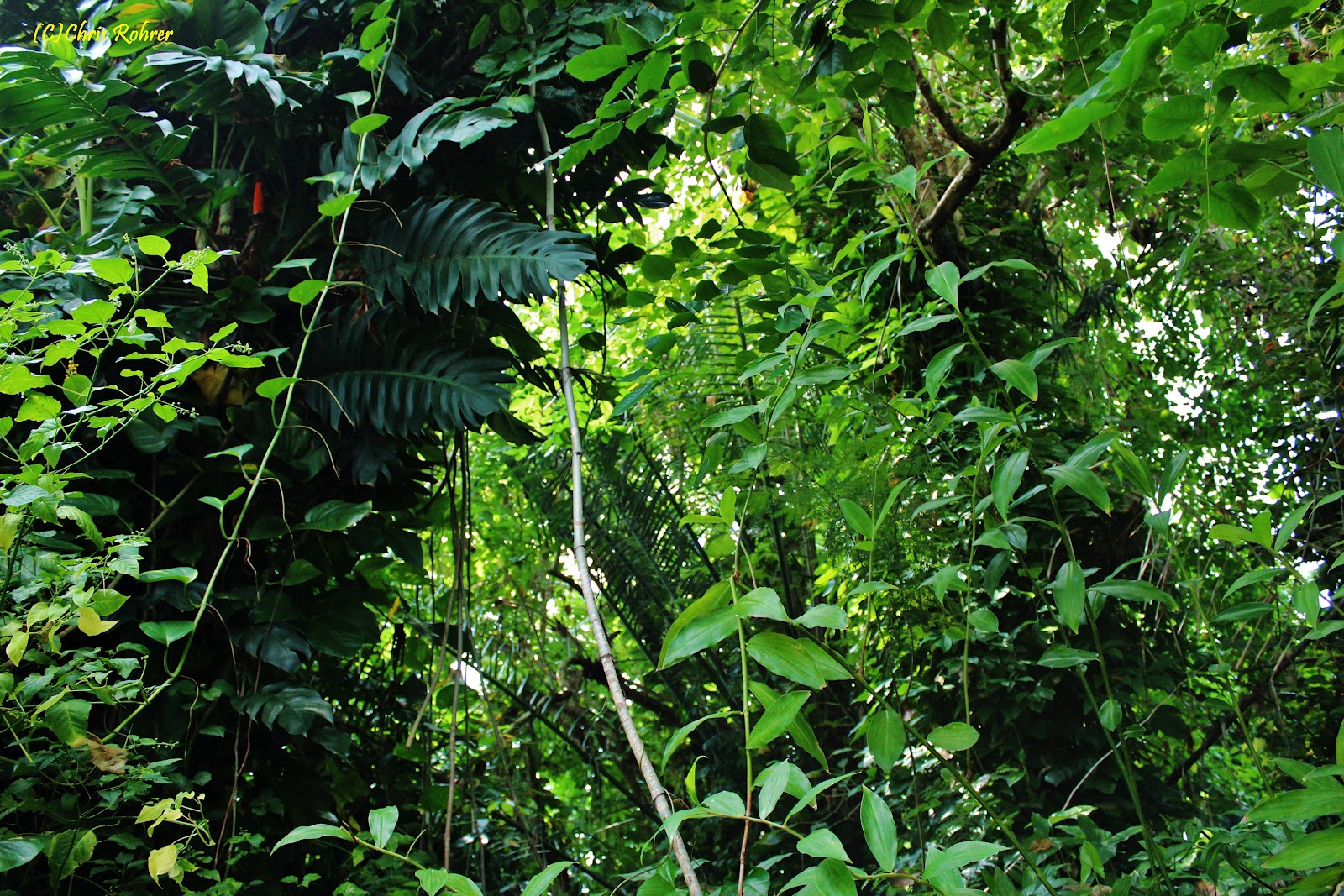
Because I am stupid and left my memory card in the computer, I was not able to get excellent pics inside the place.  I was so angry...and even now, while typing, I am having an issue with the terrible disposable  camera!!!  The Venezuelan Rain Forest did not come out because of all the humidity.....these pics below are terrible because they are dark and misty. It was really a cool biome to enter. Well at least you get the idea that a rain forest in all her glory is dark.....

The Biosphere is almost completely blocked out here in this huge area filled with over 90 different species modeled after a Venezuelan Rain Forest.

Notice how the plants will grab any sunlight they can get.  Here we see pothos dropping down from an opening in the rain forest canopy.
Why the name Biosphere 2? Because Biosphere 1 is our planet Earth.  Until next time, Happy Adventures!!!  And don't forget your memory cards!!:)

Friday, July 16, 2010

Cape Verde

<><>
<>
<><>
Me and my Peace Corps buddy
Tarrafal
Teaching in Sao DomingosCidade VelhaThe foraPedro Badejo

During the beginning of the millenium, I left the US and joined the Peace Corps in Cape Verde to teach English and help train others in the teaching profession.  A lot of things happened there that  made me grow up and become the person I am today.  There was a day that just clicked for me and everything became clear and challenged everything I had done in my life.  It was one of  those singular moments of clarity that lead me to where I am today. I remember it....painting my bedroom walls and listening to Melanie C on my boombox:)  We don't have many of those in life, but when they happen, we must act on them or sacrifice the person we are meant to become.  My first was in Mexico, my second was in Prescott, AZ, and my third was in Cape Verde....and I think it was my last:) They all relate to profession, family, and place.  Cape Verde was about place and hobbies. It was here that my love for gardening started to grow. So on this hot, steamy, cloudy, monsoon day....I thought I would talk a bit about the beautiful islands known as Cape Verde off the coast of West Africa.

In my previous blogs, I wrote about gardening with my family in Wisconsin, growing potted plants at school, and now this is the account of how I started a garden at my home in Cape Verde on the island of Sal. One of the things that I discovered moving to the islands was the need for having great vegetables.  The islands had avocado, some eggplant, green beans, and that was about it. Cape Verde is a network of about 9 main islands.  They were occupied by Portugal and released in 1975 to declare their independance. These islands suffered from severe deforestation and soil run off into the ocean resulting in starvation and desert conditions on mostly all the islands. The people  had used  up their finite resources which is a familiar tale across the world...just look at Haiti as the leader of that particular issue. Cape Verde had become almost inhospitable to live and many thousands of people fled the country  to the main continent of Africa, Europe,  and the East Coast of the United States.  Today you will see neighborhoods of Cape Verdeans around the Boston and Baltimore areas.

My first day arriving to the island of Sal, I discovered how different this island was from the rest.  It was like moving to Mars or what I would imagine to be Mars:)  It was nothing but dunes and beautiful blue beaches. Coming from the Bay area, it was quite a shock to my system.  How can people live on an island without trees or gardens? I realized that without plants, life was somehow less and that I craved the presence of them in my life.  Apparently, I wasn't the only one who valued plant life on the island.  At that time, plants were expensive to purchase and good soil was hard to come by....but it was possible:)  The ground was hard and inhospitable so plants would have to be in pots.  I became real familiar with the "ice plant".  On the islands of Boa Vista, Maio, and Sal you will find a lot of dunes and very few palm oasis. There are plants, but not many...and the ones you see are cherished by the locals and migratory birds on their stop to the African continent.

We left Sal and took a hopper flight over to Santiago, the main island where agriculture happened.  It was also there that we discovered that the University of Arizona was helping the country repopulate their forests with mainly mesquite trees.  It was like walking back into Tucson again as xeroscape and sun friendly plants were grown.  We spent a whole day in the center of the island listening to the goals.  I sometimes question the dangers of introducing non native trees, plants, and animals into an area, but there was logic in the plan.  Precious soil used on the island was getting washed out into the ocean because there weren't trees there to stop the soil erosion.  Today you can see the success of the program on the islands and how is has helped increase their production of crops.  If you travel to the main island of Santiago, which is a real treat, you should visit the "fora" or countryside village of Sao Domingos.   During this time, most of the farming took place in the washes where the rain would collect....and they grew everything from bananas, avocados, mangos....but they did it in a different way than most.....everything was just tossed into the tight ravine wash area and to me, it was a very bizarre and unorganized way to farm...but it was the only space they had to use.  In several of the pictures above, you will see me standing on top of a cliff and in the background below , you will see the "strip" of green in the washes where the farmers worked. 

When I needed to get my "green" on, I went to the city of Cidade Velha (the old city).  It seemed that on the island of Santiago, there was one sacred place that trees and other plants were not affected by the devastation or plant massacre.  Here you will see some lovely spaces where you can relax by the beach and drink a cold bottle of Sagres(a Portuguese beer).

It's not to say that Cape Verde was completely void of plant life, but it was noticable in many areas.  While progress has been slow on the islands, it is happening and the Cape Verde I knew then is probably a whole new creature today offering its' yearly thousands of European visitors beautiful beaches and an escape from mainland.

I was eventually moved to the desert island of Sal where my hunger for good vegetables began.  There was a limited supply of fresh produce and so the only way of having a variety was to grow them myself.  I saved my Peace Corps stipend and bought blocks of cement to line our courtyard with homemade planters.  There weren't any garden seeds around so my mother and grandmother sent me a package of them from the States.  I purchased my soil, planted my seeds and began my adventures in my own little peace of heaven.  I battled catepillars and slugs everyday, but it was rewarding.  It also made me realize how important plants were and fueled a passion I didn't know I had and so began my gardening adventures.  Sometimes you don't realize how important things are until they are absent from your life.  Happy gardening!!