Showing posts with label Sonoran toad. Show all posts

Monday, July 27, 2020

The Second Spring

This Northern Bobwhite(subspecies Masked Bobwhite) is an endemic to Arizona and Sonora, Mexico.  They disappeared from the wild when ranchers destroyed their habitat decades ago.  But with conservation efforts and a lot of volunteer work, this bird may once again make a comeback.  
This time of year in Southeastern Arizona is truly magical. It's dangerous, exciting and full of surprises.  Oh it's still hot and muggy, but the summer rains combined with shorebird migration "change" the Arizona birding into a unique third period of birding or what we call here, the Second Spring.  


Ash-throated Flycatcher
Before I get started with this week's post, I wanted to give you some information about a species that no longer lives here in Southeastern Arizona, the Masked Bobwhite(a most likely extinct-in-the wild subspecies of Northern Bobwhite).  If you live in Southeastern Arizona and would like to help bring back a species that has been extirpated from the wild, click on this link here. They are also looking for volunteers to help out with the reintroduction of these very important quail.  Here's a message from the coordinator. "We need a volunteer who can come out to the refuge and conduct general quail care (you'll be trained) on Sundays. We need a real commitment to do it every Sunday. It's about an hour worth of work but could be more if you also want to help with vegetation management. If you're interested please contact Stan Culling stan_culling@fws.gov 520-823-4251 x103 Thank you!"

the parent female Hooded Oriole feeds her young one
Now onto this week's exciting times. These next 3 months of birding in Southeastern Arizona are some of the hardest and yet most rewarding times in the state.  Cassin's Sparrows begin nesting here as the monsoon rains hit the grasslands. Several other species are actively nesting like the Yellow-billed Cuckoos and Buff-collared Nightjars.  Meanwhile bird species like the Lucy's Warblers, Bell's Vireos and Hooded Orioles are feeding their young!  It's really a complicated range of birding here! One group is just beginning to nest while another is feeding young!

Costa's Hummingbird
On top of that, hummingbirds are beginning to move through the area.  The first hummingbirds to move south are the male Rufous Hummers.  Other species like the Plain-capped Starthroat also pop in for a visit.  They aren't breeding here, but they are searching for food sources.  Local hummingbirds like the Costa's Hummingbird above are finishing up with their nesting season.  It's really fascinating stuff and makes Arizona birding interesting and different from other parts of the country. 

Black-tailed Prairie Dog
 This past week, I wanted to do some photography work.  I headed out to the Arizona-Sonora Desert Museum to check out the wild birds breeding on their grounds.  It did not disappoint! 


Also of note?  If you're into reptiles and amphibians, this is the time of the year to visit. The rains, along with that heat, gets these critters moving.  So while you're watching birds, enjoy the herp show going on. 

Desert Spiny Lizard
 During this time of year, birders need to be careful with torrential rains, flooding and running washes.  They also need to bring water with them at all times.  If there's an issue with your vehicle, you want to make sure you have an extra larger container of water with you. 

Rufous Hummingbird
 I surveyed ONLY 2 places this past week, The Desert Museum and Agua Caliente Park.  This means that I spent an hour to four at these locations.  I made other smaller stops from my vehicle.  Those counts were 20 minutes or less. These stops are primarily to check for migrating shorebirds. (And to build up my strength again to hike longer distances)


Couch's Spadefoot
 Due to the Covid pandemic, I have been working almost every day in my yard/garden.  It has been incredibly rewarding.  Soon our butterfly show will also begin.  We've put in these amazing pollinator plants around the property and it has increased our hummingbird and butterfly numbers in Midtown Tucson.  I am really excited about August and September as we see butterfly numbers really increase.  I've created little butterfly islands to make the watering easier.  


I'm a huge turtle, toad and frog fan.  During an important birding quest this week, I observed lots of amazing frogs and toads come alive and begin to breed in the rain puddles.  It's incredible that we have such diverse amphibian life in our desert.  Every time I see a frog or toad here, I just think about how crazy it is that they can survive in this climate. 

A Sonoran Toad actively feeds from a colony of ants nearby
 Now onto this week's chase.  Staying closer to home this year in Pima County, I've been trying to find new bird species within the county and add new ticks.  Well, another interesting species, the Painted Bunting makes their way into Arizona during the monsoon season.  They aren't common but it isn't unusual to find one here during these next 3 months. They're often far away and difficult to see in the shade.  But I can now say that I have a decent photo of this bird.  It's just taken me a few years. 


naked eye view
We had stunning close up views of this bird casually feeding off the roof of the visitor's center and around the nearby garden below.  The bird was very actively feeding which leads me to believe that he will be a one day wonder.  


the western subspecies of a male Painted Bunting
What does an Arizona sunset look like during monsoon?  This is looking out our window towards the Catalina mountains. This is not an exaggerated picture.  Monsoon is truly a unique Arizona treat.  We hope for more rain this year.  August usually provides us the much needed precipitation. 


I refuse to sit and watch the world pass me by.  While we "recovered" from Covid and are no longer contagious, we still experience some moments of coughing and fatigue.  During my trek with a friend to the desert museum, I wore my mask, walked around for 4 hours in the humid temps and almost passed out.  I felt terrible.  Thankfully, my friend understood that I needed to go home.  Once I got home, I crashed and slept several hours.  I let my body recharge a few days and tried it again.  The second time was better, but when I overdo it, I do a little coughing....and sleep:)  Apparently this is normal.  This is yet another reason why people need to wear masks, wash hands and social distance.  It takes forever to feel better. 

Burrowing Owl
As we approach the month of August, I plan for several new birds for that life list.  Plan A and B were taken away from me.  But Plan C has been one I've been waiting to take off the shelf and dust.  Hopefully it will happen.  Stay safe and until next time....

Thursday, July 21, 2016

The Toad Witch


The invasive Bullfrog
I know I know.  You're all saying, "Um, frogs?"  Well, I better clarify.  It's frogs, toads and a snake with some birds:)  I did my yearly bird survey at the Aribabi Ranch in Mexico during the first week of July. Somehow, the tiny developing Herper inside of me showed some interest:)

Anny holds her target study, the Sonoran toad.  Here is a breakdown of the frogs and toads seen here.  Left side top to bottom-Sonoran Toad, Red-spotted Toad.  Middle, top-bottom, Lowland Leopard Frog, Sinaloa Toad, Spadefoot Toad. Right, top-bottom. Bullfrog, Woodhouse's Toad

It was hot and miserable.  There were also plenty of bugs to add to the uncomfortable nature of our stay.  BUT.  I went with a group studying the Sonoran Toad(also known as the Colorado River Toad).  While they were doing their investigations, I did my own.  They were a wonderful group and made the trip down a whole lot of fun. 


The target species-the Sonoran Toad
Below is a pic of the crew during our dinner event.  The young lady at the corner of the table is Anny.  She is a graduate student who will be working with the venom of the Sonoran Toad to help develop a treatment for such things as drug addiction.  It was fun watching the crew brainstorm and put this project together as a team.  Meanwhile, I was with the herp guy, Jim Rorabaugh.  He's into everything "nature" but he really really likes lizards, toads, frogs and snakes. Over time, I've learned to appreciate them more thanks to Jim's work out in the field. 


I've seen most of the birds on this ranch so getting the bird survey done was a snap.  And I had great views of some birds that would be considered "rare" for the US.  During the nasty heat, a Summer Tanager sits down on a fence and poses. 


As he sings quite proudly, a Broad-billed Hummingbird sails past him. 


During the early morning hours, I would run my survey.  During the afternoon, I'd hide away from the nasty sun.  And during the evening, I went out with Jim and crew to look for frogs and toads!

Sinaloa Toad
In the process, Jim ID's his first ever Sinaloa Toad at the ranch!  There's nothing quite like finding a new species at a place we have surveyed for several years.  Jim has been coming to Aribabi for years and it was a first for him.  To watch him get excited was great fun.  Surprises are the best. This toad was very rare for the area. 

Yellow-billed Cuckoo
Also rare?  the Western sub-species of Yellow-billed Cuckoos.  I've been to the ranch over several summers and haven't had more than two pair calling from the Cocospera River.  This year, we had an amazing 3+ pairs of cuckoos!


The first night, it looked like it would storm but it didn't.  Instead, it stayed muggy and I didn't sleep at all.  The second night was better.  We did have a storm blow into the area, but we didn't get any rain from it.  However, the temps cooled way down! 

Spadefoot Toad
During that night, the crew went under barbed wire fences and into grassy areas to look for toads and frogs.  Or whatever else came our way.  People went after frogs in nasty water.  I'd flash lights and bugs would run into me.  I am definitely a birder.  This business of picking up frogs in poopy cattle ponds is not my idea of fun.  However, watching frogger people get into the whole activity was fun. Night time photography is the worst!  50 photos for one decent one.  

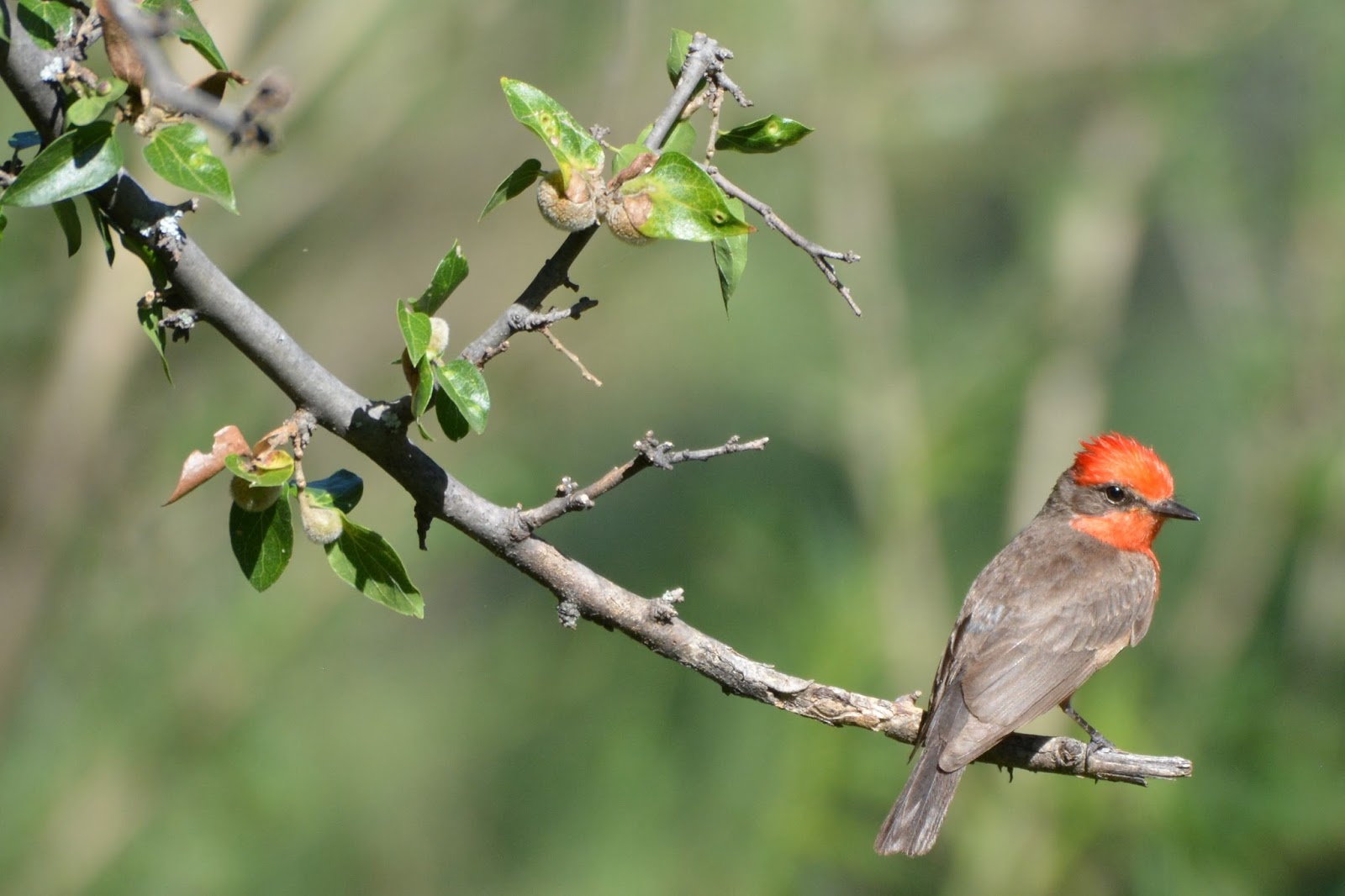
Vermilion Flycatcher
During the day time, I relaxed as I casually saw my birds. 

Sinaloa Wren
I made an effort to track down the very vocal Sinaloa Wrens.  They appear to be working on a second clutch for the summer.  The nesting sites were active. 


Here is one of those nests.  It hangs down from the tree.  The hole of the nest is underneath this basket.  Pretty cool!


There were also several other birds I needed to track.  

Woodhouse's Toad-note scary "spider" behind the toad! 
The Thick-billed Kingbirds were back again nesting. 

Thick-billed Kingbird
AND I finally heard and saw the Rose-throated Becards that are always reported from this area. This bird is significant because it is only found around healthy riparian areas.  Their populations have been said to be in decline, but thankfully on this trip, two adults and two juveniles were seen!  I was SO happy.  This is the 4th time I've seen this species in my life.  Maybe one day, I'll finally get to see one in Arizona.

Rose-throated Becard
Then it's time for a muffled scream, followed by a cooooool moment.  If I know there are snakes, I'm okay.  Had I not known about this tiny snake, I would have freaked out.  But Jim gave us a heads up. 

Sonoran Lyresnake
I stand back and try to get a decent photo of the snake for documentation purposes. I can't help feeling the heebie jeebies.  It's a way cool critter and I know it.  But I have this stupid human reaction to snakes.  I wish I could control it, but I can't.  Maybe it's the way they sneakily slink silently along the vegetation. 


Anyhow, our crew got the job done and we were ready to head back home to the cooler temps.  I wish Anny the best of luck on her grad project.  It sounds like a lot of fun.  


Life is an adventure.  Where will we go next?  Stay tuned for more......