Showing posts with label Purple Sandpiper. Show all posts

Monday, April 8, 2019

Holyhead


We visited so many wonderful places in Wales thanks to friends Bonnie and Steve. One of my absolute favorite places that Steve took me to bird was Holyhead(pronounced Holly head).  

Purple Sandpiper
All I know about Holyhead is that it's a major sea port serving Ireland and Wales. There's a cool looking lighthouse that attracts a lot of people during the summer months. They walk down the stairs and cross the bridge to eat ice cream and then climb the stairs back up to the parking lot.  As a birder, I learned that this area is a natural breeding ground for several amazing birds like Razorbills, Common Murres and Atlantic Puffins. 


It is notable to mention that there are many great birding hotspots along the way to Holyhead. When Steve mentioned our itinerary for the day, I was excited.  I love ocean birding.  The rocky coastal area was full of fantastic sea life.  In a future post, I'll focus more on those things but for now, let's enjoy the amazing world of Holyhead. It's the furthest point you can go in Wales before hitting the ocean waters to Ireland. 
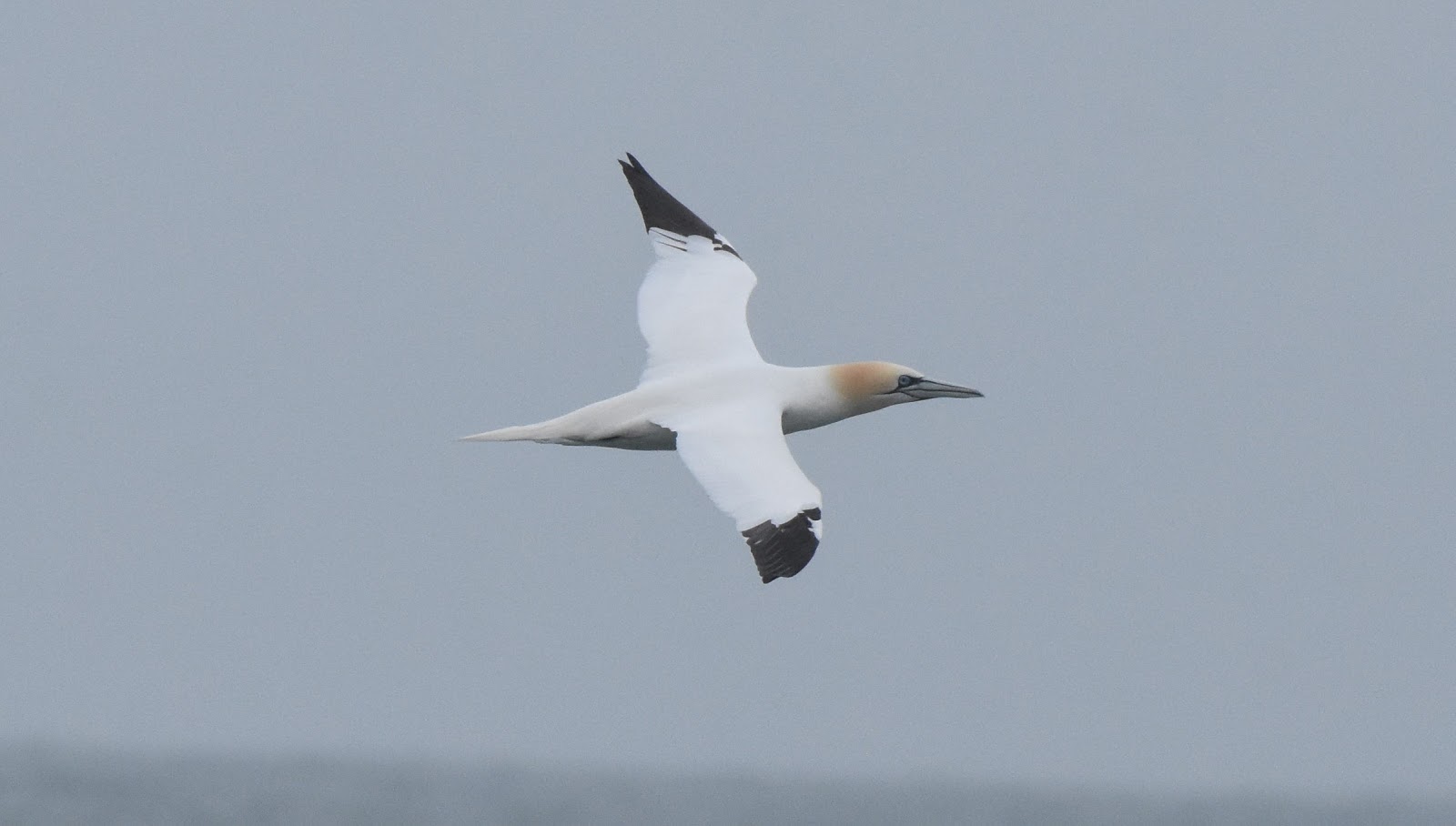
Northern Gannet
My first lifer was the Northern Gannet.  I was SUPER thrilled to finally see this bird.  What a beauty!


Once we reached Holyhead, I didn't know what to expect.  It was INCREDIBLE!  We walked down the steep stone stairs into the incredible secret world of Razorbills. Steve told me to gaze through the stone hole.  What I saw blew me away!


Little did I know but on this day I would get stellar views on one of my most anticipated lifers, the Razorbills. Observing these birds come alive from the pages of my bird guide was a total high. 


They were actively flying in and out of their sea cliff homes pairing up and preparing for the breeding season. 


These birds can be found along the Atlantic coast of the United States in places like Maine. This summer we'll get up close and personal with them again on Machias Seal Island with Ms. Kathie Brown. They are one of my focus birds this year.


Once Steve saw that I was ready to move on with more observations, he took me further down the stairs to Mordor:) 


We went to the furthest point before reaching the locked sky bridge.  To the left of the bridge, I could see more Razorbills and ........Common Murres!  They call them Guillemots. So I was a bit confused at first, but I began to mentally translate their Guillemots, Goosanders and Divers into my American equivalents. 


Take a closer look above and you'll find the Common Murres/Guillemots to the left and bottom of the picture. 

Black-headed Gulls
All around the birding world of Wales, we could hear and see other coastal birds like the Red-billed Chough below. 


This is one amazing bird.  We saw them along coastal areas near sea cliffs and rocky shores that always had some grassy areas. 


There was a gift shop nearby and so we stopped by and I did some card shopping. One could also get coffee or tea here.  And more ice cream. 

Black Guillemot
Being along the ocean is a treat, especially when I don't have a lot of large water areas around the Tucson area to bird:)


The gray skies were heavy.  The sea mist was refreshing. And I tried to memorize all of the little details like the ocean smells or new landscape views that seemed to be straight out of a wonderful foreign film.  It was really quite something to experience.  


I work and I work.  Every moment of my life is planned.  Currently, we're doing a survey for New Mexico and will be heading to Texas to find some new birds.  I do work as well.  This is the only week I have left before finals begin and then it's my nose to the grindstone as a teacher for the rest of April and May.  But even then, when I'm not in the classroom, we'll meet new friend Homer(from Florida) find our amazing Arizona birds.  And then our Tucson Audubon Birdathon with the Wrenegades begins as we raise money to help protect Southeastern Arizona's birds.  It's all a balancing act.  This post is dedicated to birder and naturalist Pete Moulton.  He passed away this last week and it was a shock.  He was a good man with a great big heart always helping others with ID's on their dragonflies and birds.  Pete was also an amazing photographer.  He will be missed.  Until next time.....

Wednesday, January 10, 2018

Our Frozen Smiles


Kathie freezes near the Hardy Boat dock
The historic sub-zero arctic temps continued to challenge humans and wildlife alike.  Each day we layered ourselves with 4 or 5 outfits.  Some days, we'd drive in -11 to -17 temps. 

We spot a VERY cold Red Fox in South Bristol. 
Our focus continued on the tips of several peninsulas in Maine.  We needed the open ocean water where the waves would crash.  It was the habitat for several important life birds, the Great Cormorant and Purple Sandpiper. We brought the scope and scanned the endless "smoking" ocean. But before we did all of this fun ocean birding, we had to begin our daily routine.  

Blue Jays mob the feeders in great numbers
Kathie filled her feeders and did backyard bird counts.  Because it was so cold, every creature with feathers and fur fed from her feeders.  These backyard birds were otherwise scarce in most places we visited.  By feeding the birds in these historic freezing temps, we gave them a fighting chance to survive.  And yes, there were birds that froze to death.  Most of the birds here are hardy, but I discovered that Mourning Doves do not do well in these temps. 

The Slate colored Dark-eyed Juncos enjoy the cold snap as only juncos can

After we had a little breakfast, fed the birds and put on thousands of layers of clothes, I kissed my buddy Coda good-bye.  This pooch stole my heart. 

My Coda....I mean their Coda.  This dog was my new best buddy
It was out into the wild world away from the safety of the warm house and bird feeders to find ocean birds. Kathie was excited about an area known as Pemaquid Point. Looking back at our adventures, it continues to be one of my favorite places to look for birds. 


Pemaquid Point was an important spot to visit as it has historically had Purple Sandpipers 
We had birded here back in the summer of 2014 so I was somewhat familiar with the area.  In the gray hazy skies, we unloaded our gear and moved to the ocean's edge. I looked down and observed movement along the rocks. Before the trip, I studied the Purple Sandpiper well. For me, understanding the Purple Sandpiper would be like understanding the Rock Sandpiper of the West Coast.  Their habitat is similar. 


Purple Sandpipers reminded me of a cross between American Dippers and Spotted Sandpipers as they bobbed and weaved in and out of the ocean waves
So I watched from the distance and carefully planned my descent to the edge of the ocean.  It was a bit scary but I needed better pics of these birds. I had Kathie spot me from above.  Snow covered ice patches between slippery rocks.  At one point, the snow stopped and the ocean began.  The water was deep and the current was strong so I stayed a safer distance from these birds.  But I was able to see their orange bills and legs well.  


Pemaquid Point is a bit magical.  It's a lovely snapshot of coastal Maine.  


Kathie took me to a local store where they sold Whoopy Pies.  I hung out in the back of the store and listened to the Mainer's accents and it made me smile.  I bought a Blueberry Muffin and Kathie had the Whoopy Pie.  However, we did not purchase any cigarettes for the road:)


Kathie loves creating checklists so we were constantly adding data.  I did not like listing outside and freezing my fingers off. 


So we'd stop for coffee and do our lists inside of a nice warm cafe. 


For days, we continued our ocean adventures counting gulls, guillemots, eagles, ducks, scoters and grebes. We always kept our eyes open for an alcid close to shore.  


A Black Guillemot in winter plumage
I'd scan the shorelines and look for blips on the ocean's horizon. If I saw rafts of ducks, etc, we'd get the scope and count birds. 


Depending on the tide, birds were either close or far.  If the tide was high, we wouldn't move on. Sorry Blondie. We'd stay because the birds were close.  If the tide was far out, we'd have a difficult time spotting birds. So we planned everything around high tide. 


The frost tinged winds challenged many birders.  At one area, I tried getting close to the Harlequin Ducks but it was too dangerous. If we stood on the point, we froze.  If we scoped below off the point, we were warmer but then, we weren't able to see everything on the ocean.  It was a Catch 22. 

Another birder joins us with his dog as he searches for his last US duck of the year, the Harlequin Duck
Sometimes we'd see a large blip in the distance.  It was either a seal or a large cormorant sitting awkwardly on a rock.  I thought I'd have difficulty ID'ing this bird but when I saw how massive this cormorant was, it was a no brainer! Another lifer achieved!

The Great Cormorant is a winter visitor to the coastal waters of Maine.  It's a large bodied cormorant that flies with rapid shallow wing flaps.  When it sits on a rock, it looks like a seal folded over.  

We thought it would get better but little did we know, the worst was yet to come, the Bomb Cyclone.  To top it off, there was a supermoon which would wreck havoc on the coastal towns with the higher than normal tides.  After a week of beautiful birding in horrible conditions, we'd discover just how challenging the birding would get.  

Example of clothing layering.  Under that gray coat, there is a vest, sweater and shirt. The sweater provided a hood that would cover my hat and head from the severe winds.  The scarf would cover my large nose and face. 

My final write explores the last treks of our days in Maine.  Stay tuned for more!