Showing posts with label Oilbird. Show all posts

Sunday, December 30, 2018

Las Aventuras: Bookends


One of my favorite moments from this year in the grasslands as Pronghorn come to get a sip
As a person who has blogged for about 8 years, I have seen myself transform into many things.  Over the years so much has happened.  There has been so much change. I began as an amateur gardener and photographer.  I am none of those things anymore. I miss that carefree me, but I love that I am more certain of the work I do now. With certainty comes calculation and focused study. 


a very cold Red Fox in Maine
As I have begun branching out into the world birding arena, I have experienced frustration, joy, excitement, fear and anxiety.  This was the year I'd learn to leave my comfort zone, challenge my fears and face the changes that are happening around this world. 


watching youth get excited about birds in the Caroni Wetlands of Trinidad was a hopeful moment
For me, Trinidad was a wonderful exploration into a world of beauty and the unknown. This was a culture I was unfamiliar with and it was out of my comfort zone. Just when I thought I was free of all the child learned fears I had been taught; I discovered they were still there inside.  And when unleashed, I found myself out-of-control in the middle of a rain forest panicking.  It turns out that I was my own worst enemy.  Everything had been fine really, but I had unwittingly caused my own torture.  Afterwards I was embarrassed by my outburst. Thankfully, a kind man told me to take a deep breath and that it would be ok. While people spoke English on the island, I didn't speak their English and it took time to understand. I've traveled and lived all over the world and this was a first for me. 


the guide means well but this capuchin was not having it.  He was throwing branches at us to let us know to stay away. This wasn't the first encounter I've had with this species.  Once I had a mango thrown at my head on Coiba Island!
But not all things were a fiction of my mind. Over the years, my experience anywhere has told me to be cautious. I experienced a drive-by-shooting and heard daily stories of people having their throats slit at random which included my host's cousin while I was there. To make things worse, I was near a church where the daily funerals happened.  Was this really what it was like for a Trinidadian every day? Like everyone else, I learned to lock myself indoors at night and tread lightly during the day alone with my hidden camera gear. A dog barking at night scared me but a dog on the property made me feel safer. With 3 dead bolts on my door, I knew not to answer my door after sunset. Most of all, I learned what frustrated locals were suffering at home on a daily basis. Crime, like drug trafficking, happened anytime and everywhere. It was exhausting to be vigilant at all moments.  Thankfully, Asa Wright brought me comfort while I was there.  I could bird freely without worries. But outside of the property lines, it was a whole different world.  


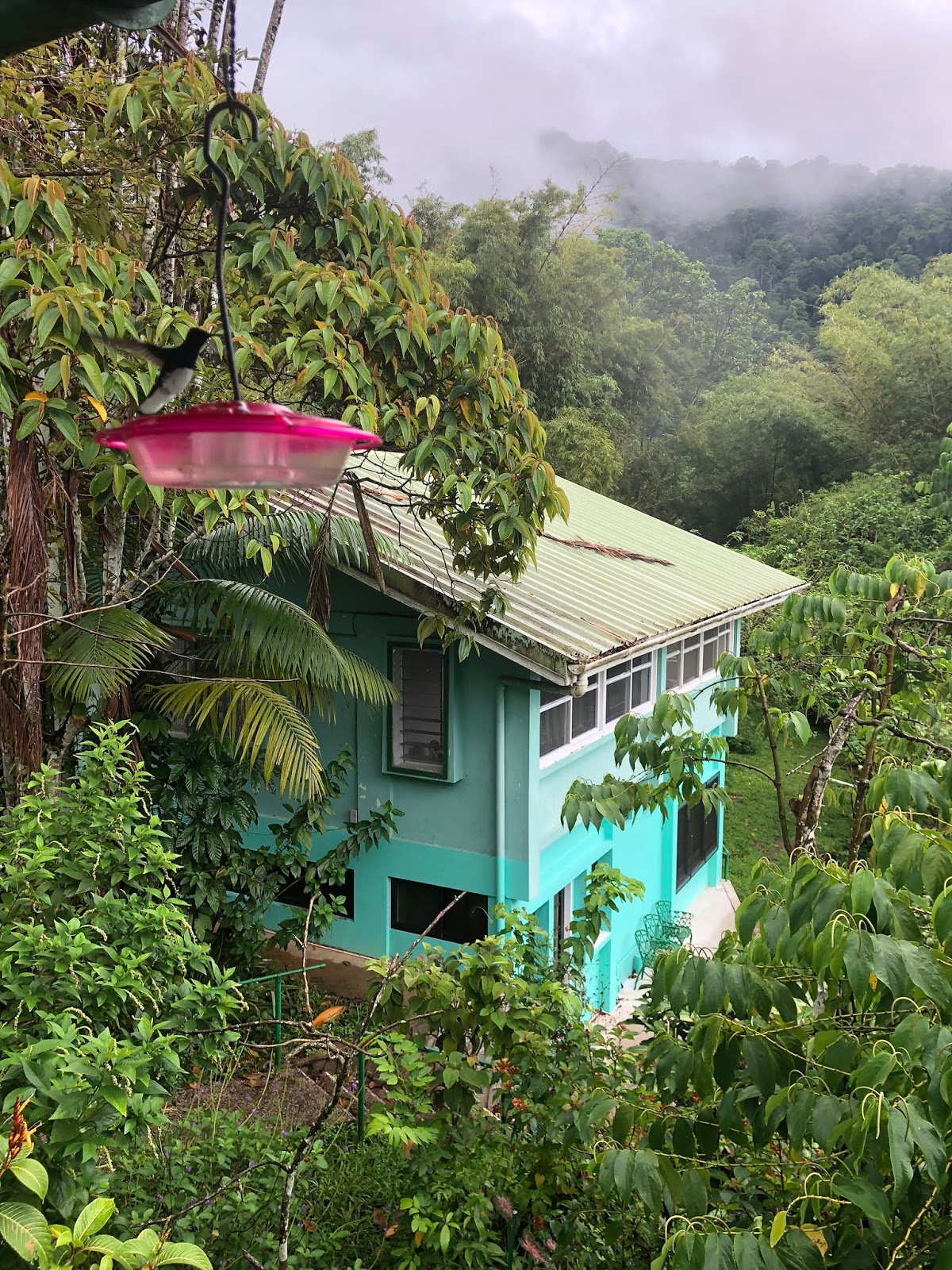
My amazing room at the Asa Wright Center.  I loved it!
The Asa Wright Center was magical and safe. Locals and tourists joined together here and had dinners. It is a very special place. I met some incredible people who made my experience on the island amazing. And I am thankful for their friendships. 


The Scarlet Ibis were one of the many Trinidadian Highlights
Even after everything I have written, Trinidad was one of my favorite trips this year.  It was here that I learned how to cook again in the kitchen.  It had always been there, but I had gotten lazy in the US. Being on a budget forced me to cook and it brought me joy. 


Fresh produce markets inspire and I become inspired back home and find my own way of getting fresh produce.
When I rented my apartment outside of the Asa Wright Center, I went shopping daily for fresh vegetables. Now because of Trinidad, I eat fresh food every week and am naturally losing weight because of a healthier diet. 


The amazing Oilbirds of Asa Wright!
After a near month in Trinidad, Micheal and I headed over to Maui for a relaxing vacation. And while Hawaii was also magical, I came face-to-face with humanity's need to destroy and replace. It was incredibly beautiful and sad at the same time.  I felt hopelessness on a couple of these islands as the endemic birds face the uphill battle of global warming and mosquito infection/malaria.  So when I found my endemic lifers, I didn't feel joy. I felt this huge empty sadness and anger.  


the 'Apapane is one good looking Hawaiian endemic!
Leaving my Tucson world of birds was a good thing. Developing global views of the birding world outside my comfort zone gives me a deeper understanding of this planet. Every step I make outside of my comfort zone brings me one step closer to enlightenment. For all the good that this world does, it's also outweighed by more habitat destruction and population growth.  And that weighs heavily on me. That carefree birder I knew only a few years back is gone.  I'm not quite jaded yet but I am not as naive as I once was. 


a security detail goes ahead of me as we count birds like Red Warblers in this private sector of Malinche
On a special trek, I had a security detail come with me to bird an off limits area of the Malinche volcano in Puebla. It was such an honor to be able to bird this area and also add invaluable ebird information to this private forested sector of the volcano.  A special thank you to my host sister for arranging this incredible day of "work". 


I do research in the local gardens around Tlaxcala and find a migrating Nashville Warbler
The drug wars are on the rise again.  The issues in Venezuela, Mexico, Trinidad and other areas are real. The US is the major reason for this bloody war south of our border.  Travel in these areas can be tricky.  I really wanted to see an amazing sparrow found outside of Mexico City.  The bird is endangered and found in a very sketchy area. For the first time since becoming a birder, I hired a guide to help me access this area safely.  We were right on the border of a drug route and it required the "safety in numbers" rule. It was an amazing day out but it made me upset.  This isn't the Mexico I grew up to love. Tlaxcala, one of the safest states in the country, has now experienced some crime.  My friend and sister told me that Tlaxcala used to be safe.  I remembered those times fondly.  At a dinner, she warned me to be careful with my equipment.  "Guero, things are not the same.  People are now getting robbed in daylight. Be careful." But while I was there, I was the giant with all smiles because I genuinely feel my happiest there. If there were no borders, I'd own a home in this beautiful little village.  I love the people.  I love the culture.  And I feel at home. I could take people on bird walks here and they'd have fun.  For the most part, it's really a safe state to explore!


Happy and fresh produce with Delfina!  She makes my favorite cream of pea soup!
However, when someone says to me that bird watching is fun, I get a little irritated. Yes it can be fun, but it's called birding and it requires a lot of strategic savvy.  And quite a bit of it is NOT easy. I've spent hours upon hours researching all these places organizing the work.  


We discover the southern most range of Evening Grosbeaks in central Mexico and it blows my mind away!
And if there is one connection to everything else about this blog post, it's that Tucson has witnessed a rise in crime. It's not just happening everywhere else. It's also happening in our backyards! My neighborhood has seen an uptick in homeless people and theft. Why?  Drugs, like meth, are out-of-control. It has forced my hand to upgrade security measures on our place in midtown Tucson.  So I budgeted in $$ for a better car and a new secured patio which then cut into this year's birding budget.  All of it is good. But one has to go with the ebb and flow of things.  There are no short cuts in this life. Safety and security are important things.  From plenty of past experience with our crazy criminal neighbor and theft in the neighborhood, I can tell you that the police are not reliable in this city.  So we have to fend for ourselves most of the time.


Black-legged Kittiwake in Glendale, AZ!!!  Worthy of a state chase!
Stepping aside from the human condition, I'll now show you some of the rewards and highlights from these incredible treks and why I would go lengths to see these birds. I began my year with my lifer Black-legged Kittiwake in Maine with friend Kathie Brown. It was cold outside and simple.  I knew that it would be the most relaxing and stress free bird outing of the year.  I felt a calm before the storm, even though we were birding from within the historical cyclone bomb of Maine! The blizzard was the most peaceful thing I had felt this year because for one glorious moment, I forgot about the orange clown who is ruining my country, the attacks on public school teachers and the undoing of environmental protections. While I traveled throughout this year, I went on a major teacher strike to save our public schools,did some guiding to make up for the loss of my work paychecks, sold some of my photography and had several articles published in magazines. The birding kept me sane!  We did some amazing fund raising for Tucson Audubon.  And at the end, I added a rare Black-legged Kittiwake to my Arizona state list.  It was a fitting way to end my 2018 birding year. 


Here's the thing.  Birding in Arizona is pretty epic.  If you're a birder looking for a great place to live, I highly recommend this state.  I mean LOOK^^^at these crazy birds!  A little Mexico, east coast and California coastal stuff going on here!  Plus a first record of a Ringed Kingfisher!!  I took some of these pics, like the Ferruginous Pygmy Owl, Short-eared Owl and Slate-throated Redstart, in other areas because they were difficult to get pics of......the Ferrug, I didn't want to disturb because they are skittish. 
In Arizona, I added 18 new bird species to my state list.  In Pima county, I added 11 new birds. And for my life list, I added 120 new life birds. 


This is just some of them!
This post is dedicated to Barb Padgett and Bernie Brouchoud who passed away this year.  Barb was a supporter of Tucson Audubon and the Magee Marsh.  This year, Kathie and I plan to honor her by visiting her bench in Ohio. Barb was always there for me and donated money to my fundraising events.  Plus she was a fellow Trekkie.  I mean a really really good Star Trek fan!  We shared in lots of discussions. My only wish is to find her a Yellow-headed Blackbird for her memorial.  She never saw one and joked that I made them up. I'm sorry Barb that we never met in person but I am thankful for our fun discussions.


And Bernie was a guy I knew growing up.  He was vital in the creation of Woodland Dunes.  I knew I was on nature's side when I heard a council member, who I knew well, speak of building lots of factories in Bernie's established Woodland Dunes.  I didn't agree with the guy then and kept my mouth shut because I supposedly didn't know anything. I was a stupid kid. Secretly, I hoped Bernie would win and protect this land that I used as my playground.  I knew the forests well around that area. We had forts. We knew where the deer hid. Monarchs and snails and birds loved this little woods. Then one day, my playground forest and her little winding creek were wiped out and buried for "progress". I was stunned by the emptiness.  It was GONE! Bernie's land was next to "mine" and in jeopardy but thankfully Bernie won. And those factories?  Yeah, most of them are empty buildings now because the jobs went elsewhere. We wiped out a creek and a woods for nothing.  But for all the fights, Bernie won against the establishment and today Woodland Dunes is one of our finest landmarks. Thank you Bernie and Barb for your contributions to the important preservation of this planet. 


I'll always cherish this moment.  I helped Bernie get his last North American warbler, the Hermit Warbler  I was able to properly say good-bye to him.  It was a very special day for both dad and his son.  And it meant the world to me. It seems like just yesterday that he was here. Time flies by so quickly. Bernie taught me so many things as a kid AND adult about birds.  I won't forget his lessons. 
What can I say about 2018? The more I experience with the birds; the more I know.  Birds bring people together.  Birds make us see things that are happening around us.  Sometimes for the better and sometimes for the worse. Sometimes I feel like I'm becoming a bird.  I want to be outdoors all the time and not caged up inside a room. In November, I had a hard time piecing together a general outline for birding next year. Today, I am happy to say that I have several projects lined up for 2019 that will take me into the summer.  I had to juggle a tighter budget for this next year which made things a challenge. However, it's going to be an exciting ride!


I'm wishing you all a wonderful new year! I think January will mark a new milestone for this blog as we hit a million views.  Thank you for following and being a part of the weekly adventures! 

Monday, July 16, 2018

The Superstars of the Trinidadian Birding World


Finding birds can be a very magical experience
A lot of people asked, "Why Trinidad?"  Honestly, I don't know.  I was curious about a new culture.  But birds also helped me make the decision.  Anywhere we go, there are always "the superstars" of the birding world that we hope to observe in the wild.  Trinidad has quite a few that I was excited about observing in the wild. 

a natural stream forms a pool at the Asa Wright Centre
It was also more than just finding the birds.  I wanted to explore the habitat on my own.  For the first time in my life, I actually did some birding in a cave! 


Bearded Bellbird
The first superstar for me was this beautiful Bearded Bellbird above.  This bird feeds from fruits and berries and was rather common here in Trinidad.  If you've ever heard ANY bellbird species, you'll recognize the loud one noted almost electical sounding "BONK!" Throughout your stay at Asa Wright, you'll hear these birds often from inside the forest.  The hike on the dark emerald trail was gorgeous. We followed the "BONK".  After several moments, my eyes finally adjusted and found the bird on a branch. BONK! The "beard" is actually made up of flesh.  The better the "beard", the more attractive the mate!  


The thrill of observing one of those cartoon superstars come alive from the pages in my guide got my heart pumping.  Another journey into this dense forest was to study manakins.  They are one of my favorite groups of birds.  At Asa Wright, there are TWO species of manakin that have well established leks.  For the first time in my life, I was able to communicate with these species.  We "spoke" with one another while I watched them do their thing. 

White-bearded Manakin
Another "bearded" named species, the White-bearded Manakin responded to a sashay two snap "giiiiirrrrrrrrl".  I'd hear the "snap snap" of the wings and snap my fingers twice.  The manakin did an elaborate dance on the ground for me.  I spent several hours with both manakin species in the dark woods forgetting about the chiggers and mosquitoes.  Big mistake on my part.  I was so focused on these birds that I didn't realize I was getting bit up.  

Channel-billed Toucan
One bird that I almost dipped on was the Channel-billed Toucan.  I went days without seeing one and then, I saw one.....for a second.  So could I count it?  Yes, but I wasn't having it.  On my last day at the centre, only one of the toucans flew out for less than a minute and gave me great looks.  Sometimes we don't always get to see our superstars. Take for example, the Purple Honeycreeper!  Not once did I see one.  I saw both Green and Red-legged Honeycreepers.....but never once did I spy the supposedly "common" Purple Honeycreeper.  Lesson for me?  Never assume I'll see the common birds. 


One of the biggest challenges was finding the critically endangered Trinidad piping-guan.  There wasn't anyone going from the centre to look for this bird so I had to contract an outside guide to drive me to the area where they were seen.  From the reports, it was hit or miss.  I think of all the birds on this trip, this was the one I wanted to see the most.  A wise woman told me once to target all the endangered birds first and this year I have employed this strategy.  The Sierra Madre Sparrow and Black-polled and Belding's Yellowthroats were incredibly special finds.  They are endangered because of habitat destruction.  The Trinidad piping-guan, the true endemic of Trinidad birding, is only found on Trinidad in one area now. Habitat destruction is not the issue.  Poaching is.  To get to the birds, we drove through miles of beautiful rain forest along the Trinidadian coast. Many of the small villages were isolated in areas that were difficult to drive.  The road was in very bad shape and it took us several hours to get to the village where there is still a stable population. 


The unspoiled beauty of Grande Riviere
We waited for an hour in the rain.  I was losing hope and then the rain stopped and a bird hopped up onto a branch.  The Trinidad piping-guan!!!! And not just one but 12!!!


Trinidad piping-guan
I put my umbrella away and began documenting the birds sipping from the rain water collected in the bromeliad cups at sunrise.  They stayed for about an hour and then disappeared into the forest to forage around the ground for food.  After seeing these birds, I felt good.  The trip in my mind was a success.  In Trinidad, there are a few species that carry the country's name.  The Trinidad Motmot was once part of the Blue-crowned Motmot complex.  I saw and heard the birds but in very dark rain forest settings.  There is the Trinidad Euphonia which is found in northeastern South America.  So while the Euphonia is listed as an endemic, it's not the same as the Trinidad Motmots or piping-guans which are ONLY located on Trinidad. 


My focus was ONLY on Trinidad because there was so much to see here.  Tobago is another trek one day.  And I plan on going with others to find that island's specialty birds. However, with that said, it is SUPER cheap to go from Trinidad to Tobago.  It's 50 bucks round trip and like a bus terminal, you just wait in the airport to get on their hourly scheduled flights.  No reservations needed unless it's a major holiday. 


The superstar bird I connected with the most was the Golden-crowned Manakin.  It has a one high pitched note that I was able to replicate myself.  Throughout my stay I was able to call them from the forest.  I'd hear one in the woods and then I'd respond.  And within moments the bird would be looking right at me.  I even called one to the deck of Asa Wright.  I heard it and then told the photographers to get ready.  And for a brief moment, the Golden-headed Manakin showed.  Manakins are life.  My license plate on my car says Manakin.  In the tropics I would study this group of birds more if I lived there.  In Arizona, I study sparrows. 

Golden-crowned Manakin
The last of the greats in Trinidad was a visit to the Oilbird colony in the caves.  They come up as rare on ebird because Trinidad is their northern most range.  Oilbirds are like potoos, owls and other nightjars in that they feed by night.  But unlike these other night birds, the Oilbird is the only flying fruit eater of the forest. They communicate much like bats but if you heard them in the caves during the day, you'd swear there were monsters lurking inside the darkness.  Their "growls" are quite intimidating. 


I've included this little informational video on these birds from the Asa Wright grounds.  While the narrator is speaking, listen to the sounds in the background.  Every year, the team surveys the caves and counts the birds. Several have trackers and at first many had believed that these oilbirds were faithful to these caverns but from a conversation I had with one of the guides, they've discovered that these oilbirds will fly as far as Venezuela for several weeks to feed. 


In the darkness at "5, 4, 3, 2, 1", our guide, Yosanna gave us a cue to be ready with our cameras. Then there was indirect light on the bird. And at "5, 4, 3, 2, 1" the light went off the bird. Several growls could be heard from deep inside the cavern. 


Oilbird
These birds were surprisingly large! Today they are listed as "least concern" but still protected as their specific habitat, caves, need to be preserved. In the video, it's mentioned that their numbers had decreased due to people taking the babies from the nest.  What I'm about to write will sound barbaric but it's what people did. If you don't want the gruesome details, just skip to the next pic. People from days yonder would collect the babies that are much larger than the adults. Their body fat is made mostly of palm oil(one of their food sources).  Their heads would be cut off and the the people would light the birds up.  It is said that the light would last 3-4 hours long.  They would also use the oil to cook as well.  


This was the last of my true target birds.  Everything else was just a fun find.  On this gorgeous trail into the cave area, it began to rain.  I wore all my proper birding clothes and even with all the proper preparation, I managed to slip into a spiny palm and stab myself good.  I brought an umbrella and I wore hiking shoes with grips.  There were railings on certain parts of the trail but there were also poisonous tarantulas living inside the hollows of the rails.  And unlike the tarantulas here in Arizona, they would attack if you got too close. This hike was the last "deep" hike into the forest as the last wave of chiggers killed my legs.  They have sulfur powder for you to put on before hiking but it didn't work for moi.  Long pants prevent much of the biting but I was still bit up pretty bad. There is something about my blood, even with sprays and powders and the proper gear, that bugs love.  


Gail survived.  She was a trouper. Her focus was photography and being from Canada, she was challenged by the humid and slickery conditions of the Trinidad climate. 
Birding is not easy. I mean, it can be, but often, it is challenging both mentally and physically. The Oilbird trek is an easy to moderate one depending on the rain. We had a really nice lady with asthma almost pass out.  She slipped on the trail but friend and Asa Wright guide Yosanna came to the rescue. I felt safe with Yosanna as she is a snake person. Many times Fer-de-lance vipers hang out on that trail camouflaged among the leaf litter.  Yosanna's eyes scanned our path to the cavern. If anyone would step on a snake, it would be me.  I've almost done it twice over the years.  Had it not been for others stopping me, I might have stepped on the poor things. 

During the rainy season, always pack an umbrella
So wherever you go, always check for the "special" birds like the endemics or endangered species.  Some places are easier than others to see certain species. Every place has their "superstars".  With a little research and luck, you'll hopefully get to observe them in the wild.  Sometimes, you work with others.  And other times, you work alone. That's the beauty of birding. 


I have one more write coming up from Trinidad on another cool hotspot.  Then we'll be heading to Mexico to investigate a recent killing of a jaguar just across the border.  He was known as the "Huachuca" jaguar.  That makes TWO illegally poached situations both in Arizona and Mexico.  Then it's off to Maui, Hawaii where we'll search for some of the fun birds found on that island. In August, I'll be guiding 2 day treks with Tucson Audubon's Southeast Birding Festival.  I'll be back teaching again and juggling my dual lives. There's so much in store for this year so stay tuned for more!  Next week, it's Nariva Swamp.  Until next time.....


Look at my hair!!!  I'm a huge disaster!  The humidity and rain just killed my "look"  Yosanna, however, remains fashionably cool.  But no matter what, the birds and company are most always excellent!

Thursday, June 21, 2018

The Road to 900 Life Birds

I love the cold.  I love winter.  Unfortunately, I don't get to bird often in it.  Birding with my bud, Kathie Brown was a lot of fun.  We found lifers Great Cormorants, a Black-legged Kittiwake and Purple Sandpipers(they are not purple!)

This year my goal is to reach 1000 life birds to celebrate my anniversary as a birder.  I, as of this date, have reached the 900 life bird mark.  It took two months of research to hit this important landmark.  


My favorite habitat, the grasslands of Southern Arizona finally introduced me to my beautiful lifer, the Lapland Longspur
I read manuals.  I researched online diaries.  I listened to bird calls and studied habitat.  And I also set up an outline on how I would attempt to find certain birds.  I really enjoy the energy that goes into the work.  To help memorize the names, I write them down over and over on paper and say their names out loud to make the writing-to-memory transfer.  


This year I've taken you to Maine and Mexico City.  We'll also be exploring this summer the planned adventures from both Trinidad and Maui islands. It is serious business, but with that said, I have enjoyed the journeys getting to 900.  Without further ado, I'll start at 800.  Let's get started. 


At 800, we were in Costa Rica searching for birds in a preserve known as Caño Negro along the Nicaraguan border.  It is here our boat tour stopped to look at a beautiful Great Potoo.  The boat nearly tipped over as we all got excited about observing this sleeping bird on a branch.  It took awhile for our eyes to find this very well camouflaged bird. 


Costa Rica helped keep the life bird tick going strong, day after day. 


I love this pic of Micheal and Gordon.  Birding takes us to the most incredible and magical spaces on our planet.  
At 810, we discovered the beautiful Purple-throated Mountain-gem. It's a hummingbird.  At this point, we were in the Monteverde Cloud Forest.  This bird is a stunner. 


During our final days in Costa Rica, we stopped at Rancho Naturalista for a special hummer called the Snowcap.  


He would make 820 on my life list. Rancho Naturalista was a lot of fun and we had a great day out with Lisa and Sergio.  


Thanks to Sergio, friend and guide, we stopped on university grounds near Cartagena to spy a really cool looking heron known at the Boat-billed Heron. This would make life bird 830 in the same day! I have since seen this bird several times.  Often they are quite hidden, so to have this one out in the open was very special. 


Within that very same time period, in the Talamanca Highlands of Costa Rica, I added this beautiful Sooty-capped Chlorospingus, making it life bird 840.  Almost every location in Costa Rica is rich for new birds!  It would be hard to pick a favorite place out of our trek there, but I really did enjoy the misty beauty of the Talamanca Highlands.  My life birds in Costa Rica ended at 846.  Here's where it begins to get interesting. 


female Belding's Yellowthroat
I began to miss Mexico.  In October of last year, I flew to Baja California to find the Belding's Yellowthroat(#850).  It was my first major mission chasing endangered birds. This was a truly exciting trip in a very beautiful location. I eventually found these yellowthroats and was very happy to add them to my observation sightings.  Afterwards, my non-birding friends and I drank all day at the beach.  In between those months, I added several wintering birds in Maine to the list. 


Like Manakins, Sparrows get me excited!  This endangered sparrow is definitely one of the highlights from this year!
Then I reached 860 outside of Mexico City where I hired the services of bird guru Rafa Calderon for a difficult and endangered sparrow.  The area was too dangerous for me to explore on my own, hence the help of Rafa and driver Gerardo. Plus driving in Mexico City is a terrible idea! Also of note in this category, I added two other yellowthroats, the endangered Black-polled and the not endangered Hooded Yellowthroat species.  While I could have found the Hooded Yellowthroat on my own, getting to the only known spot where the Black-polled Yellowthroats are would have been a nightmare. 

Carib Grackle
For those of you who follow this blog, this is where the new material begins.  My first several days in Trinidad would quickly mark my journey towards the 900 mark.  The first bird I saw out of the airport was the Carib Grackle. I can honestly tell you that THIS grackle does look somewhat different.  It has a different type of call and appears to be a smaller version of the Great-tailed Grackle.  It marks 870.  


As I made my way up to Asa Wright(a future post), I saw the very common Silver-beaked Tanager. This bird is found everywhere on this island and not difficult to find at all. 


Golden-headed Manakin
 Then 890 would happen.  The final two birds I'll speak about in greater detail in the upcoming posts over the next several weeks.  One of the reasons why I am in Trinidad right now is to study the manakins.  They are deep in the forest and I was so in love with the 2 species of manakin found on the Asa Wright grounds, that I didn't realize I was getting bit up by bugs.  Some people love their owls.  Some love hummingbirds.  I am mesmerized by all things manakin.  I watched them for several hours.  As it was getting dark, I had only realized too late that I would pay the price for those observations.  My body was covered in bug bites.  Still, I wouldn't change a thing.  I'll speak more of this species (and another!) in the upcoming Trinidad writes. 


This bird really made a monstrous noise in the cave.  Had I not known what I was hearing, I think I would have been scared for my life!
 I'd like to thank Yosanna, a guide at Asa Wright for number 900, the Oilbird.  What a special and magnificent way to end the 800's.  The game is difficult now.  There's no way around it.  There's a lot of planning that goes into such events.  I rehearsed my photo shoot with this particular species 2 weeks before I saw them.  I'd go out at sunset and work with my night settings on my camera for practice.  These birds are found in dark caves and it was an amazing experience.  Again more on that experience in a few weeks.  


At the entrance to the cave of the Oilbirds with Yosanna.  I look like a natural disaster yet Yosanna maintains her composure and dignity like a pro.  I don't know how she does it, but this desert rat looks like a mess.  I'm not used to all the moisture!  Anyhow, we celebrate 900!
I am now quite a ways into the 900 category.  I have one more big excursion to do.  I am looking for the Blue-and-Yellow Macaws at Nariva Swamp.  I'm still in Trinidad hiding out from the Arizona heat.  It has been an amazing trip and worth all the physical pains. More on that later.  Until next time.....