Showing posts with label Keel Billed Toucan. Show all posts

Monday, August 20, 2012

Looking Back-Gamboa

I find that reviewing my photography is an important thing.  Today I begin the 4 part series that started my birding adventures with a camera.   Last year I traveled to Panama with an okay camera.  It would also be the first time I started to watermark my work as I had several pics stolen and used on other sites as their own.  It was also the first time that I seriously examined my work with a critical eye.  Sometimes my eye was too critical and I left pictures out of the writing.  If you followed Las Aventuras last year, these pictures will not be repeats at all.  Part of my job with this 4 day series was to re-examine my work from last year and figure out why I didn't post them.  If you are newer to the blog, all of these pics will be new.  If you are interested in Panama, check out the post suggestions below.  This is how I came across Eileen from Viewing Nature With Eileen.
Every year I take a major trip somewhere.  I haven't taken one this year....yet.  The house came first this summer. But we are currently planning a big event for next year that may include penguins and lots of snow.  Before travel to another country, we research months in advance on places that are barely known about or are important to explore for cultural reasons.  We are Spanish language specialists(my day job) and love getting a closer look at the cultures surrounding the language.  Like any language, Spanish is different from one country to the next.  In any case, there is a lot to see/cram into these visits.  Today we visit Gamboa. And then we'll move onto Coiba Island, Bocas Del Toro, and Boquete.
Oropendola Nest
Gamboa would prove to change directions for me in my pursuit of wildlife.  Last year at this time, I didn't really understand birding and kind of laughed at it.  But a friendly man by the name of Ivan helped me take a closer look at our winged friends.  This place is not only beautiful but it changed me.  If I had money, I'd buy one of those old homes there and live!  It was really beautiful.  Birders if you haven't been to the famed Pipeline Road in Gamboa, it's really worth your time.  You won't regret the trip at all. 
Crimson-crested Woodpecker
But onto the photography.  I didn't post a lot of these shots because they were blurred or at the time, I thought rather boring.   But with blogging, it's okay to post the not so perfect shots as well.   I went back on several of my albums and pulled these beauties out.  I hadn't been planning on doing these posts as I was studying the Ivory Bill Woodpecker which led to several other Woodpeckers in Mexico etc.  It was devastating to find out that several of the largest woodpeckers were wiped out and now labeled extinct.  But I remembered a shot from the rainforest of this colorful number above and I went back into my files(thank you to a fellow birder who told me never to delete pics).  Good advice because I was able to ID this particular Woodpecker.
And this Toucan flew right into view.  While I didn't get the shot of the head like I had hoped, I did capture proof that I saw one on the wild.  No zoo. No captive wildlife program.  And I realized for the first time in my life that the camera I was using wasn't good enough for me.  I'm going to be honest here.  I loved my camera, but I discovered that my hands would be tied for most of the shoots around Panama.  I didn't have control of the focus or shutter speed.  If I had the camera I have now(the Canon Rebel), I would have gotten that shot.  But I also learned much from the experience.
While we were in Gamboa, I was inspired by this bamboo corridor.   Today I have created this idea with Buddha Belly's Bamboo in the fern garden.  It looks great!  You can see me climbing one of the poles on the left side because I'm a bamboo freak:)
Oh and this story.  Here we are catching a break from the downpour.  I was filming a heron and my camera cap rolled into the water.  I thought it was gone but when I looked down I could see it in the water but they were full of caiman and crocs...so a boat person came along and fished it out for me.  I was extremely thankful for his help. 
Black Vultures
The hikes were long and difficult.  Bring plenty of water with you as we dehydrated quickly. It was one of the sweatiest experiences of my life, but the wildlife was a treat to observe.  I made a video last year capturing the beauty of this area.  More tomorrow.....
This is pretty scary.  Harbinger of Death?

Saturday, December 3, 2011

The Attractive Cecropia

One of the most perfect examples of how interconnected everything is to one another in nature is thru the example of the Cecropia tree. While in Panama this past summer, I furthered my studies on tropical plants and their importance to different species of animals, insects, and birds. Today's post focuses on the importance one species can have on the world.  Remove it and the balance is destroyed.  When a species goes extinct on this planet, something else is affected.  At first, it may not be noticed, but eventually it will catch up with what I'd like to call the "cascade effect".  While the Cecropia is an easy example to use for biodiversity, it's certainly not the only tree or plant that serves multiple purposes in our natural environment.  I could write about the importance of the Saguaro cactus in the Sonoran desert and how it plays an important role for mammals, insects, and birds alike, but I took these pictures and wanted to use them in my write!
Cecropia
This tree is host to the Cecropia moth, sloth, and ants!  These trees are characteristic features of many American tropical rainforest ecosystems and may be among the dominant tree species in some places. Being aggressive, rapid growth trees, whose succulent fruits are readily sought by various animals, they tend to be among the first pioneer species to occupy former forest areas cleared for pasture or altered by human activity.Cecropia hololeuca, known in Brazil as "silver cecropia", has broad, silver-hue leaves that make it to be used as an ornamental plant for landscaping projects, as is the case also with the similar species C. pachystachya.  Source:  Wikipedia
Here's an example on how interconnected everything is.  Inside the Cecropia, a type of ant lives.  If any movement is felt on the bark of the tree, the ants will come out and attack.  In a sense, they become the guardians of the tree in a very healthy symbiotic way. If you tap the tree, the ants will immediately come out from the bark and attack!  So you may ask, "Then how does the sloth live off this tree?"  Well the sloth is so SLOOOOOOOOOW moving that it is unaffected by the ants. While we were in Panama, it appeared that every one of these Cecropia trees had a sloth hanging out in it! 
There are a lot of varieties out there. Some have larger leaves while others have smaller forms.Cecropia species are used as food plants by the larvae of some Lepidoptera species, including  the Cecropia Moth (Hyalophora cecropia). The leaves and buds are also eaten by sloths as their main source of food. But many herbivores avoid these plants: most Cecropia are myrmecophytes, housing dolichoderine ants of the genus Azteca, which will vigorously defend their hostplant against getting eaten.
Cecropia fruit, known as snake fingers, are a popular food of diverse animals however, including bats like the Common Fruit Bat (Artibeus jamaicensis) or Carollia species, the Central American Squirrel Monkey (Saimiri oerstedii), and birds like the Green Aracari (Pteroglossus viridis), the Keel Bill Toucan (Ramphastos sulfuratus)pic below, and many other birds.The seeds are not normally digested and thus these animals are important in distributing the trees. Some birds – e.g. the Lesser Potoo (Nyctibius griseus) – nest in Cecropia trees. The Elfin Woods Warbler (Dendroica angelae) is notable for using Cecropia leaves as nesting material, which no other New World Warbler (family Parulidae) seems to do.
Keel Billed Toucan at a Refuge Center.  I also have a photo of this bird in the wild at this link.
I've found the Panama series to be very rewarding and educational for me.  If you are interested in the Panama journals, head over to the month of August where you'll find daily accounts of our adventures there.  I'd like to thank our landscaping guide Steve for his insightful background at La Loma on Isla Bastimentos in Bocas Del Toro.  Steve gave me a guide on the thousands of tropical trees that were found around Panama.  During a tropical downpour, I took his book and a candle where I hung out in a hammock and read....and read.  Each time I travel, I focus on a new group of trees that I learn about...and slowly I add each tree to my list of trees discovered.  I still have a long ways to go, but that's the part I love about all of this.  More tomorrow....

Monday, August 15, 2011

The Closeted Birder

Yesterday's post was a huevo buster so I'm hoping today's isn't bad. Do you ever get caught up with identification issues? I'm OCD about this stuff and if you find an error or disagree with an identification, please email me and let me know. In my field notes and birding book from Panama, I found some challenges. I had even shown my pics to a couple birders who had a difficult time telling the difference between some of my bird and butterfly pics!!! Well, as you can imagine from the title, today's post is about a bird's-eye view on both our feathered friends and their eagle eyed followers from around the world. We'll explore birding in Panama as far as the crow flies on this cool and often expensive hobby. So as the saying goes, "Birds of a feather flock together!"  Join me for this special Las Aventuras photo shoot.

Kiskadee
 It started earlier this year when a young student teacher walked in through my friend's doors.  As a former Amazon guide, he could speak with birds and identify them! I remember him as very literal, intelligent, and a kind hearted person who was passionate about birds.  His eyes lit up everytime a bird crossed his path. My grandparents were into birds, but this guy was an addict! Anyone could see that birds were his true love. And to top it off, he married a fellow birder as well!  We had fun discussions because I love plants and he loved birds which always revolved around nature. In fact, he had told me about this place known as Gamboa.  While working at the butterfly garden, I also came across many birders(who also love butterflies) and they spoke of this holy place known as the Pipeline Road!!  If you believe in Jesus, you go to Israel to visit the sites of his life.  If you believe in Santa, you head to the North Pole(although I think he's hanging out in Germany for a bit:). Global warming.  And if you believe in birds, you head to Panama:) 

The Brown Pelican
The fact at hand is that I have slowly been entering the world of birding.  When you plant something, birds come to nest or visit your gardens.  When I head up to Mt. Lemmon, my friends open up their birdfeeders at the cabin.  I go to Madera Canyon and see even more birds!  Even more curious, I'll be identifying some plant or taking a shot of something and a bird will enter the pic. Once I've snapped the pic, I'll feel suddenly strange like someone is creeping on me.  Turns out the silent stalker wasn't creeping on me but on the bird who flew into my shot.   The birding society is an interesting one.  Sometimes I think they wish they were birds. Secret. Quiet. Whisperers. These odd birds are always somewhere nearby watching everything like a hawk.

Blue Chested Hummingbird
Wise as an owl. I've come to respect the birder because s/he brings a quiet intelligence to Mother Nature. Always with a keen eye, they have their binoculars and expensive cameras ready to snap amazing shots of birds in their natural environment.  There isn't any noise pollution from them nor is there any trash left behind.  In fact, when a birder disappears, very little evidence remains that they were actually there.  So on this trip to Panama, I discovered how open people were about being birders.  Birders don't actually talk about birding freely here in Tucson because the general public doesn't really give a hoot about our amazing Sonoran desert which I think has the potential to kill the goose that lays the golden egg. In fact, it's a feather in our cap for Southern Arizona because people from all over the world come to see our diverse bird populations and they bring lots of money.  Back in Panama, people freely talked about the beautiful birds flying around their cities and parks.  It seemed like everyone knew something about birds.  If you didn't bring it up, they would!

Wattled Jacana
In Panama, there are so many birds EVERYWHERE!  You can't help but notice the amazing colors of feathers, the sounds, and flight patterns of these beautiful creatures.  I thought my birding friend, at first, was a bit cuckoo, when he would make bird sounds. He'd ask me, "Does it sound like this?" And I was floored.  It was like he was speaking Klingon to me....which I can't understand by the way.  I may be a sci fi nerd, but I'm not that extreme.  Just saying:)  Not many people have the ability to speak bird.  However once I arrived in Panama, I discovered that many people were bird whisperers.  Each person had their own call and with their "tweet, pop, or click" of some kind, a bird would come our way.  I was in shock.  They don't teach this stuff at school.  Where and when did they learn how to become songbirds?

Snail Kite
So I did what the birders did.  I looked up, around, below, on the shore, in the water and I brought my camera.  Last night while identifying pictures, a wonderful accident happened.  I was getting madder than a wet hen with the identification of a longwing butterfly.  The spots were all wrong and it was driving me crazy.  Finally I typed in the latin name for this butterfly and  discovered a man by the name of Bill Hubick who had been to Gamboa and the Pipeline road.  So instead of writing my blog, I lost myself in his incredible work as a photographer and bird specialist.  He also has pics of other animals and insects which are all in my  opinion, amazing shots.  Anyhow, his labels on birds, mammals, insects, reptiles and amphibians were detailed and accurate.  I wonder how much time it took him to label his endless photo galleries?  Here's his website.  It's pretty incredible stuff.....   http://www.billhubick.com/index.php

Crimson Backed Tanager
Birds are everywhere.  Sometimes they'll pose like a sitting duck while at other times, they'll move so fast that my camera just catches a blur. Beep Beep!  That was the challenge of this trip, but it was also part of the fun.  One of the trickiest things for me was keeping my hand steady with the camera.  My hands tend to shake which I believe lends itself to the style of my filming technique.  Video is at the end of this post.
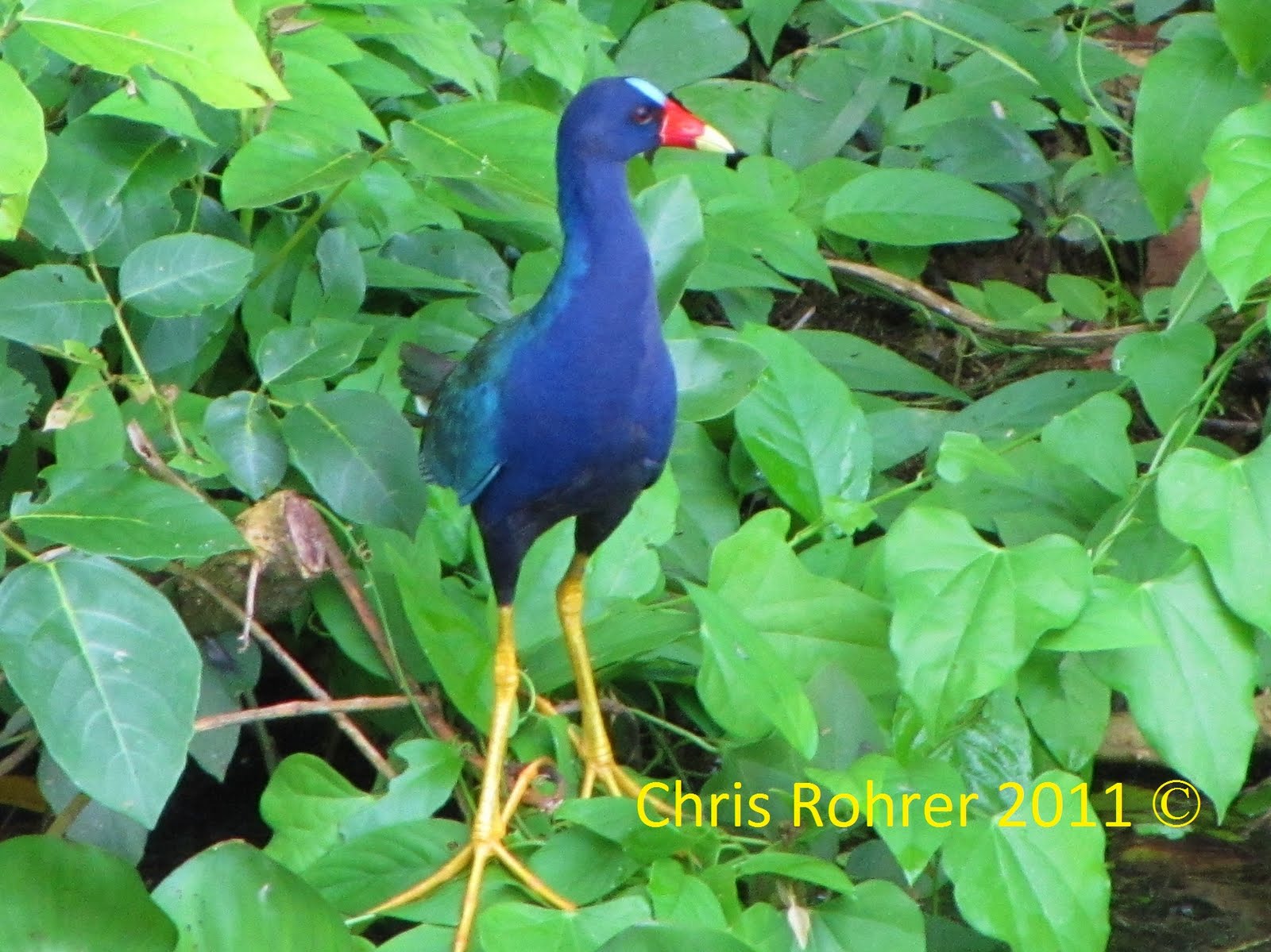
Purple Gallinule
While I haven't stepped fully out of the closet as a birder, I do have a greater appreciation for the society of people who worship the feather. What do they look like? Most are sophisticated types who stay at expensive hotels or bed and breakfast places.  They'll spend thousands of dollars for those precious early morning hours and canopy tours. There are a lot of skinny bird(er)s(because they walk a lot or just eat like birds?), but I've seen a couple fuller ones here and there(my kind of people).  A lot of them look like they watch Harry Potter movies.  I find many of them to be middle aged or older(like retired), but I saw several little hatchlings being trained on Pipeline which I thought was really cool. A lot of this stuff I just described about birders also applies to me in some ways...except the eat like a bird bit.  Some speak bird while others are imposters.  Apparently, a little bird told me that there is this birding "checklist".  Some will enjoy the full experience of the bird "checklist" by visiting the country and do more than just bird. Some are even clever enough to go on family vacations and plan activities in high birding areas...any free time that's available is spent birding.  I think that is a cool compromise.   But some mockingbirds imitate the real birders by pretending to care about the "checklist". They'll go to the places just to say they went and mark it off on their "checklist".  Apparently the "checklist" is like cock fighting and I'm pretty sure that's illegal.  I thought that was an interesting tidbit. Birders who foul their own nests.  Why go some place just to say you've been there?  That doesn't make sense! So as far as I'm concerned, you people get the biggest insult of all.....you get the bird!


Birders will sometimes deny that they are birders because they don't want people to think of them differently.  I met a man who said he liked birds "alright"....and yet he had bird guides and knew most of the birds in my pics! Suspicious. Why doesn't he come out already and just admit it? What a lame duck!  It's easy......"My name is John and I'm.....a birder." What a silly goose! I've discovered that from this trip, my camera shots focused on the wildlife instead of the places and people.  Why?  Look at the pic above and notice the grace and beauty that Mother Nature provides . She makes you stop often and marvel at her creations.

Black Vulture at Coiba Island
My personal favorites on this trip were the Kiskadees and Black Vultures.  The vultures were clumsy landers and they made me laugh. There always seemed to be concentrations of them on something interesting, but when I would go to look for a carcass or dead tourist, I wouldn't find anything. But whatever it was, it sure was dead as a duck before they got to it.

The Magnificent Frigatebird over the Pacific Ocean
My neck would cramp from looking up so much.  My hand would hurt from trying to keep the camera steady.  My eyes would ache from staring into the muted greens of the rain forest. My batteries would die right when I had needed them most....thankfully I had a bunch of fresh ones ready to use.  Traveller tip.  I already have written that it's important to buy a lot of batteries before arriving in the country of your destination.  Make sure you put them in a ziploc bag to prevent moisture from corroding them and you'll be as happy as a lark that you did!

American Oystercatcher on Isla Granitos de Oro
Sand flies bit me left and right as I sat on the beach staring at birds. But some shoots were comfortable.  We sat at a bar and drank mojitos near a river and saw lots of birds from our table. Drinking mojitos is like ducks to water for me. Photographer note.  Never hesitate to make that shot.  You never know if you'll be back in that same spot again or if you'll see your subject again.  When in doubt, make the shot.

Inmature Lance Tailed Manakin
My most precious and satisfying moment was from this pic above.  We were in drippy moist rain forest on Coiba island when our guide Javier spoke his bird magic.  They came to him.  It was a Snow White and the 7 Manakins moment. It helps to have the voice of a nightingale.

A baby Caracara on Coibita Island

I also found that birds were difficult to identify because there were 3 categories for some of the them.  There were the colorful males that contrasted, sometimes vastly, with their female counterparts.  And then there was a 3rd category....Inmature Males.  We knew they were out there, but in the bird community there is an actual category for them!!  Why don't we do this with people?:)  You can see that difference between my two lucky shots of the Lance Tailed Manakin.  The "mature" one is blue while the inmature is green. Both have a red cap however.

Inmature Bare Throated Tiger Heron
Another favorite shot for me.  This bird was my friend while we were on Coiba island.  He hopped for me in circles and it was quite comical.  I was thinking I should make a movie, "Dances With Herons."  A birder is probably reading this post right now thinking me a complete bird brain.  Well it's probably too late for that:)  I think this inmature Bare Throated Tiger Heron was trying to get its lunch to come out.  Warning! Some birders are known to be very literal and don't have a sense of humor.  Most of my jokes are lost on them and if they aren't, they sure don't know how to laugh at them. Of course this post is in fine feather, and I certainly don't mean to ruffle anyone's feathers:)


Yeah, Coiba was awesome.  I have a post coming up on this island.  I'm having difficulty with it right now because there are so many pics from this place. I'll have to get all my ducks in a row for this one.  Otherwise, I'll be facing an issue that we bloggers have and that is putting too many pics on one post which gives our readers a picture overload.  Not me.  I just put 5000 bird pics up on this post today.  Call me a hypocrite:)  Seriously,  I have so many DIFFERENT shots that require special writing.....and specifically for the garden and plant portion of my blog.  Coiba was a feast for the mind and body. Most of these bird pics come from either our Coiba or Gamboa visits.


Lance tailed Manakin on Coiba
If you've ever been in a rain forest, you've probably heard strange "space" like sounds.  These come from the bird known as the Oropendula.  It's also a strange looking bird....but I wouldn't call this bird an odd duck.


Montezuma Oropendula

Well since birders love having their birding "checklist" nearby, I'll mention several that I saw which I snapped pics of but didn't post because I thought  that those shots were "for the birds"....The Ringed Kingfisher, the Amazon Kingfisher, a Lineated Woodpecker, a Scarlet Macaw(can mostly be found on Coiba Island and in the Darien Gap), and a Common Blackhawk.


Snowy-bellied Hummingbird

So many birds and not enough time. It's absolutely incredible how many different kinds of birds are out there!

Keel Billed Toucan
This above pic is what I call cheating.  We were at a refuge center in Boquete and I snapped this pic.  Did I see one in the wild?  Yes.  I even snapped a pretty decent pic of the big guy near the Chagres River near Gamboa, but I like this above pic better.  The one I took in the wild can be seen on my video below.


Fiery Billed Aracari

I'd like to thank all the birders who took me under their wings and helped me put this post together.  A special thanks to Ivan and Javier from Panama for not only their insights but their incredible knowledge of birds.  You couldn't find a better guide than Javier for Coibas Island and better birding place to stay than Ivan's Bed and Breakfast in Gamboa.  Ivan has a lot of useful tips that will get you around the Gamboa, Pipeline Road and surrounding areas.  For you birders, a new edition has been published for birding in Panama.  The older one has better descriptions while this newer edition, The Birds of Panama, has a quicker and faster page turn while you're out in the field.  The pics are A LOT better than the old guide plus you have a map next to the pictures showing you where the birds are located.

The Yellow Headed Caracara in Gamboa

It's time for this bird to fly the coop!