Showing posts with label Isla Bastimentos. Show all posts

Monday, February 27, 2012

La Loma Jungle Lodge and Chocolate Farm

The Red Frog and symbol of this island
On a trip this past summer to Isla Bastimentos in the Bocas Del Toro region, we stayed at the amazing La Loma Jungle Lodge and Chocolate Farm for a little pampering before heading out to the turtle conservation program on the opposite end of the Bocas islands.
This was a very positive experience for us and we had a great 3 day stay here. A couple things to note.  It's really hot and humid in this region.  Luckily, we had a breeze up in our cabin overlooking the ocean. And there are several cabins located up a steep hill.  Watch your step and take your time going up hill with your luggage.  But we had help and people helped carry our luggage up on our way up the hill.  The staff, owners, and guest staff are really kind people.  The owners were back in Europe for vacation, but we had their replacements Karen and Steve who did an amazing job keeping us occupied around the island.  Steve is a retired landscaper who has a great knowledge of rain forest trees and plants.  Karen is a scifi/fantasy geek like I am and we spoke about Game of Thrones amongst other things.
Our cabin was beautiful, private, and open to the rain forest environment.  We were able to read and hang out in our hammock on breaks.  This is really a great getaway for newlyweds or families.  It's also an excellent place for birding.  Listen to this one.  So this birder guy brings his family.  He has to do all the family stuff like go to the beach, bla bla bla, but when they turned their backs, he had his binoculars out spying on the trillion and one birds.  Clever man:)
Our showers were open to the world and I have to say......I loved it:)
This is one nice bathroom.  I felt safe and welcome on this cozy little forested island.  The Bastimentos National Park is located there as well.
Mosquito nets keep the bugs out and I slept quite well on this lovely little vacation.
Imagine yourself on this hammock(hamoca) taking a break from caving or swimming.
If you love native cultures or the outdoors, you'll love this visit.  The mangroves here are spectacular.
And if you're a birder, check out these Oropendalas from my open bedroom.  Their calls are unique and pretty strange.  They sound like something from outer space.
If you like gardens or growing your own food, all of it is made on the farm!  The meals were delish!
You will also have some amazing guides take you around the National Park and island.  Here we toured the Chocolate farm and sampled the fruit.  But the pic above is the only one I have of us entering the cave hidden in the lush flora.  There were a lot of bats!:)
And there was this dog that followed us all over the island and he was our magical guardian.  Sometimes he'd come out of nowhere!  Expect to see caiman, sloths, a billion birds, jellyfish, lots and lots of frogs, and a lot of critters.
While it may seem pricey at about 100 buck a person per night, sometimes it's just the break you need while backpacking through the rain forest.  And who doesn't like freshly made chocolate?!!!  You get to see it being made right there!  If you're heading to Panama and want a nice cozy getaway, I highly recommend this posh visit.  And if you are interested more in going to Panama, just head on over to the month of August on this blog for lots of interesting tidbits and fun.  Check this place out:)  More soon....

Wednesday, November 30, 2011

The May Tree

I am wrapping up my tropics special for the year with a lot of little photo shoots I did on the side.  We spent the entire month of August in Panama and I didn't want to stray too long from the Tucson garden during my writing because the central theme is Tucson gardening.  I LOVE plants and it's my dream to learn as much as I can about them....even if they don't grow in Tucson.  Anytime we learn a new language, we tend to want to learn the slang expressions or words that stand out as funny.  Well the same goes for me when it comes to plants.  As we were heading to Isla Bastimentos, this tree stood out from the rest and caught my attention.  Known as the May Tree, it towers over the canopy of the rain forest appearing much like a broccoli sprout.
Caught in a rain storm, Steve, our host and landscape guru, gave me a book on tropical plants in the rain forest.  I hung out with candle light in my hammock as the rain just poured down.....and read.....and read.  So many trees.  So much biodiversity.  A rain forest can look the same because a lot of the leaves are similiar on trees as are the roots and bark.  My tropic friends are probably saying, "No no.  They don't look the same at all!"  And I understand your meaning.  If you came to the desert, you'd probably look at the cacti and think they were the same plant.....especially the Opuntia varieties!  It is my goal on trips to educate myself on different plants in different areas.  Here's what's really embarrassing.  I know NOTHING....ZILCH!!! about the plants that grow in my hometown of Two Rivers.  I can recognize a Maple tree but that's about it.  In college, my friends had to identify the 101 different pine trees in the forests and I thought....how boring!.  Yet today, I see the value in the activity.  I really know my desert plants and trees, but if I leave the area, it's like a whole new world!  So back to the tropics....
It's interesting to note that if you research a plant online, very little can sometimes be found.  Yet at the same time, there are so many resources out there for birders.  And for buttefly enthusiasts, it's hit or miss depending on the region you are visiting.  The May Tree, or what they call it on Isla Bastimentos and in the tropical trees book that I had been reading, has it listed as such because the tree generally flowers around the month of May into June.  However, while typing the name in both Spanish and English, I found nothing about this tree.  Could it be a nickname given to the tree for this area? Or is there another name out there? Either way, it's a beautiful tree.

Monday, November 28, 2011

Breadfruit

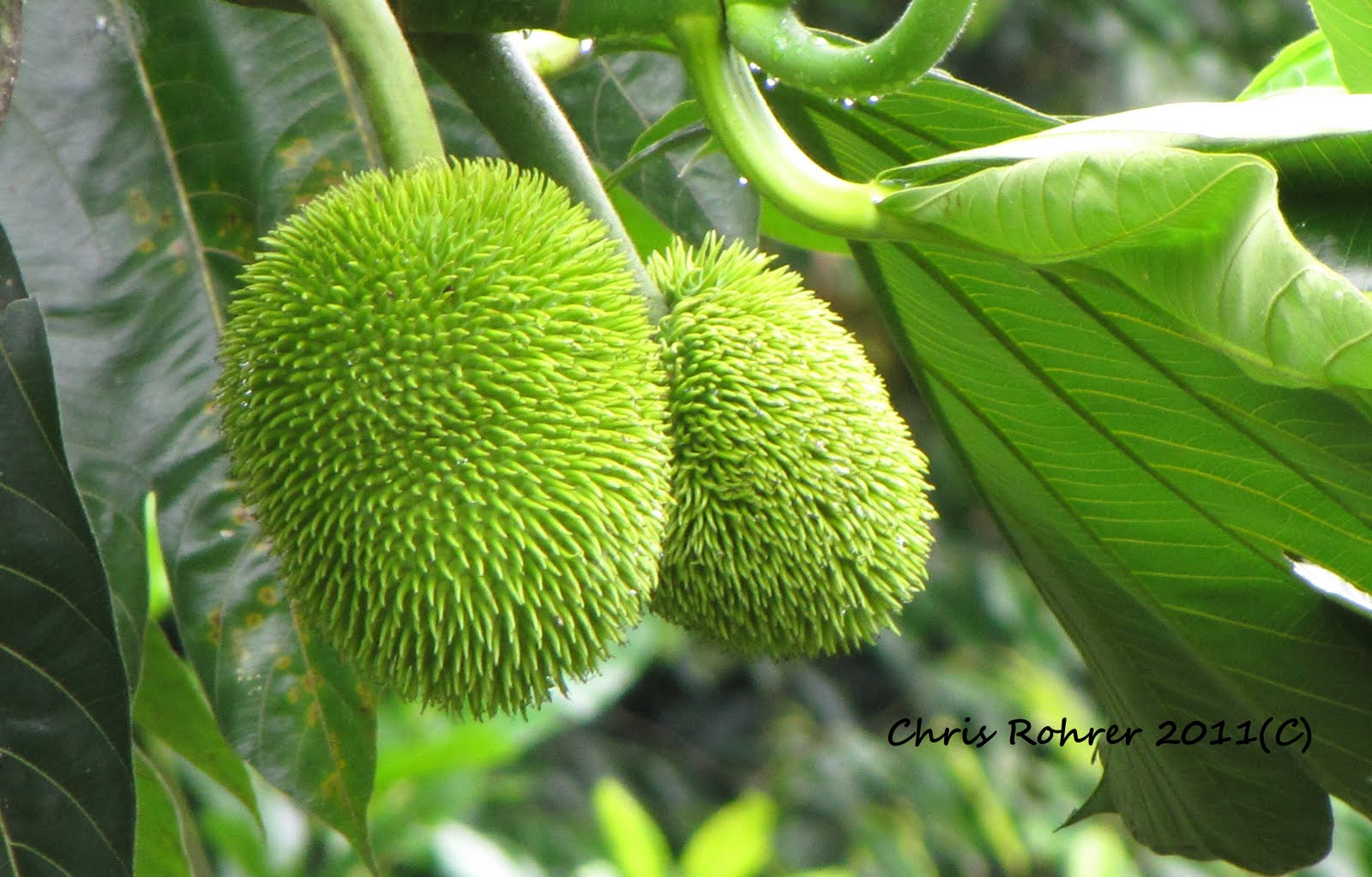
As I'm finishing up posts on the tropics, I thought I would mention several plants that caught my eye on these trips.  The first one is the breadfruit which I encountered in Panama this summer in the Bocas del Toro and Coiba region.  It was so odd looking and therefore caught my attention.  This fruit is known as breadfruit(Artocarpus altilis) and here's what I learned. 

It's from the mulberry family, Moraceae, and grows as a tree.....and a very large one at that! Its name is derived from the texture of the cooked fruit, which has a potato-like flavor, similar to fresh-baked bread.  A lot people report enjoying the flavor but state it doesn't have the typical sweet taste associated with fruits.  I had wanted to try this, but unfortuneatly it didn't happen.  These trees can grow to a height of 85 feet and indeed, they were very tall.  I found many of them growing near a water source and bending in a curve.
The leaves are gorgeous on this plant and make quite the statement in the tropical garden.  This tree can produce a yield of around 200 fruits per season.  I loved the look, but more importantly I am curious as to how they taste.  Perhaps someday I'll get a chance to do so:)  I have another plant coming up from the tropics that I thought was interesting in the next day or so.  More tomorrow....

Wednesday, August 31, 2011

There and Back Again


So we've come to the end of our journey in Panama.  I hope you enjoyed the series of posts on the various themes over this past month. It was enjoyable for me to write on all these amazing things that I was able to witness in person.  As a teacher and my own student, I learn best by experiential learning.  No classroom can prepare you for the sights and sounds of a moment.  Of course, there is a lot more to write about in the garden and we'll take a break for a bit from the series and look into some helpful gardening ideas for your own home.  Plus I also have to do some record keeping from El Presidio for myself and also keep the homeowners up-to-date on what's going on around the property.  This last post was written in Gamboa where we began and ended our journey in Panama.  It's dated July 5th, 2011 on a Saturday night which was warm and tropical.  Night sounds abound from frogs, insects, and other nocturnal critters. I am in my bed reflecting on my personal journey and connecting with the people who are no longer with me. In the beginning, I had written about how personal Gamboa was for me.....well, here's the letter that I wrote.  Finally, I put one last video together for this series and I think it's my best one yet which highlights all the things we did in Panama.

"Dear Grandma and Grandpa Rohrer,

     My final days have arrived here in Panama.  This trip has been quite simply wonderful, but now it's time to end this journey.  As you know, we began our trek in Gamboa at a place called Ivans.  I didn't know why I wanted to end our trip here at first, but I think I've only now figured out why it was important for me to return. Everything about this place reminds me of you both and it makes me happy.  I'm a child again spending the weekends at your house.  The home even smells like your place and makes me wrap myself up even tighter into my blankets.  Walking around this ghost town was like playing in your magic garden in the far backyard near the creek The one that no longer exists.  The totem pole and grapevine covered trellis that invited us all into your garden is now gone....replaced with a concrete road.  When I go back to visit your home, it seems that almost all of my childhood and your green art have been erased from existance.  The apple tree.  The pear tree. The garden.  Only a stubborn patch of rhubarb still pops up to remind me where you both spent your days.
     The bing cherry ice cream is fresh here and melts just like it used to on our road trips to the Penguin during our many little adventures in that green car. Cones cost 50 cents here! You remember those trips, right? The ones where the waitress would rollerskate up to our car window and take our order. Do you remember Grandpa when I asked you what flavor I should try because there were too many to choose from?  What the heck was blue moon anyway? But you told me that I should try the bing cherry and it became one of my favorites.  I had bing cherry ice cream again in Panama and I remembered.
     Even this house has your touch wth the bird feeder, the home cooked meals, the wooden slated closets, and photos of plants and birds.  I walked the neighborhood tonight along the rain forest paths seeing the old old homes that were falling apart....remembering our walks together Grandma. Many of those homes in Manitowoc still look the same and need some fixing up.  I walked along the canal full of ships just like we did on Lake Michigan, but instead of seagulls, there were parakeets and toucans. It doesn't seem like a long time ago, but time has definitely passed.....and so have you both. Sometimes I wish I could rewind time for just a day to have one more conversation....one more walk.....one more scolding about fighting with my sister......one more lunch listening to WOMT radio at noon. As we eat lunch,  both of you are watching the bird feeder and getting angry at that damned squirrel.  Grandpa, you run outside and chase it off so you can see more finches. "Get out of here!!!  Get out of here!!!" I'd start laughing because you both looked so funny screaming at Mr. Squirrel.  Of course, when you weren't looking, he'd be back again.:)
     In fact, everything about Gamboa has reminded me of the simpler times.....the happy times......the best times. It's during this stay that I'm reminded how much I miss your presence in my life.  When I see potted geraniums, I think of your basement in winter where you protected your babies from the freezing temps. In summer, you would take a seemingly dead plant and bring it back to life. When I see cargo ships on the canal, I think of your work Grandpa at the Burger shipyards.  When I see the old Catholic church crumbling at the corner, I'm reminded of our Sunday mornings together......and the breakfasts afterward! Does your church even exist anymore like the one here on the corner? I walk through the bamboo groves along the Chagres river and it's like walking with you Grandma through those reeds by the little creek. That is gone as well. This city is trapped in the past.  Being here makes me think about what it was like growing up in the early 1900's for you both.  The canal was getting ready to open while you both grew up on gravel roads before cars became popular. Horses were still the main means of transportation. Malaria and yellow fever claimed many lives in Panama.  Back home it was Scarlet fever. How old were you Grandma when you lost both of your parents?  13? 14?  I can't imagine any of it.  But they were different times.  So much has changed in a century.
     As I watched the capybara playing in the fields today, I sipped my cool and sweaty glass of mojito.  I try to absorb as much as I can before I leave Panama and this magical town of Gamboa.  How many years has it been since my last stayover? 20? 30?  How is it that here in Gamboa I stumbled upon your presence?  Tonight my thoughts turn to you both as I get ready for some sleep. 

Love you much,

Your grandson"

End of paper journal.  Check out the video from our Panama Adventures.  Until tomorrow friends....

Monday, August 22, 2011

The Red Frog

Endemic. Unique. One of a kind. Only found in one area.  One island.  Today we're going to the area known as Bocas Del Toro!  But specifically to the island known as Bastimentos.  I'll write about this island tomorrow, but today it's all about the red frog!
The province of Bocas Del Toro has several large and many smaller islands that are surrounded by the Caribbean waters.  It is one of the top areas for tourists, naturalists, and the indigenous communities of the Ngöbe-Buglé.  And guess what?  The Smithsonian also has a research station on one of their own islands studying these amphibians:)
These little guys were all over the place chirping and hopping on trees, rocks, and hanging out in bromeliads where they were laying eggs or fertilizing them.  It was really amazing to see so many frogs around one area.  This strawberry red frog is endemic to Bastimentos.  In fact each of the islands in the archipelago of Bocas Del Toro has its own colored frog which ranges from a gold color, blue color, red body with blue legs, etc.  You see, on Bastimentos, the red frog is symbolic.  There is even a beach with the name Red Frog where drunk people and surfers reside.  Before you cross the bridge onto this beach, you'll find several local kids with red frogs in their hands.  Traveller tip from Rohrer.  Do not encourage these kids to do this.  They will show you the frog and then expect you to pay them a quarter.  Many times these kids will remove the frogs from their natural area, and being that they(the males) are extremely territorial, will have a difficult time readjusting to being released somewhere else.....if they even survive with all the handling that they have to endure all day long.  Please don't encourage this behavior if you go and visit.  PLUS Red Frog Beach is a tourist trap unless you are going there to surf.  Luckily we weren't on that part of the island...just passing through:)  For a frog that is supposedly toxic, you have to wonder:)
Red poison-dart frog (Dendrobates pumilio)
 In Arizona, we have several frogs and toads, but it's not everyday you get to see them.  All we had to do is step out of our cabin and within a few steps, there would be several hopping around.  It is my hope that this island takes better care of itself as tourism has carelessly carved a chunk of land from the pristine rain forest that still covers most of it.  The recession put an end to the construction happening at the resort leaving only a few homes near the Red Frog Beach instead of several hundred as had been originally planned.
The Bastimentos color morph of Dendrobates pumilio or "Bastis" typically comes in three morphs, being either red, yellow, or white, with black spots on the back and legs. They are all found together on Isla Bastimentos in Panama, and have been reported to be true breeding to a certain degree, despite the ease of mixing with varieties.  The most important part is that they have the plants to lay their eggs.  Bromeliads found around the rain forest all contained at least one of these beautiful red frogs.
                                 
They eat smaller anthropods like formicine ants and other tiny insects. If you head to Bastimentos or other islands in the Bocas del Toro province, keep your eyes open for these colorful gems.  Below is a video I snapped from a trail.  More on Bastimentos tomorrow....

Sunday, August 21, 2011

Los Manglares


I'm sorry.  I just had to use the Spanish word for mangroves...."Los Manglares".  It's fun for me to say over and over.  Let's just say this word is one of my favorites from my list of Spanish words that are much more interesting than their English counterparts:)  Say these words...."pantuflas"(pahn-two-flas) or "bufandas"(boo-fa-n-daas).  You see?  It's much more fun than saying "slippers" or "scarves".  Well, if you haven't guessed by the title today, it's all about mangroves.  This very important plant was all around us during our visits to the national park system of Panama.  In fact, today's post begins our journeys to the Bocas del Toro region in the Caribbean. Specifically, we focused our energy on the confused island of Bastimentos.  I'll write more about this place later.  Today, we're going to explore the importance of mangroves and the difference between white and red mangroves. 
I knew I was in a grove of mangroves the minute I saw the murky and smelly waters.  Consider them a natural barrier to protect land from storms and hurricanes.  Without them, beaches wash away and precious marine life disappears with it.  With mangroves around, the world's endangered coral reefs flourish and our inlands are a much safer place.  PLUS the groves harbor diverse populations of mammals, birds, crabs, fish, reptiles, amphibians, and insects!  These areas are rich in nutrients and provide a lifeline to our Mother Earth. Today, they are threatened by development and pollution.   "Mangrove foliage, however, has declined by nearly half over the past several decades because of increasing coastal development and damage to its habitat. As the habitat has changed, ever-smaller quantities of mangrove-derived detritus are available for formation and export of dissolved organic matter to the ocean. The researchers speculate that the rapid decline in mangrove extent threatens the delicate balance and may eventually shut off the important link between the land and ocean, with potential consequences for atmospheric composition and climate." Source: http://www.sciencedaily.com/releases/2006/02/060227123154.htm Ahh, but who cares?  Let's build that comfortable hotel with its' a/c and wireless options.  It won't be us who suffers the consequences, but our children and grandchildren.  By that time, it should be quite the show.  People fighting over limited resources because the world population kept increasing......the sins of our father(and mothers) indeed.  Maybe I should cut back on my pinot noir:)  Such talk of doom and gloom!

I loved all the crabs running around the mangroves.  Many of them hung out in the soil and on the actual mangrove roots.
"Direct Human Importance

In addition to benefiting the natural ecosystems of the surrounding area, mangroves are also extremely important to human communities as well. Traditionally, they have been sustainably used for food production, medicines, fuel wood, and construction materials. Many indigenous coastal residents rely on mangroves to sustain their traditional cultures. In this way, the mangroves' ability to act as habitat to many possible food sources, as well as it's ability to remain stable while growing tall and strong, are very important to human communities as well. In addition to this, mangrove forests also act as a buffer zone between the open ocean and the land. This not only protects the shores from damage, but also its many inhabitants-including humans. Mangroves protect the coastal land areas from life threatening erosion and siltation problems, preventing a great deal of property damage and sometimes even human death. Finally, the mangroves' ability to treat effluent, discussed above, is also very important for the local communities. Most of the substances that the mangroves treat are human made. Thus, the mangroves are acting as a filter system for the local communities, keeping their ocean waters free of pollution and thus their fish and other food sources free of contaminants. All of these "eco-services" that the mangroves provide, free of charge to the local communities, have a tremendous economic value for all who are dependent on them. Unfortunately, although the hardy mangroves have withstood fierce storms and heavy winds for thousands of years, they are now being devastated by human business and industry." Source:  http://serendip.brynmawr.edu/biology/b103/f00/web3/hayesconroyj3.html
 So what's my personal opinion about all of this?  The mangroves are very important.  I see how they tie both the ocean and mainland together.  Without these buffers, the rough waves would destroy the calm dark and smelly waters which are natural nurseries for baby fish, jellyfish, caiman, crabs, and many other animals.  It would be a tragedy to lose these magnificent groves.  The destruction of these plant barriers would kill Panama's coral reefs.  As the Amazon rainforest is to our Earth's atmosphere; coral reefs are to our world's ocean ecosystem.  I'd hate to think of the consequences.
So what was it like floating through mangrove forest?  It was peaceful. There were bugs and lots of them.  On Coiba, we saw so many birds and crocodiles.  In Bocas del Toro, we saw a slew of sloths, crabs, and jellyfish.  The waters were full of secretive caiman.  On this particular "river", it was fun to watch the transformation from where salt water and fresh water met.  Once the salt water disappeared, the mangrove section would vanish and be replaced with palms and ferns.  So what kinds of mangroves are there?  During our boat ride, we saw two varieties....the white mangrove and the red mangrove.  There are 3 species of mangrove which also includes the black, but we never saw that particular variety during our visit.

The Red Mangrove
-live in deepest salt-water of the three, going from a few inches to over a foot deep.
-have large prop-roots, often times called "walking roots", with thick lenticels for gas exchange.
-named "red" because they produce chemicals called tannins that turn the water and mud a rusty color.
-leaves are broadly-elliptical and the largest of the three (about 3 to 5 inches long).
-viviparous propagules can survive in salt water for over a year.
Plainly written.....the roots look like they are "walking" in the water.

The White Mangrove
-live farthest away from the water of the three, just above the water level
-sometimes have pneumatophores but they are usually less common. When pneumatophores are present they are usually less prominent than on the black.
-named "white" because of the whitish appearance of the bark.
-leaves are rounded elliptical, have two small glands at leaf base, and are more-yellow green in color.
-viviparous propagules can survive in salt water for at least 1 month. Basicially, the roots come up from the soil instead of "walking" in the water.

There you have it.  Magical and fun.  Mangroves are a definite MUST SEE on a trip to the wild.  Tomorrow,  begins the first write of Bocas Del Toro!