Hello fellow bloggers,
Today's post is one of those fun ones. I should be in the garden more...and I am....but on my off time from work, etc., I find myself exploring the little nooks and crannies of Arizona and it's fun. Today is another visit to the Ostrich Ranch, but I'll be exploring the interesting world of parrots. You saw these guys last time on a post titled "Splash" last week. I have a lot of experience with them and for some reason, they are attracted to me anywhere I go.
My family has never raised Lorikeets before so it was interesting to watch them hop and fly around.....and they also had some fun playtime while we were there. They come from the Australian region and colonies can be found all over the New Zealand, Australian and Polynesian islands. So I guess it makes sense to have a Forest of Lorikeets on an Ostrich ranch.

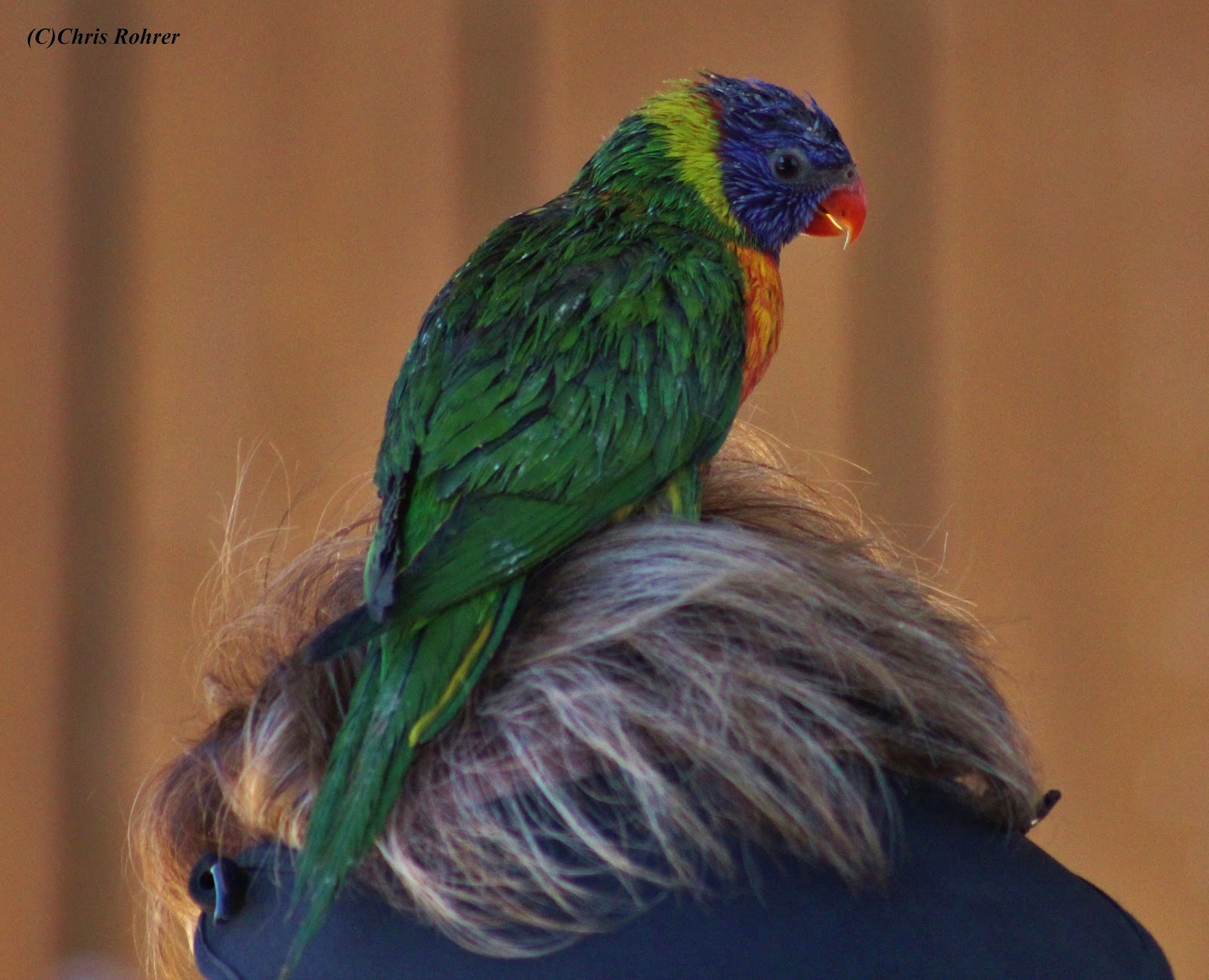
My focus today is how to handle a parrot if one approaches you:) I am very relaxed around most birds and they can sense that emotion. I walked into the caged area and I had them all over me. A young girl asked me if I worked there. I laughed and told her no. She then asked, "Why do you have so many all over you?" I told her to stay still and freeze(because kids like to chase:). Right after I said that, she froze and one landed on her head:) And then the kid was worried about it pooping on her. Ahhhh.....the poop. Everyone wants a parrot on their shoulder but they don't want the nasty stuff on their clothes. But it all comes with the territory:)

Now those of you who have parrots/parakeets may have your birds trained to not "do the deed" on your shoulders or hair, but if this isn't the case, I find that having them on your hand and moving them away from your body will teach them to poo off body:) But as with everything, it does take time and patience. The good thing is that this group of birds is really smart.
Watch your jewelry, buttons on shirts or glasses. They love this stuff and will pick or bite them off with their beaks:) Personally I love when they go to your ear and "whisper secrets". It tickles a bit.
And I'd like to remind my blogger friends that I'm not one for caging birds at all. If you do have birds, a large cage like the one I was in is really ideal. They had A LOT of space to fly. There were trees for them to play on as well as the bird houses to nest. When I lived at home, I'd train our Quaker and Lovebirds to escape their jails. My siblings and parents would get irritated that I did that but sometimes they just wanted to get out and say, "Hi." Of course when the bigger birds did it, everyone cleared the room because they inflicted bodily harm:)

I remember one time taking a nap on the couch and our green Quaker opened up his cage and walked on the floor over to where I was "sleeping". Now I knew he was coming, but I pretended to sleep and see what he would do. He crept up onto the couch and walked onto my chest. Chuckie then moved over to my face and proceeded on playing with my ears and nibbling on my hair. When I woke up, he began to giggle and whisper, "Chuckie." and then start laughing. We taught him his name and he was quite the lover. He's still alive and kicking by the way. Yeah, they live a long time! Think of your wills. On a trip to Panama this summer, I was reminded that some zoos or refuges take in birds that are not wanted by the surviving family members. I also had this discussion with my parents:)
 |
| Several birds were flying my way!:) |
Another point I want to make about parrots....especially the big ones like Macaws or African Greys. If they feel like they're going to fall or your hand is not steady, they will grab onto you with their beak or sharp feet. Provide a strong support when extending your arm or be prepared for bite marks, scratches or blood:)

But this is why I'll never keep birds as pets. They need to fly. They need social interaction. Most people are so busy that they don't have enough time for their birds. And they'll outlive us which is not fair at all to them. This is just my humble opinion but birds make strong connections either with another bird or the bird owner. We all die and when we do, many birds go through a deep depression. They will pick their feathers or simply not want to be with another owner again. We've rescued many birds because people die all the time and their kids didn't want them at all. My mother being in the pet industry usually seems to be the contact person for relocating larger birds to new homes. In fact, today my mother has an African Grey because of situations like these.

One other item I'd like to bring up. Here in Arizona(and elsewhere), it is vital that you make sure you know where you are getting your bird from! Please verify where the bird came from and only adopt from trusted sources. On my travels to Central America and the Amazon, I have witnessed bird populations decimated due to poaching which is creating mass extinction of these birds in their areas. I remember watching my mother raise parrots from eggs. It's quite the operation:)
Also be aware that some states like California will check your vehicles and body search you for the dreaded Quaker that has escaped into their enviroment. This bird has been introduced to many parts of the country and has done well:) I remember my trip from Arizona to California when I did my big move. We were stopped and I had my Peach Faced Lovebird with me. It was no joke, but my Dad and I giggled a bit. They'd love our Quakers:)
Years later, the Peach Faced Lovebird would become a new addition to Arizona's birding list. Apparently many of them escaped and created colonies around Phoenix and several bodies of water in the area. The Peach-faced Lovebird is a very pretty small parrot native to South-western Africa. Like many caged birds, accidental releases in urban areas are common. Unlike most accidental releases, this parrot has the potential to rapidly adapt to desert habitats in Arizona. Who knew?!!
 |
| Playtime:) |
So that's my commentary and opinion:) Parrots are fun birds to observe in the wild. Best chances to see them? Well, like most things, it's usually bright and early. You'll probably need to get on a boat and cross a river or two:) Or maybe the ocean. Listen. Because they are loud critters. People would always say my house sounded like the Amazon. Then I went to the Amazon and found out why! More tomorrow....


 Posts
Posts