

 Posts
Posts


 |
| Black Rosy-Finch |
 |
| Good people working together to help enrich the lives of young people. It's never easy keeping a smile but break gives us that much needed downtime to recharge our batteries. |
 |
| a wintering Greater Pewee in Reid Park continues |

The USS Betty White made her maiden voyage up to the northern boundaries of the state just outside of the North Rim of the Grand Canyon to search for 2 new Arizona birds, the Black and Gray-crowned Rosy-Finches. It was a 2-for-one journey with friends Gordon Karre and Barb Meding.
 |
| Just part of one of the flocks that zipped up and down. They reminded us of our wintering lonspurs in the grasslands |
 |
| A birder has to be careful observing birds. With this location, I had a little vertigo. The hillside was quite steep! |
 |
| The very tricky Gray-crowned Rosy-Finch was a skulker for us and did not like to pose on the ground for the camera so I had to catch it in flight. Fish or bird? You tell me. |
 |
| A nice side-by-side comparison of the two species. They are similar and were tricky to pick apart. |

There were 2 large flocks that would rotate in and out of the area we were standing. I think we got to observe both flocks twice with a 5 minute interval between their visits. I'd move once they flew to a new spot to get different angles of the birds.
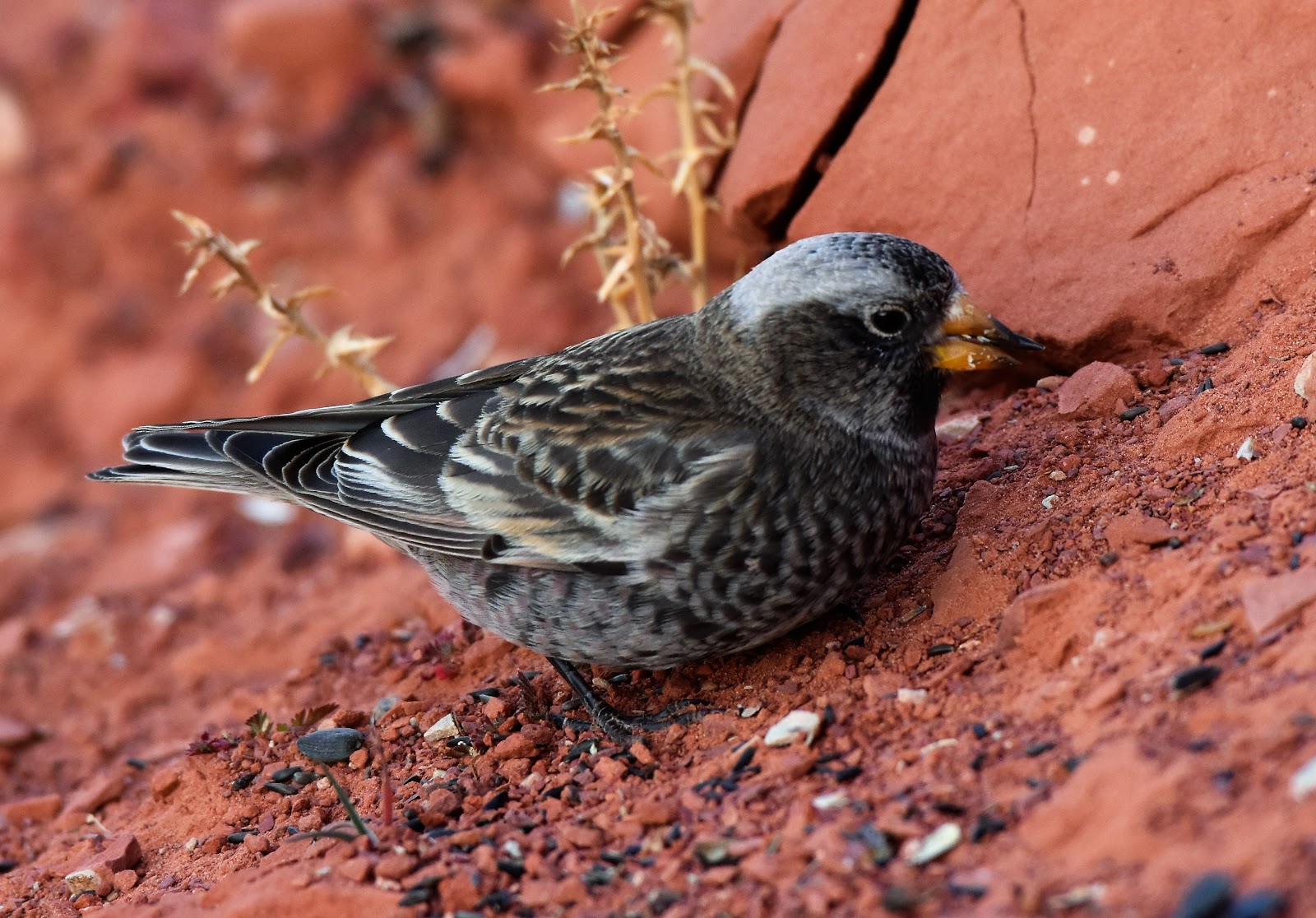
They feed from the Russian Thistle on the hillsides. But to keep these beautiful birds there for birders to observe, people are continually throwing oilseed sunflower seeds to keep them around a little longer. These birds love cliffs and as you can imagine, they can make it difficult for birders to get a good view. So we employ our own tactics that keep them around a little longer.

What a thrill to see these birds up close! My first time was also with Gordon during our Sandia Crest journey to New Mexico. In fact, that's where most people go to see all three species. While we are in the southern most range for Black Rosy-Finches, they are not commonly seen like this for birders. There's usually a once-a-year sighting by a couple birders. However, a Gray-crowned Rosy-Finch is RARE! Their range is the largest of all the Rosy-Finches but it doesn't dip quite down into AZ. However, they are suspected to enter the state in areas that are difficult to reach for birders. With that said, there are a few historical records including one from 2013 in a remote area of the state. The area we visited was much more accessible!

After we had that amazing observation, we went for the California Condors of Marble Canyon on the Navajo Bridge. I wanted to see the rare wild born California Condor in the area! There was a Condor volunteer there monitoring the four birds in the canyon. With his scope, he pointed it in the direction of the wild born bird and I was super excited! It made me so happy. I love condors. Their location is also quite beautiful. And seeing a wild born one on the cliffs and not from a zoo gives me hope. As long as hunters use lead bullets, these birds will have to be monitored for lead poisoning. Hunting for food is fine, but it's gross to think of lead in your own food. Why not use copper bullets if you like to kill things for pleasure? The Condors eat the lead filled carcasses left behind by the hunters. There are 3 major threats to Condors. 1. Lead poisoning 2. Golden Eagles/Coyotes 3. Telephone Wires

Then, in a random twist for our trek back home, we took a ride to Winslow, Arizona where we had to take it easy.

The USS Betty White promises many more treks. Our next trek will take us into California but until then, I wish everyone a wonderful holiday season. Until next time!


