Showing posts with label Botteri's Sparrow. Show all posts

Wednesday, August 16, 2017

The Grassland Road


Several months ago I began working with Luke Safford to guide a trip with Tucson Audubon and their wonderful Southeast Birding Festival. I got to pick the place and how we birded.  So I had to choose.  My favorite places to bird in August are the grasslands, Mt. Lemmon and Willcox Lake. So I chose my absolute favorite, Las Cienagas Grasslands. 

Botteri's Sparrow
 It was a bit scary but Luke was very helpful and gave me all the tools I needed to tailor this trek for our guests.  I needed a driver.  Done.  I wanted another guide with me.  Done.  Before I knew it, our trip to the grasslands was booked!  Twenty hopeful birders got into our two vans and placed their life lists in our hands!  The thing about the grasslands is that I feel very connected to the birds here. I knew our guests would fall in love with the landscape.  And they'd soon fall in love with our sparrows.......even if they didn't think they would:) 


In fact, as an educator, I feel it important to bird areas that have the most activity.  During this time of year, the grassland birds are extremely vocal and easily seen.  Our friends had no problem spotting birds.  But my goal?  Teaching them the calls and sounds of our grassland birds.  And by the bird gods did they learn them!  I had goosebumps listening to the birders pick out the sounds while ID'ing the birds on their own.  


To make things even better?  First class personality and professional bird guide, Chris Benesh joined the party. He is a relaxed and funny guy who helped take the stress out of this trip with our 20 guests. I'm not used to leading a group with so many people!


The weekend before the festival, I went with Magill Weber and we birded the area for my target birds that I wanted to present to the group.  On our list, I had put down birds like the Thick-billed Kingbird, Cassin's, Grasshopper and Botteri's Sparrows, Eastern Meadowlarks and the Cassin's and Western Kingbirds.  BUT.....to make something truly special....I mean.....really really special.....I feel that there needs to be more than just birds.  


And the Cienagas Grasslands have it all.  There is history.  There are birds.  There is epic landscape dotted with colorful wildflowers.  And there are Pronghorn. I feel at peace here. 


I think this trip was one of the cheapest of the tours.  And it was the one that made a lasting impression on everyone.  We saw coyotes, pronghorn and prairie dogs.  Speaking of Prairie Dogs....

Mojave Rattlesnake during our scouting mission
 We were running behind schedule and I was worried we wouldn't make all of our stops because we were enjoying the morning.  So I had scheduled a stop at the Prairie Dog settlement on the tour.  I wasn't sure if the group wanted to go and see more mammals but thankfully several participants spoke up and said that they wanted to see the furry little critters.  So we went.....

Cassin's Sparrow
 Cassin's Sparrows were EVERYWHERE!  This is a specialty bird here in Southern Arizona during our monsoon season.  They are very vocal and the last of the sparrows to breed for the summer.  And they can breed many times during a nice wet monsoon season.  This year has been another exceptional year for this grassland species. 


We arrived at the Prairie Dog settlement. I was looking for Burrowing Owls.  They were looking at the dogs.  


Juveniles played.  Adults fed.  And an Australian couple was more interested in a strange bird out in the field. Chris was helping other birders ID certain critters. I was helping a birder ID a Western Kingbird in flight when Willy and Jess asked me about the weird looking bird.  Thinking regular resident birds, I asked them if it was a Killdeer.  They told me "no".  It was too big.  Ok.  How about a Long-billed Curlew?  Hesitation.  Then Willy said he was pretty sure it wasn't a curlew. That got my attention. 

Black-tailed Prairie Dog
 I left the lady after she had ID'd her Western Kingbird. I joined the group who were all now looking at this strange bird.  What happened afterwards was funny and awesome at the same time.  Both Chris and myself put our binos up on the bird and excitedly told the group that we had a mega rare bird!  The Upland Sandpiper!


Everyone became serious.  Photographers grabbed their cameras.  Never in my life had I expected to see an Upland Sandpiper in Arizona!  The birders got excited and their cameras began snapping off shots left and right.  


I think I almost wet my pants.  It wasn't a lifer for me but it was an excellent state bird! No scope was needed and everyone got to see the bird well.  It doesn't get better than this in the epic world of birding. 


Upland Sandpiper
Chris immediately called the Andrew Core hotline(the AZ rare bird alert contact) and I went to the Arizona Rare Bird page on Facebook to post our findings. During that morning, other birders would visit our very special find and be able to count it on their lists.  That night a huge storm blew into the area and the Upland Sandpiper disappeared.  


 What a very special weekend we all had!  One of the participants said that when we got quiet during our initial ID, they knew we had a special bird.  They were excited for us as well!  There's nothing quite like the adrenaline rush of finding something new.  


 I lead a tour the next day to Madera Canyon.  We found some excellent birds and it was fun watching people get excited about adding lifers to their lists.  And it was fun leading them.  Even better?  Raising money for a good cause!  I will continue to help support Tucson Audubon for as long as I can.  They do a great job protecting our areas around the state.  It gives me great pride to hear people say the words, "Wow! This is so beautiful!"  A lot of the money raised helps protect these amazing wildlife sanctuaries of our state. 


My life is different now.  My birding style has changed.  I feel absolute joy watching others discovering our birds for the first time. Just look at the intensity above as they discover their first Painted Redstart.  I want to send a shout out to Luke Safford for helping me put this trek together and to Hollie Faulkner Mansfield for her amazing driving skills.  She seriously has a talent for taking the roads slow so that I could listen for birds.  And also to Chris Benesh for joining the trek. What an honor! I don't know how you do it as a full time job but I do know why you do it.  I was exhausted after a busy weekend out.  Eventually I'll get to the Costa Rican posts, but I am off this weekend to help out with the Jaguar cams and bird surveys down in Mexico.  It will be my final trek down to this particular site so I am a little sad about it all.  I'll have that report next week.  Here are the ebird reports from our trek out to the Cienagas Grasslands. 
For the Cienagas Grasslands, click here
For the Prairie Dog Colony, click here

Until next time.....


Tuesday, August 23, 2016

A Future To Believe In Part 2


I remember looking up into the broken sunlight of the leafy ceiling. Birds flew from one branch to another. Just shadows really. In the grasses, he pointed to a hidden deer skull. Everyone in my 2nd grade class was in awe. 


Botteri's Sparrow-lifer for Bernie
He continued to lead us into the woods pointing out a beautiful Cedar Waxwing and American Robin.  Bernie reminded us to walk quietly.  We did our best. For most of the time. I mean...we were still kids after all:)

The darker Grasshopper Sparrow of the West
Later in life, I joined yet another nature walk with Bernie.  I was now in 7th grade.  We were looking for owls.  Their hidden locations were revealed as we watched them silently sleep on their perches. For many of us, it was our first wild owl we had ever seen!

One of the many deer I saw this summer at the Woodland Dunes
By now, I knew these woods well.  We played along a creek that once ran freely into the Dunes. I hid in the forests with my friends and built secret fortresses.  We also snuck out of our homes before the parents noticed that we hadn't done the chores. No one could find us if they tried.  It was our secret hiding place.


Eventually they cut down our secret forest and covered the creek with dirt and ugly factories. Angered adults and kids watched helplessly as the chainsaws shredded the trees to the ground. Today, those same factories that destroyed our natural playland sit empty because the work has since gone elsewhere. They had also tried to cut down the Woodland Dunes many years ago, but a few stood firm and protected this sacred area. Bernie lead the grassroot efforts to keep it free from "progress".  Many locals didn't get it. land=work=$$.  Oh if they could have seen their futures.  Today, nothing is left of the city I once knew.  The city continues to shrink and locals struggle to find work.  It is a shadow of what it used to be.  But the one thing that still attracts people from all over?  Our beautiful coastline and forests. And I gotta say.  The birding in Manitowoc County is pretty awesome.

Horned Lark
Later on in life, I returned back to the Dunes as a birder and an adult. Now I could truly understand the scope of what Bernie had set out to do. He was still there banding owls and educating us, the public. But it wouldn't be for long. Now, he was training others to do what he had done for decades.  It only took me a couple decades to catch up with Bernie and understand why the Woodland Dunes had been so important.  A few people knew early on, like Bernie, that the Woodland Dunes was an important wildlife area that needed to be protected for migrating birds, nesting songbirds, etc.  I have very few regrets in life, but there are times as a kid when I wish I would have spent more time and attention to the people and the important work they were doing. 


He was still the kind person I remembered as a kid. I watched him handle the owls with ease as he taught others the proper way to band them. 


After listening to his stories about banding birds, I realized that there is still so much I don't know. He even banded the trickier ones like Chimney Swifts! 

Bernie's Hermit Warbler
And now it was my turn to help this wonderful man out.  It was an honor and privilege to aide him in the discovery of our birds here in Southern Arizona.  We found Bernie's last warbler for the US and North America. Afterwards, we headed to the grasslands where we were able to watch a herd of pronghorns casually stroll through the verdant hills.


He gave me his "needs" list and I smiled.  While I love birding in the mountains, my favorite habitat to bird is in the grasslands.  And he needed quite a few of the grassland birds!  We had beautiful views of his lifer Botteri's and Cassin's Sparrows.  He discovered Cassin's and Thick-billed Kingbirds. And of course, the Hermit Warbler. 5 lifebirds!


Time is precious.  And although I only had a day to bird with Bernie and his son Jeff, I was so happy to do so.  It's the least I could do for a man who has done so much for us.  Thank you Bernie for your life long work.  Thank you for keeping areas like the Woodland Dunes safe from development. I don't recognize much of my city anymore, but I do remember my childhood playgrounds because they were protected and made safe by people like you.  When I enter the Dunes or Point Beach State Forest, I am neither child nor adult. I exist in a timeless space where it all comes together as one. I am surrounded by happy thoughts of my past.  I am reminded of my present. And I see future generations of kids exploring these places like I did when I was a kid.  Your life long work continues to inspire us and will continue for as long as people treasure these beautiful spaces.  Thank you for all that you do!

Not my photo but from the Woodland Dunes website.  I remember these days in the 70's and early 80's.  A sunny day with wet snow and yet still cold enough to wear gloves.  Bernie educates us about the nature.

Until next time.......

Sunday, August 7, 2016

Summerfest


Another summer has come and gone just as quickly as the one before it. For a birder, it's a reminder that time is running out for the year!

Garter Snake in Wisconsin
Each year, I sit down and make a list of birds and places that need to be seen.  It becomes more and more complicated as I go.  This summer was an interesting one.  

Pronghorn in the Ciénagas Grasslands
Between the ABA splits, Arizona, California and Wisconsin, I have been able to add 29 new life birds to the list this year.  The challenges increase for each new bird found.  


Woodhouse's Toad
Some of the highlights, so far, (for this year) have included birds like the Pine Flycatcher, Kirtland's Warbler, Spotted Dove, Little Gull, Yellow-billed Loon, Streak-backed Oriole and Rusty Blackbird. None of these birds were located close to home so it takes a great deal of planning and strategy to find them. 

Inca Dove
And it should be mentioned that as I find new birds, I also have better views of others. Plus I've had the pleasure of meeting so many wonderful people along the way.

Blue-winged Teal
Currently, I sit at 734 lifebirds. And I do mean sit.  I still have a potential pelagic to do as well as 2 other trips before the year is up. I'm hoping to hit the 800 mark before the December 31st deadline! Wishful thinking? Or a fool's errand?  That remains to be seen.   As long as I move forward and do not become stagnant, I'm okay.  As I advance in my years, a lot of my work will take me out of the country more often than it does now.  I have pretty much finished finding new birds in AZ and surrounding states. Of course, there will be rare birds visiting like they do, but there won't be as many to chase. Soon it will be time to tackle a bigger place, known as Earth.

Baltimore Oriole
My current stand for the year is 435 bird species seen in the US.  And for North America, 444 birds. 


Common Terns
I never know what each year will bring, but it seems to me that this year has been about target birding very specific areas that require a lot of energy and planning for just ONE bird. For example, a trek out to Catalina Island landed us the Spotted Dove and US countable Red-billed Tropicbird. A lot of study went into the Kirtland's Warbler habitat in Wisconsin.  We wanted to see that bird in Wisconsin and not Michigan so it took us several months to plan on legal ways of finding the bird without getting in trouble.    

Botteri's Sparrow
Some birds, like the Rusty Blackbird, required me to go to the area 3 times before locating it. And one of those times, we had someone shooting at us! Other birds, like the Little Gulls, required patience as I scanned through hundreds of Bonaparte's Gulls. 

Cassin's Sparrow
While out on the road in southern Arizona, we had excellent views of breeding Botteri's and Cassin's Sparrows in the grasslands. In the large scheme of things, I have seen a lot of rare birds like the Arctic Tern and Purple Gallinule. The most important thing to remember about birding is that it's about YOU and the BIRDS.  I think people can get lost with the whole "competition" thing.  It's not a competition, but it certainly feels like one sometimes.  For me, it's about mastering the art of birding. This is also a potential career move after retirement. For me, it's about the travel and storytelling behind each new bird found. I'm a world birder not just an Arizona birder.  It'll be hard to let go of that ownership and attachment that I have for this state. It is, after all, where I began really studying my birds. I have to save that money for other expenses now which should include some remodeling of our bathrooms...or a tile floor:) 


Nesting Gray Hawks are studied by the UA
I ask myself these questions daily. What can I do better?  I've never seen that behavior, is that common?  Why wasn't I more patient?  Why wasn't I quick enough with my camera? Where's the darn bird?!!:) I am forever addicted to these birds.  At family events, I'm still looking at birds in the sky while everyone is drinking their beer and chatting about the every day life. I love nature.  And I love being outdoors(minus the bugs and heat). I am so curious about what's going on around me that I forget that the "boring stuff" is important stuff to other people. Don't get me wrong, I still like a good gossip session:)

Killdeer
As this summer ends, I learn that birding for lifers isn't about the quantity.  It's always about the quality of observation.  Each year varies in theme, but if one thing is certain, it's that this all is extremely challenging as it takes me out of my comfort zone.  There is so much to do. And so much to see. As my summer comes to an end, I begin another period of planning for the fall and winter months.  The checklist slowly shrinks as I target areas where there are birds I have never seen.  This year's theme, "Home" will continue. 


Tuesday, June 25, 2013

Colorful Characters


Cedar Waxwing
My days are coming to an end in Guatemala.  But before I left on this trip, I tried to get in as much birding as I could around Southern Arizona.  Today I have a collection of special birds from around Pima County near the Proctor Road and higher elevations.
When it becomes too hot to bird in the desert, we rise to higher elevations.
Blue Grosbeak
The characters have all changed again.  The month of June is a slow one concerning birds.  But once the monsoon picks up, the rarities will begin to show up left and right.
Cordilleran Flycatcher
Up on Mt. Lemmon, the Cordilleran Flycatchers were everywhere with their green/yellow colors.
Pygmy Nuthatch
The lifebird, a Red-faced Warbler, made me think of the holiday season as he fed from the various trees up on Summerhaven on Mt. Lemmon. Talk about a gorgeous warbler!  Tricky bugger as well!!!
Red-faced Warbler
A lot of people always ask me why our North American birds are much more drab.   Well, birds have to blend in with their surroundings.  But I'd like to point out with this post that there are birds with color here. I couldn't stop taking pics of this tricky warbler!


Sorry....I went a little Red-faced Warbler nuts!  Lifebirds will do that:)
Cordilleran Flycatcher
The thing is....even colorful birds can blend in with their surroundings:)  My ears reveal their location and I am then able to locate the bird.  My partner in crime, Micheal, can locate the birds by eyesight alone.  That's how we found the Cedar Waxwing!  It was silent in the trees as I walked right by it.
Hooded Oriole
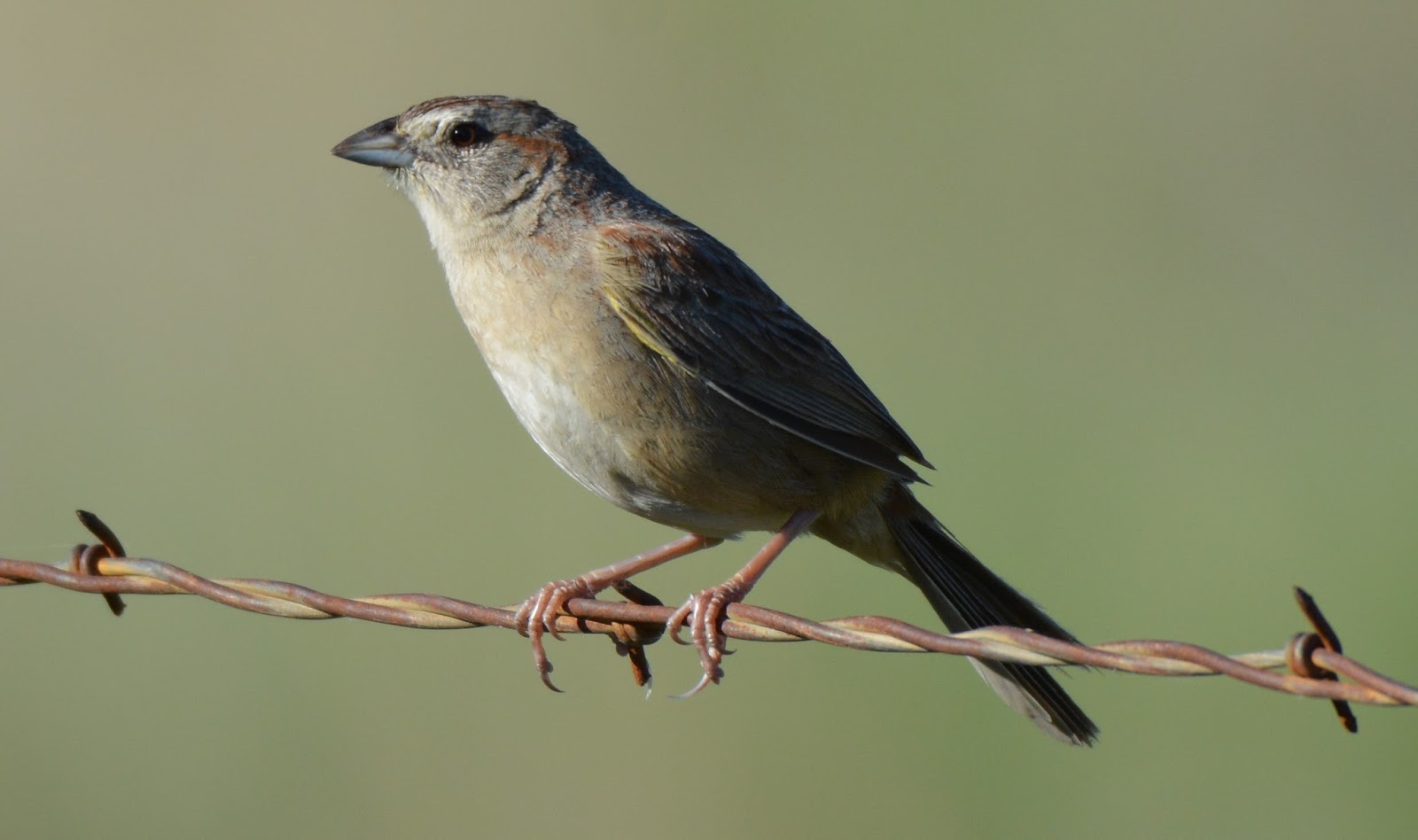
Even the browns of our many Northern American birds are attractive.  Take the Botteri's Sparrow below.  It has a rusty color.
Botteri's Sparrow
The Western Wood Pewee may be drab on the outside, but it's another beautiful bird as it flies from its' perch.
Western Wood Pewee
This little guy will normally have yellow on the underside of the breast covered by it's gray vest.  There is some slight yellow here, but the sun washed the color out.
I really enjoy watching the Pewees at work.  They have such a loud snap snap!  as they chase after the bugs.
Not enough color???  Okay let's get back to business.  I put two shots up of a Western Tanager using two different cameras.  We both trained our cameras on the bird.  I use a slightly different lens for my Canon than what Micheal uses for his Nikkon.  The Nikkon wins here.
Western Tanager(with Canon)
I like both shots, but the detail is better on his shot below.  Before going to Guatemala, I wanted to play around with the cameras to get a better idea on which one to bring.
Western Tanager(with Nikkon)
Once I have good ID shots, I'll start playing around with artsy photography part more.  I used to do that more but the having a solid bird ID photo is important.
As you can see in the pics above and below, the birds use the Saguaro Cactus for many different reasons. This cactus is very important to our habitat.
Northern Cardinal
In fact, with lifebird number 2 today(the Purple Martin), it is very important!  The bird nests in the cavity of this plant.
Purple Martin
The Purple Martin appears black here but I assure you, it's a shiny purple color.  The sun plays tricks on the eyes and camera. Plus the feathers are iridescent giving the bird the appearance of looking like a blackbird.
So why are there so many brown birds in North America?  Maybe I'm not understanding the question:)  We have lots of color out there, but the trick is to keep a look out for these characters.
On my next post, it's not about my photography at all.  It's a little about night birding and thanking the people responsible for my education in the birding world.  It's not an overnight thing and it does take time to learn this incredible hobby. All you need is a love for nature, some epic hiking, and a little patience.  I will be gone the first week of July to Mexico and I again apologize for my absence.  We are heading to Northern Mexico in the state of Sonora to study the birds at a large and private ranch.  This blog is an account of my adventures from around the world and at home.  Many times it's about birds but it's also about everything else. Life is an adventure.  All we have to do is step outside our doors to find it:) I'm out of town but will be back in July.