|
Peregrine Saker Falcon
Cleverly done. An education program for the public on history and the birds of the Renaissance period. I had not expected something like this and was surprised to see this exciting show out in the open at the Renaissance Festival near Florence. It was the first thing we saw as we entered onto the grounds. |
 |
| Red Tailed Hawk |
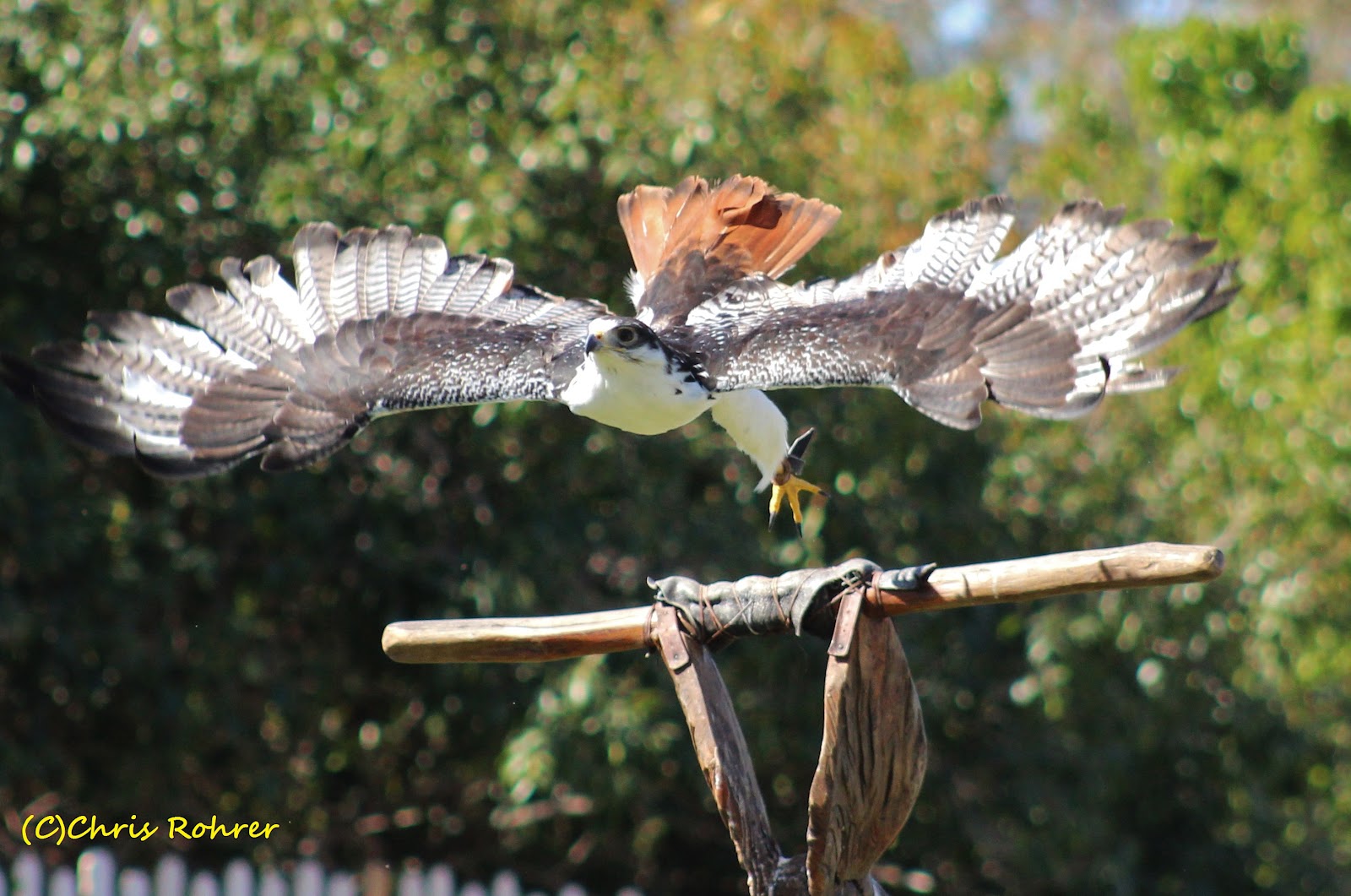
It began with a presentation on the Red Tailed Hawk. If you read history novels, you'll find many of these birds mentioned as they were used for hunting purposes by royalty,etc. My eyes were drawn to the hawk as it flew over my head.
And out from my side, the camera flew into action as I caught this bird in flight. How were these birds used in ancient times? And how did the hunter operate? The hunter would need a horn for communication with the other hunters. In addition to this the hunter depended on the assistance of certain domesticated animals. Three animals in particular were essential tools for the medieval hunter: the horse, the hound and the hawk (or falcon).
"Medieval terminology spoke of "hawks of the tower" and "hawks of the fist", which roughly corresponds to falcons and hawks, respectively. The female hawk was preferred, since it was both larger than the male and easier to train. Hawks were captured all over Europe, but birds from Norway or Iceland were considered of particularly good quality."
 |
| Eagle Owl |
"Training a hawk was a painstaking process. It was normal at first to "seel" the bird’s eyelids—sew them shut—so that it would not be scared or distracted. The trainer would then carry the hawk on his arm for several days, to get it accustomed to human presence. The eyes would gradually be unsealed, and the training would begin. The bird would be encouraged to fly from its perch to the falconer’s hand over a gradually longer distance. Hunting game would be encouraged first by the use of meat, then a lure, and eventually live prey. Such prey included herons, sometime with their legs broken to facilitate the kill. " Source
Wiki
They also had owls here at this presentation. What I like about the Birds of Prey presentations held in various outlets like our Renaissance Fair or the Arizona Sonora Desert Museum in Tucson is that many of these birds were rescued and saved from near death. They are cared for with the utmost respect and are given a second chance at life. Reasons why they come to a program such as this....humans, a broken wing, fallen out of nest, mother killed in the wild and babies left in the nest, etc.
They then take on a new role in life and educate the public. This was a really nice surprise for me and made me smile. Why? Because there were a lot of people in attendance at this festival watching this program. Smarter educated humans make better decisions when they come into contact with majestic birds such as these in the wild or around their homes. For the next shots, I'd like you to take a look at how BIG this Eagle Owl is!! The above pictures show it flying to the perch.
The wingspan is incredible and they are able to lift larger animals off the ground....like yappy little puppies:) Their wings have also been known to break a human arm. Check out this pic below to see the size of this owl!!!
I'm in love and forever will be with the owl species. When I heard that there were owls in this show, my heart started beating quickly. I stood and just stared like a little kid into the owl's eyes. Let me put this into better perspective....there is the man and the owl flying past his head. When I saw this picture from my shots, I was just floored by the wingspan next to the human body!
A story that touched my heart. The Eagle Owl does not live here in Arizona but it is related to the Great Horned Owl....which does live here. The pic below is a rescued owl with one blind eye. Many of these cases are human caused and the more I educate myself; the more angry I become with human ignorance...whether it be with a plant, bird or animal. There is good but there is also ignorance which I have witnessed on many of my treks.
 |
| Great Horned Owl |
Owls were symbolic and continue to be today. Intelligence, brilliance, wisdom, power, knowledge,
intuition, messages, mysticism, mystery, unconscious, silent observation, independence, protection, bravery, transition, longevity, reincarnation......."If you are drawn to owls or owl symbolism, you may have this same ability to uncover secrets. People may feel uneasy around you, as if you are able to see through pretence. The owl also teaches us to acknowledge the dark side of our personality, and in that darkness we may find food for growth."
Source
Finally, the most associated bird during the Renaissance times was the Peregrine Saker Falcon. It was the easiest of birds to train for hunting purposes. Fast, quick, agile.....this guy had my heart racing as he sped through the air at high speeds. The trained Falconer used his chain and spun it around in the air. The bird took flight quickly. As the falcon spun through the air at high speeds, an item was thrown up where it was caught in NO TIME by this bird. I was amazed by the fast movements!
Up up and away! You'll see several of those shots below.....and did you know that Falconry has been around for 3000 years!!! And guess what? It continues today. Airports use the Peregrine Falcon to chase birds away from the airstrip.
Spin, spin and turn. Catch, spin, return.....
....to arm of the Falconer!
Amazing!
The show is called the Ancient Art of Falconry and it shows several times during the day.
 |
| Vulture |
The Renaissance Festival is here until April 1st. Check it out Saturday and Sunday.


 Posts
Posts