Saturday, September 24, 2011

Friday, September 23, 2011

The Grey Leaves of our Desert


If you live in the desert, you may already know this, but if you didn't, this post may help you out with plant choices for your Tucson garden.  Do you ever notice that large green leaf plants have a harder time surviving our summer heat than their smaller grey leaf counterparts? Look closely at the leaves and you'll discover several things like tiny "hairs" or a waxy coating.   The grey leaf plants like a Texas Ranger or lavender both thrive and survive due to some interesting adaptations.  And it's for these reasons that these plants do extrememly well in our Tucson climate.

I found this explanation best explained by Jane Edmanson in Australia.  Why Australia?  Many species of plants do well here in Tucson from this part of the world.  If you head over to the Boyce Thompson Arboretum, there is an entire garden area dedicated to these uniquely adapted plants for our Sonoran desert landscape. Native is still the best, but there are certainly other choices out there for the avid gardener.  "Collectively, many of the plants with bluish grey, silver, even white coloured leaves, are known as grey leaf plants.  Another interesting characteristic of many of these grey leaf plants is the leaves can be hairy. Both the hairs and the waxy surface help reflect sunlight. The more sunlight that's reflected from a plant, the less water it needs for its functions, and the better it copes with drier conditions. The sides are reflective and the hairs trap a layer of humidity above the surface of the leaf to further reduce water loss. Another way that plants can reduce water loss is related to the waxy coating on their leaves. It’s on the outer surface, and means the plant uses less water and copes with dry conditions. A perfect example is Eucalyptus caesia which is sometimes called ‘Silver Princess'. It has a beautiful grey bloom on the branches, the leaves are greyish blue and capped by pinkish red buds that birds love. So many of the grey leaf plants are decorative and provide a welcome contrast to green plants in the garden. Their drought tolerance makes them practical in dry times, and with water restrictions, mean it’s possible to have colour and interest in the garden." Source: Gardening Australia
In the fern garden from last year.
Additionally many of these plants make excellent choices for moonlight gardens.  Here is a post I wrote this past year on how to create this magical type of garden. Creating a Moonlight Garden So if you've ever wondered why your silver grey leaf plants seem to perform better during our extremely dry and hot summer months, you now know:) It's good to mix the different colored leaves in for contrast. More tomorrow as we head back into the desert for ideas....
The Eucalyptus looks amazing next to the Arizona Ash tree in summer and fall. Taken last year in 2010
PS. Gray or Grey?  While writing this post, I became confused.  I've always written "grey".  Here's the spelling explanation.  grAy=American; grEy=English


Thursday, September 22, 2011

"Ergodic"

Walking through a canyon of random snapshots that captures...
The art of nature.....
The sound of nature....
And the form of nature....
which all join together to form one connected space.

Wednesday, September 21, 2011

Landscaping with Palms

Palm trees are amazing.  For the Tucson landscape, we have several wonderful choices.  Of course, Phoenix has many more palm choices because it's a bit warmer during their winter.  Back in spring, I did a report on palms here in the Tucson desert and how they did during our historic freeze.  During these hot and warm summer months when most plants SHOULDN'T be transplanted into the ground, palm trees are one of the plants that SHOULD be placed into our landscape.  According to Master Gardener Cathy Cromwell(additional comments from me in parentheses), here's why....
The tips are a bit dry due to extreme heat and almost zero rain.  Make a well around your baby palm and set to trickle.
  1. "The root systems on palms grow actively during warm weather, making April through September the best planting time in the low desert.  To plant, dig a hole that is as deep as the root ball and about 2 feet wider on all sides.  The palm should be planted at the same soil level as the container it came in, not set deeper or higher.  It is unneccessary to amend the backfill with organic matter or other materials."(I'll usually mix our ground soil with a bag of palm soil for new plants) 
This is our large California Palm.  I won't trim it now with the intense sun.  I'll wait until it cools down.  The "skirt" protects the new growth on the top part of the trunk from the scorching heat.  This palm is about 30 years old. 

  1. "Although many palm species grow well here, they are not low-water-use plants.  To maintain health and vigor, they need regular deep soakings.  Water should penetrate about 2 feet deep with each irrigation.  To determine how far water has soaked, push a soil probe (any long, pointed piece of metal) into the ground after watering.  It will move easily through moist soil but stop when it hits dry soil.   Immediately after transplanting, slowly soak the palm's entire root area.  Palms planted during summer probably will need to be watered daily for two weeks.  During this time, soil should remain moist, like a damp sponge, but not be overly saturated. (You will rot the plant from overwatering).  As the roots begin to establish, gradually lengthen the intervals between irrigations.  How often you water, depends on the soil type.   Sandy soil will drain more quickly, requiring more frequent watering than other soil types.  Clay soil retains moisture and doesn't need to be irrigated as often.  As a guideline, established palms need watering every 2 weeks or so in summer and every 4 to 6 weeks in winter."  
  2. "If palms are lacking nutrients, older fronds begin to yellow.  Once this happens, no amount of fertilizer will "green up" those leaves.  Don't be tempted to overfertilize, as this will do more harm than good.  Yellowing in palms is caused most often by a lack of nitrogen, potassium or magnesium.  Since it can be a bit difficult to pinpoint the problem, use a fertilizer formulated for palms, which will have an appropriate mix of those important needs.  Do not fertilize newly planted palms; instead, wait until the next growing season.  Established palms need feeding only once or twice per year, during their active growing season.  Apply fertilizer in midspring and early summer."
  3. Maintaining your palm.  Remember that all new growth happens on top of the palm and should NEVER be topped off.  Keep in mind how tall some of these palms can grow.  Never plant below a utility line or you'll end up having to remove years of work. I have our tree and palm experts come out once a year to trim.  Usually they trim our palm in February, but it could have two trimmings really.  Remember while "skinning" a palm can be attractive, it can also expose your palm tree to our extreme freezes.  This past winter demonstrated which palms would die and which ones would survive.  Plant in clusters as they look attractive in this manner.  A random palm, for me, is disturbing:)  One palm is native to our Sonoran desert....the Washingtonia filifera or California Palm. Being native to this desert, makes it very low maintenance for you. It's also the one we have on our property.  I've worked with palms now for several years and they are great choices for the landscape....and especially if you have the room to clump them into an oasis looking form. More tomorrow gardening friends.

Tuesday, September 20, 2011

The Return From Extinction

Recently I posted a news article from NBC on the discovery of another Woolly Mammoth found in the Arctic.  While it wasn't new information for the general public, this discovery, I believe, has some merit on what's currently being done with our cloning technology.  I know it sounds all science fiction'ish, but it's happening.  Today's article is linking two similiar ideas together that I have been researching over this past year.  One deals with the Woolly Mammoth and genetic material while the other is on a zebra that was previously extinct and brought back to the African landscape with some selective breeding/DNA technique.  None of this is made up and sounds straight out of Jurassic Park, but it's not only being planned....it has happened. 
The last of the Quagga.  Today science is finding ways to help bring this extinct animal back.
Several issues and questions entered my mind regarding this breakthrough.  Is it ethical?  Should it be done? If you're grafting genes onto an existing embryo of an animal that is closely related to the extinct animal, will it really be the same animal?  I'm not a scientist but I do understand the "talk" going on about bringing back animals from extinction.  Imagine.  Man's errors corrected...the Dodo bird, the Tasmanian Wolf, etc.  Do any of us realize how many animals have gone extinct over this past century because of humankind's stupidity?  And what about that discovery of the Woolly Mammoth in the Arctic? Why are people finding more of them?  Is the ice melting? As a kid, I read Ranger Rick and loved everything outdoors.  I always dreamt that the Amazon had a hidden dinosaur in its vast and unexplored jungles or that the Lockness Monster was just too clever to find for men searching the waters for her existence.
The Tasmanian Wolf believed to have gone into extinction over a half century ago
My find on the Woolly Mammoth was published elsewhere and some smart alec commented that the news was "like 10 years ago".  What this person may or may not have understood is that the discovery of more genetic material is important to the cloning world.  If they are to clone an extinct animal, they need excellent genetic material which is found from blood, hair, or tissue samples. Men, during the industrial revolution, did a fantastic job wiping out animals as they "conquered" new lands.  They wiped out herds of buffalo to near extinction, killed wolves because they were eating their cattle(this caused extinction for many subspecies of wolves all around the world!), and took their pistols to the sky and shot down clouds of birds. When it was too late, they kept their last specimens in zoos where they died.  Perhaps the smartest thing they did was preserve the last remaining species for future generations.  By doing so, there would be genetic material to examine when science could figure out how to clone.  Did they foresee this back then?  Who knows?  But here is an article about the Quagga that went extinct in 1883 and today is found in South Africa. Known as the Quagga Project,which started in 1987, this endeavor was an attempt to bring a subspecies of zebra back from extinction.  Today these animals are growing in number.   Are the Quagga back? What do you think?
         The Quagga
Pic taken from http://www.50birds.com/extan/gextanimals1.htm
"DNA analysis has shown that the Quagga was not a separate species of zebra but in fact a subspecies of the Plains Zebra (Equus Quagga) The Quagga, formerly inhabited the Karoo and southern Free State of South Africa. Like other grazing mammals, Quaggas had been ruthlessly hunted. They were seen by the settlers as competitors for the grazing of their livestock, mainly sheep and goats. By selective breeding from a selected founder population of southern Plains Zebras an attempt is being made to retrieve at least the genes responsible for the Quagga’s characteristic striping pattern. The project is aimed at rectifying a tragic mistake made over a hundred years ago through greed and short sightedness. It is hoped that if this revival is successful, in due course herds showing the phenotype of the original quagga will again roam the plains of the Karoo. When the Quagga mare at Amsterdam Zoo died on 12 August 1883, it was not realised that she was the very last of her kind. Because of the confusion caused by the indiscriminate use of the term "Quagga" for any zebra, the true Quagga was hunted to extinction without this being realised until many years later." This topic is quite controversial in the science field. Source: http://www.quaggaproject.org/

While I believe the creation of the Quagga and Woolly Mammoth are two separate issues and use or will use different techniques for the process, this article demonstrates that the science is happening today....and they are very close. The technology to use recovered DNA for breeding does not yet exist, but some scientists are saying that we are not far off and within 4 or 5 years, we may see the birth of a new baby Woolly Mammoth born from an African or Asian Elephant.  And if this isn't interesting enough, the world's first international conference for the restoration of endangered and extinct animals began back in 2010 in Poland. http://biodiversity.pl/ If that isn't a shape of things to come......

What do you think? Should extinction be permanent?
Great website to check out some of the fantastic creatures that roamed our Earth are found here.

Monday, September 19, 2011

Nasty Glochids!!

Photo by Maureen Gilmer of the Pin Cushion cactus

I love cactus.  They are cool looking and beautiful in the right spot of a well planned landscape.  I DO NOT like handling them however.  Even with gloves and tongs, I still find myself getting stuck.  However, getting stuck would be the least of my concerns as I was digging up some pin cushion cactus pads at my friend's house.  Have you ever watched sea coral blow out organic material into the water? If you haven't, it looks like a white cloud of particles.  Here is where things took a turn for the worse for me.  I was hot and sweating, wearing my gloves with tongs in hand.  I had a cardboard box to put the clippings.  As I head over to the large pin cushion cactus, I look at where I can trim off a couple pads.  I begin pulling off several pads and a "cloud" of debris is shot into the air and my eyes begin to water and burn.  The pain is excrutiating and for over a week, I felt something in my eye!!!  I went to see my doctor who smiled and flushed my eye out with a solution.  She had told me that this was a common thing that happens to gardeners in the desert southwest.  It was during this conversation that we both had to refresh our memories.  What was that thing that the cactus had on it?  It started with the letter "g".....and then...."glaaa"...."glochids" came out.  Some cactus are notorious for this nasty defense. I still love the plant, but next time I'll be sure to wear eye glasses. Some of them have cute names like "Funny Bunny Ears" or "Pin Cushion".  They're all a variety of Opuntia and there is nothing cute about getting glochids on your skin or in your eyes.  Wear long sleeved shirts to cover your arms.  The particles are so small that they will attach easily onto your body....especially if you are sweating. 

So what are glochids? Glochids are very sharp specialized short hair like spines, they are barbed at the tip, often occurring in tufts and deciduous; They are a defining characteristic, only of the subfamily, Opuntioideae, of the family Cactaceae. Not present on other cactus genera.

The issues? Problems of contact dermatitis are common wherever the fruits of prickly pear cactus are gathered. A cousin of the cholla, this plant also has large sharp spines, but it's the secondary spines, called glochids, that are the banes of workers' existence. Tiny and hair-like, they appear to be harmless fuzz, but they are highly irritating to the skin. Glochids can break off, leaving the tip embedded in your skin. This causes a rash and, in more extreme cases, infections.
Experts suggest using a magnifying glass and tweezers to remove them promptly, one by one, taking care not to cause further breakage.  They appear as bright yellow dots on the cactus pad and look harmless....even attractive. Glochids are detachable and break away very easily and quickly become embedded in skin or clothing, they are strongly hurtful. Ohhh the pain.  I won't make that mistake again. Funny Bunny Ears my....

Sunday, September 18, 2011

"Nature's Latticework"


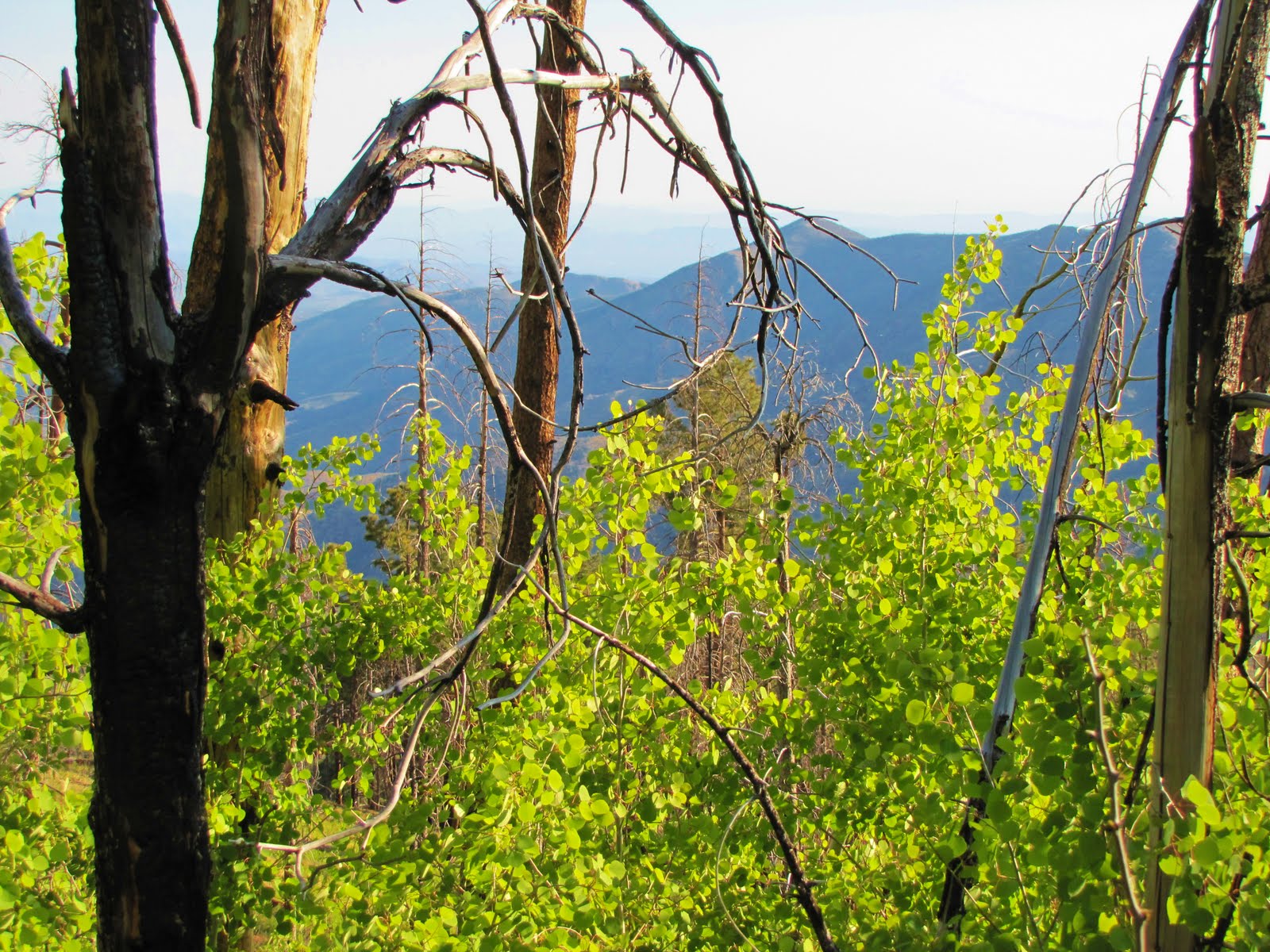
Dead trees may stand after a fire, but eventually they'll fall. New Aspen trees grow around the area while their "parents" create a maze around the area sectioning off an area of land for the future generations.

"The Lonely Among Us"


Lyrics by Imogean Heap
"Hide and Seek"

"Where are we?
what the hell is going on?
the dust has only just begun to form
crop circles in the carpet
sinking feeling

spin me round again
and rub my eyes,
this can't be happening

when busy streets a mess with people
would stop to hold their heads heavy
hide and seek
trains and sewing machines
all those years
they were here first"

Saturday, September 17, 2011

"Illumination"


A carpet of ferns blanket the forest floor reminding us that not all is lost after a fire.

"Those Grey Hairs"


New growth springs from the burned growth.......

....like a random grey hair......

....that just won't go away.......
....to remind us.......
.....that life is change.  Today's post is dedicated to my friend Keith who died several nights ago in his sleep.  My heart is saddened by the news and I'm going to miss him.  My thoughts go out to his family and partner Steve who are all obviously in shock right now.  He was so young and his death was unexpected.  I'm going to miss his witty humor, best grey(silver) hair and smile that was always present at our get togethers during Thankgiving and other events.  You will be missed dear friend. Like this post, change happens for all of us and it redefines how we look and feel about life. It is one of the most difficult things we face living this life.   You won't be forgotten my friend.